
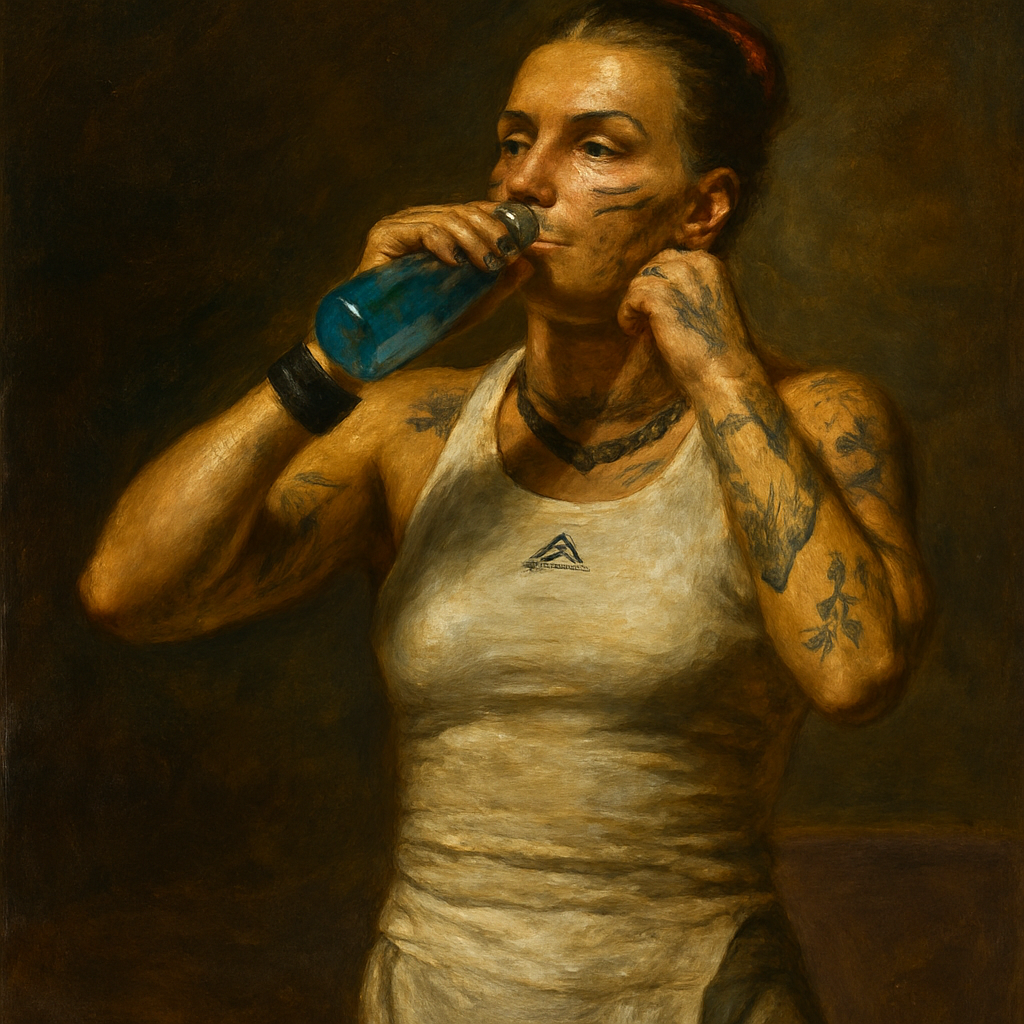
KYIV — In the often genteel world of professional tennis, where post-match handshakes are a sacrosanct ritual, Ukrainian player Oleksandra Oliynykova has made headlines for defiantly breaking that tradition. Following her first-round qualifying match at a recent ITF World Tennis Tour event, Oliynykova, a 26-year-old known for her distinctive facial tattoos, refused to shake hands with her Russian opponent, Alina Korneeva, and declined to participate in the customary joint photograph.
The incident, which quickly went viral on social media, sparked immediate debate. While some criticized the gesture as unsportsmanlike, Oliynykova and her supporters framed it as a powerful political statement in the context of Russia's ongoing war in Ukraine. In a detailed post on her Instagram account, Oliynykova clarified that her actions were not a personal attack on the 17-year-old Korneeva, but a principled stand against the nation she represents in competition.
A Statement Beyond the Scoreline
Oliynykova, currently ranked outside the WTA Top 500, was competing in the qualifying rounds of the ITF W100 tournament in Trnava, Slovakia. She lost the match to Korneeva, a rising junior star and the 2023 Australian Open girls' champion, with a score of 6-3, 6-2. It was at the net where the expected formalities dissolved. A video clip shows Oliynykova offering a brief, perfunctory tap of rackets before turning away from Korneeva's extended hand. She then walked past the tournament photographer, explicitly refusing to pose for the winner's photo.
In her subsequent social media explanation, Oliynykova wrote, "I would like to clarify the situation with the handshake and photo. My position remains unchanged — I do not shake hands with representatives of the Russian Federation and the Republic of Belarus. This is not personal, this is a matter of principle. I have great respect for Alina as an athlete, but I cannot greet her as a representative of a terrorist country." She emphasized that her stance is consistent and not selective, applying to all Russian and Belarusian athletes regardless of their individual views.
The Context of Neutral Participation
Since Russia's full-scale invasion of Ukraine in February 2022, international tennis bodies like the ITF, ATP, and WTA have allowed Russian and Belarusian athletes to compete as "neutral" individuals, without national flags or anthems, provided they do not express explicit support for the war or their governments. This policy has been a persistent point of contention for Ukrainian players, many of whom have lost homes, training bases, and family members to the conflict.
Oliynykova's act of defiance highlights the deep emotional and ethical rift this policy creates on tour. For Ukrainian athletes, facing an opponent from a nation whose military is actively attacking their homeland transcends sport. Oliynykova articulated this tension, stating that while she must compete against them due to tour rules, she draws a line at gestures she perceives as normalizing their presence or representing faux camaraderie.
Her position is shared by several other Ukrainian players, including Elina Svitolina and Marta Kostyuk, who have also opted for racket taps over handshakes after matches against Russian or Belarusian opponents. However, Oliynykova's refusal of the joint photo adds another layer of visible protest, removing the imagery of shared sportsmanship that tournaments often promote.
The Viral Persona: More Than Just Tattoos
The story gained additional traction due to Oliynykova's unique and striking appearance. She is covered in tattoos, including prominent ink on her face—a diamond under her left eye and the word "LIONESS" in bold script across her forehead. These tattoos, she has explained in interviews, are part of her identity and self-expression, representing strength and resilience. This distinctive look has made her a recognizable figure on the lower-tier circuits and ensured that any action of hers is highly visible.
The combination of her arresting visual identity and her unwavering political stance has turned Oliynykova into a symbol for many Ukrainians. On social media, the reaction was polarized but fervent. Supporters praised her courage and consistency, flooding her posts with messages of national pride. Critics, however, argued that she violated the spirit of sportsmanship and unfairly targeted a teenage athlete who is competing under a neutral banner and has not made political statements.
The Broader Impact on Tour Dynamics
This incident is not an isolated one but part of a growing pattern of friction since the war began. The tennis governing bodies have walked a tightrope, attempting to balance a non-discrimination policy for individual athletes with the profound grievances of Ukrainian players. The core challenges this situation presents include:
- The Emotional Toll on Ukrainian Players: Competing against representatives of an aggressor nation can cause severe psychological stress, as highlighted by Lesia Tsurenko's recent lawsuit against the WTA citing panic attacks.
- The Dilemma for Russian and Belarusian Athletes: Many, especially younger players like Korneeva, are caught in a geopolitical conflict beyond their control, competing without national identity but still facing public boycotts.
- The Erosion of Traditional Etiquette: The standard post-match handshake, a cornerstone of tennis tradition, is becoming a potential flashpoint rather than a moment of mutual respect.
Oliynykova addressed the complexity of competing under these conditions, writing, "It is very difficult to go out on the court against them, but these are the rules of the tour, and I have to follow them if I want to play and earn a living. My form of protest is to not give the appearance of normal relations." This statement underscores that her refusal is a calculated, preserved form of protest within the constrained options available to her.
Official Response and Precedent
As of now, neither the ITF nor the tournament in Trnava has issued a formal statement regarding the incident or indicated whether Oliynykova will face any sanction. The WTA and ATP have previously fined players for skipping mandatory post-match press conferences, but the rules surrounding handshakes are murkier, often falling under the broader umbrella of "unsportsmanlike conduct." However, given the highly charged political context, organizations have been reluctant to penalize Ukrainian players for these symbolic acts.
This reluctance sets a precedent that acknowledges the extraordinary circumstances. Punishing Oliynykova for her handshake refusal could be portrayed as insensitive to the Ukrainian cause, while doing nothing could be seen as undermining the sport's established codes of conduct. It leaves tournament officials and governing bodies in a nearly impossible position.
Oliynykova concluded her explanation with a message of gratitude to her supporters and a reaffirmation of her focus. "Thank you to everyone who supports me and Ukraine. I am here to play tennis, to represent my country with dignity, and to remind the world that the war is not over. Every action, even a small one at a tennis net, can be a reminder." Her stance transforms a routine moment of sportsmanship into a global geopolitical statement, proving that on the courts of the world, the battles being fought are sometimes about far more than just tennis.