
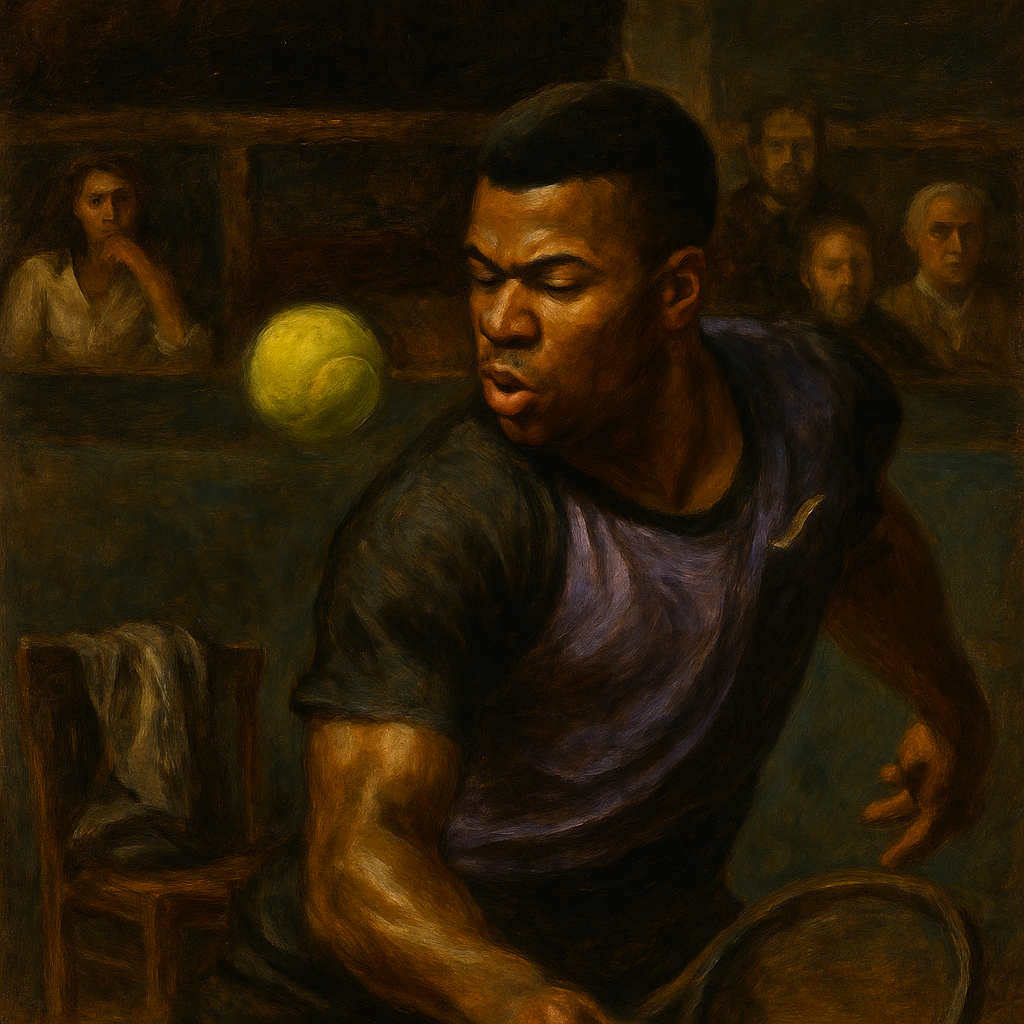
LYON, France — The world of professional tennis witnessed one of its most bizarre and unfortunate retirements this week, as French rising star Giovanni Mpetshi Perricard was forced to withdraw from the Open Parc Auvergne-Rhône-Alpes Lyon after a freak accident in which he struck himself in the face with his own racket.
The incident occurred during his first-round match against Argentine qualifier Facundo Díaz Acosta on Tuesday. In the opening set, with the score at 3-2 in Díaz Acosta's favor, the 20-year-old Frenchman, known for his powerful 6'8" frame and booming serve, lunged for a wide forehand. In the follow-through of his aggressive swing, he lost control of his racket, which recoiled violently and struck him directly on the bridge of his nose.
The immediate aftermath was shocking. Mpetshi Perricard crumpled to the red clay court, clutching his face as blood began to flow. The chair umpire quickly called for the tournament physio, who rushed to his aid. After several minutes of treatment on the court, it became clear the injury was serious. Visibly dazed and unable to continue, the young Frenchman retired from the match, handing Díaz Acosta the victory.
A Promising Career Interrupted by a Freak Moment
Giovanni Mpetshi Perricard is no ordinary player on the ATP Challenger circuit. He has been marked as one of France's most promising talents for the future. His 2024 season had been a breakthrough, highlighted by a stunning run to his first ATP Tour final at the Lyon Open just weeks prior to this incident, where he defeated top-20 player Ben Shelton before falling to Alexander Bublik.
That performance, built around a serve regularly exceeding 140 mph, propelled him to a career-high ranking inside the world's top 100. His sudden ascent made his first-round appearance in Lyon a highly anticipated homecoming. The local crowd was eager to see their new hero in action, making the abrupt and painful end to his match all the more devastating.
Witnesses and fellow players expressed their shock and concern. The ATP Tour's official social media account posted footage of the incident with the caption, "Wishing Giovanni Mpetshi Perricard a speedy recovery." The tennis community, known for its camaraderie, quickly flooded social media with messages of support for the injured player.
The Aftermath and Medical Concerns
Following the retirement, Mpetshi Perricard was taken for immediate medical assessment. Initial reports indicated he suffered a significant nasal injury. While the full extent of the damage—including potential fractures or concussion—was not immediately disclosed, the force of the impact was evident. The tournament director, Thierry Ascione, later provided an update, stating, "He is with the doctors. It's a shock, of course. We are all thinking of him."
The incident raises immediate questions about his participation in the upcoming French Open, the season's second Grand Slam, which begins in Paris just days after the Lyon event. For a player who had just earned direct entry into the main draw of a major for the first time based on his ranking, the timing could not be worse. His potential absence would represent a cruel twist of fate and a major setback.
Medical professionals in sports note that injuries of this nature, particularly when involving potential facial fractures or head trauma, require careful evaluation. The recovery protocol must prioritize long-term health over a swift competitive return. Key considerations for his medical team will include:
- Confirming whether a nasal fracture occurred and if any surgical intervention is needed.
- Ruling out a concussion or any related neurological symptoms from the blunt force trauma.
- Assessing his vision and ensuring there is no damage to the eye socket.
- Managing pain and swelling to allow for a safe return to training.
This list underscores that his return to the court is not simply a matter of waiting for bruising to fade; it is a multi-faceted medical decision that will dictate the next chapter of his young career.
Not the First Self-Inflicted Racket Injury in Tennis
While exceptionally rare at the professional level, Mpetshi Perricard's accident is not without precedent in the high-stakes, high-intensity world of tennis. Players swinging with immense force can occasionally lose grip or control, leading to dangerous recoil.
Perhaps the most famous similar incident involved former world No. 4 James Blake at the 2004 Italian Open. In a near-identical scenario, Blake swung for a forehand, and his racket bounced off the court and hit him in the face, breaking his neck vertebrae. Blake required months of recovery but eventually returned to the tour.
More recently, in 2022, American player Denis Kudla suffered a nasty cut above his eye when his racket snapped back into his face during a match. These incidents serve as stark reminders of the physical dangers inherent in the sport, even from one's own equipment. They highlight a unique risk that exists outside the normal scope of muscle strains or joint stress.
A Psychological Hurdle to Overcome
Beyond the physical healing, Mpetshi Perricard will face a significant psychological challenge. Trusting your swing and following through with full commitment is fundamental to tennis at the elite level. After an incident where your own instrument of play causes serious injury, rebuilding that instinctive, fearless motion can be difficult.
Sports psychologists suggest that a gradual, confidence-building return to practice will be crucial. He may initially flinch or subconsciously shorten his follow-through, which could drastically affect his powerful game. Overcoming this mental barrier is as important as healing the physical wound.
A Community Rallies in Support
The response from the tennis world has been one of unified support. Fellow French players, including Ugo Humbert and Arthur Fils, posted messages wishing him a speedy recovery. His opponent, Facundo Díaz Acosta, expressed his concern immediately after the match, stating, "I hope he is okay. It's a terrible way for a match to end."
Fans and analysts have also pointed to the young Frenchman's remarkably poised reaction in the moment. Despite being in clear pain and distress, he did not throw his racket in anger prior to the incident; it was purely an accident of physics and athletic exertion. His demeanor in adversity has earned him further respect.
This support network will be vital in the coming weeks. The path from a shocking injury back to competitive form is often lonely, but the encouragement from peers and fans can provide a crucial motivational boost during rehabilitation.
Looking Ahead: An Uncertain Road to Roland-Garros
As of now, the tennis world waits for a definitive medical update on Giovanni Mpetshi Perricard. His name remains on the entry list for the French Open, but his participation hangs in the balance. The French Tennis Federation (FFT) and tournament organizers will undoubtedly give him every consideration as he races against time.
Whether he makes it to the clay of Roland-Garros this year or not, the focus must be on a full and healthy recovery. At just 20 years old, his career trajectory suggests he has the talent to become a staple in the world's top 50 and a threat on any surface. This incident is a heartbreaking pause in that journey, but not its end.
The story of his retirement in Lyon will now be a footnote in his career—a bizarre and painful moment of misfortune. The hope, shared by fans, fellow players, and the sport itself, is that the next chapter will be defined by a resilient comeback, where his powerful serve and forehand once again dominate headlines, this time for all the right reasons.