
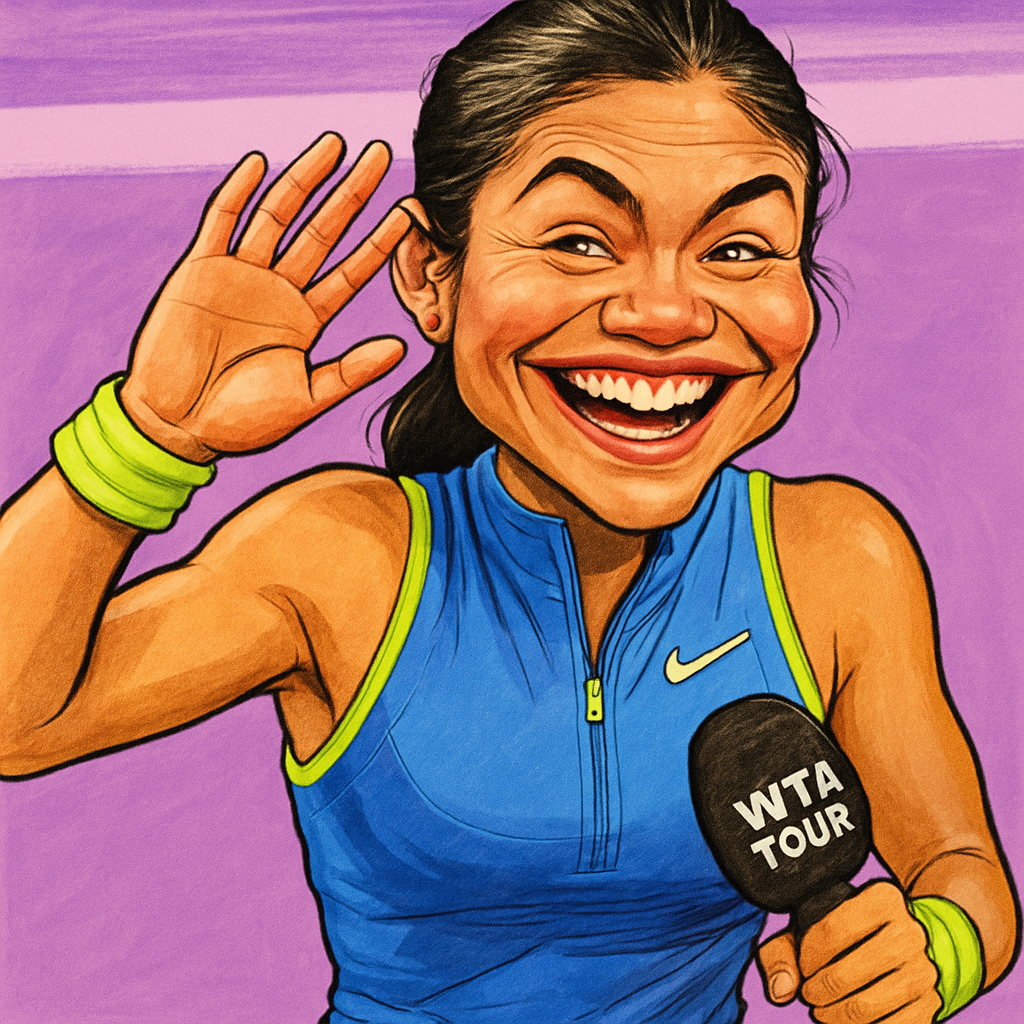
CLUJ-NAPOCA — In a moment of raw, unfiltered emotion, Emma Raducanu stood on the baseline of the BTarena, her neck craned forward, eyes laser-focused on a mark just beyond the service line. The crowd at the Winners Open in Romania held its collective breath. This wasn't about a championship point, but a point of principle. The former US Open champion, in a gesture that spoke volumes about her meticulous nature and respect for the game, was sticking her neck out—literally—to overrule a line call in her opponent's favour.
The incident occurred during her hard-fought second-round victory against Romanian wildcard Ana Bogdan. A serve from Bogdan was called out, but Raducanu, convinced it had caught the line, immediately gestured to the chair umpire to correct the call. Not content with a simple hand signal, she walked to the spot, bent at the waist, and peered down, her nose almost touching the court surface to confirm the ball mark. Satisfied, she emphatically signalled "in," handing the point to her opponent. The reaction from 1978 Wimbledon champion Virginia Wade, commentating for the BBC, was instantaneous and telling: "That is absolutely class. That is from the very top drawer. Wonderful to see."
A Gesture That Transcends the Scoreline
In an era where players routinely challenge calls via electronic review or fiercely contest them with officials, Raducanu’s instinctive sportsmanship was a refreshing anomaly. It was a decision that had zero tactical benefit; she was actively giving away a point in a tight match. Yet, for Raducanu, it seemed a non-negotiable tenet of fair play. "I think it's just a part of my character," she would later explain in her post-match interview. "I always want to be fair and give credit where it's due. If the ball is in, it's in. It's as simple as that for me."
The gesture resonated deeply because it felt authentically *her*. This wasn't a calculated PR move, but an extension of the same scrupulous honesty and intense self-reliance that has defined her career arc. Since her fairy-tale run in New York in 2021, Raducanu’s journey has been punctuated by injuries and coaching changes, a narrative often framed around external scrutiny. In Cluj, however, the narrative she authored was one of integrity, controlled aggression, and a clear-minded approach to her tennis.
Building Momentum on a Meaningful Stage
The tournament in Cluj-Napoca holds special significance for Raducanu. It is the event where, in 2022, she returned to competition after her wrist and ankle surgeries, testing the waters in a lower-pressure environment. Returning this year, she has looked increasingly assured, displaying a blend of powerful baseline hitting and deft touch that hearkens back to her Flushing Meadows form. Her run to the quarter-finals, which included the win over Bogdan and a commanding victory against compatriot Katie Boulter, showcased several positive developments:
- Physical Resilience: Moving freely and confidently on court, showing no signs of the physical limitations that have hampered her.
- Tactical Clarity: Dictating play with her forehand and using her slice backhand effectively to disrupt rhythm.
- Mental Fortitude: Closing out tight sets and managing momentum swings, as seen in her 6-3, 6-4 win over Bogdan.
Her performance, and particularly that act of sportsmanship, did not go unnoticed by legends of the game. Virginia Wade’s on-air praise was effusive. "That tells you everything you need to know about Emma Raducanu," Wade said. "It's innate. You can't teach that. In the heat of battle, to have that clarity of fairness is exceptional."
The "Raducanu Effect" in Romania
The local crowd in Cluj has warmly embraced Raducanu, partly due to her Romanian heritage from her mother's side. She has spoken fondly of the connection, often practicing her Romanian in press conferences and with fans. This mutual affection has created a supportive atmosphere that seems to buoy her. "I feel a real connection here," she admitted. "The fans are so passionate and knowledgeable. It feels like a second home, and that gives me a lot of positive energy."
This energy was palpable during her matches. Unlike the sometimes-overwhelming pressure of a British crowd at Wimbledon, the support in Romania feels enthusiastic but without the crushing weight of national expectation. It has provided an ideal backdrop for Raducanu to play expressive, attacking tennis, focusing on her own development rather than just the result—a mindset her team has been keen to cultivate.
A Statement Beyond Words
In the often-cutthroat world of professional sports, where every point is a commodity and gamesmanship is commonplace, Raducanu’s decision was a powerful silent statement. It communicated a set of values that many fear are being eroded. In overruling the call, she was effectively saying that how you win matters as much as winning itself. This ethos aligns with the observations of her current coach, Nick Cavaday, who has emphasized building a "robust and respectful" competitor.
The reaction from the tennis community was swift and universally positive. Social media lit up with praise from fans, pundits, and former players alike. Many drew comparisons to similar acts of sportsmanship by legends like Roger Federer and Andy Roddick, moments that are remembered far longer than the score of the match. It served as a potent reminder that Raducanu’s impact on the sport extends beyond her groundbreaking major win; it lies in the character she displays on its stages.
Looking Forward with Renewed Purpose
While her quarter-final run in Cluj was ended by the experienced Ukrainian, Anhelina Kalinina, the takeaways from the tournament are overwhelmingly positive for Raducanu. The victory over Boulter, a close friend and top-30 player, was a significant confidence booster, proving she can compete with and defeat high-calibre opponents. More importantly, the narrative surrounding her is subtly shifting. The conversation is moving away from surgeries and setbacks and toward her tennis, her fighting spirit, and, yes, her exemplary sportsmanship.
As she continues her 2024 campaign, the hope for Raducanu and her supporters is that this blend of physical health, tactical growth, and unwavering integrity becomes the foundation for a sustained climb back up the rankings. The moment in Cluj where she stuck her neck out on the line was more than just a corrected call; it was a reassertion of her identity as a player of principle. As Virginia Wade’s reaction confirmed, in a sport obsessed with metrics and titles, such acts of class still speak the loudest volumes of all.