
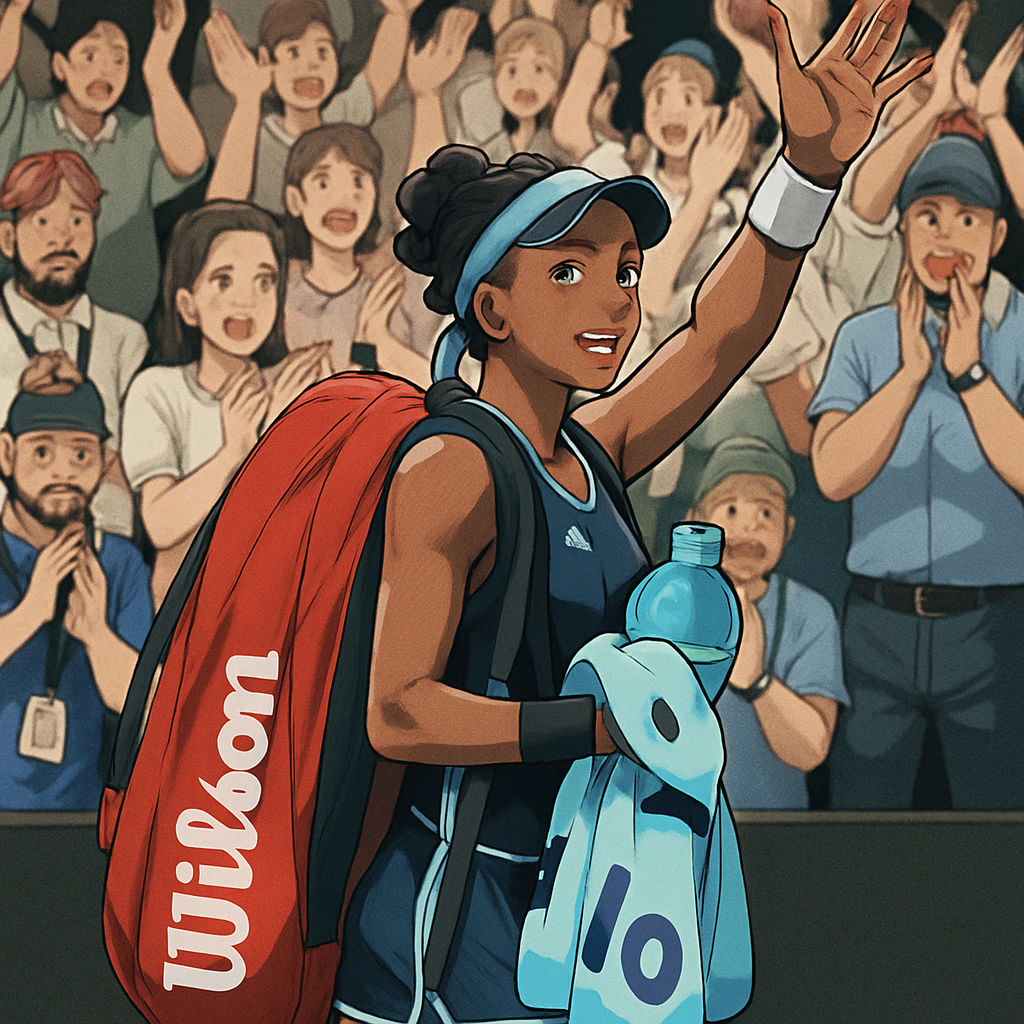
MELBOURNE — The Australian Open’s opening day was graced by a moment of profound sporting history, even as it concluded with a familiar pang of competitive heartbreak. Venus Williams, the seven-time Grand Slam champion and trailblazer for a generation, stepped onto Court 3 at Melbourne Park, and in doing so, became the oldest woman to compete in the Australian Open singles draw in the Open Era.
At 45 years and 5 months, Williams surpassed the previous record held by fellow legend Martina Navratilova. Her opponent, the 22-year-old Serbian qualifier Olga Danilovic, represented a staggering 23-year age gap, a testament to Williams' enduring athleticism and passion. The match that unfolded was a gripping, nearly three-hour epic that defied the odds and expectations, ultimately ending in a narrow 4-6, 6-3, 5-7 defeat for the American icon.
A Record Forged in Resilience
Williams' appearance was her 22nd in the main draw at Melbourne Park, a tournament where she reached the final twice, in 2003 and 2017. Her journey back to this stage has been a monumental battle against time and injury. Persistent knee issues have severely limited her schedule since 2021, with this match marking only her second Grand Slam appearance since that year's US Open. The road to this historic moment was paved with wild cards and unwavering determination.
Speaking in her post-match press conference, Williams reflected on the milestone with characteristic perspective, shifting the focus from age to achievement: "I don't consider myself old. I consider myself quite capable. It's just about getting out on the court and competing. That's what I did today. I love the game, I love competing, and I love coming out here and seeing what I can do."
A Rollercoaster of a Contest
The match itself was a microcosm of Williams' career—powerful, unpredictable, and fiercely contested. After dropping the first set, Williams showcased the vintage ball-striking and competitive fire that have defined her, storming back to take the second. She then surged to a 3-0 lead in the decider, sending the packed crowd into a frenzy with the prospect of a storybook victory. However, the physical toll of the marathon battle began to show.
Danilovic, ranked No. 125 and fighting for her own place in the sport, displayed remarkable composure to reel Williams back in. The final games were a tense affair, with Williams saving two match points on her own serve at 4-5 before Danilovic finally sealed the victory on her third opportunity. The statistics told the tale of a match decided by the finest margins:
- Total Points Won: Danilovic 99, Williams 97.
- Winners: Williams 30, Danilovic 28.
- Unforced Errors: Williams 48, Danilovic 42.
The two-point difference over nearly three hours underscored just how close Williams came to a miraculous win. Her movement, while understandably not at its peak, was supplemented by intelligent positioning and the sheer weight of her groundstrokes, which repeatedly pushed Danilovic deep behind the baseline.
Respect and Reverence from a New Generation
For Danilovic, the victory was bittersweet, achieved against a childhood idol. In her on-court interview, the emotion was palpable as she paid tribute to her legendary opponent. "I'm really emotional about this. For me, Venus is an icon. She's everything I've ever wanted to be. To be on the court with her today was an incredible honor," Danilovic said, her voice cracking.
She further elaborated in the press room, acknowledging the unique pressure of the situation: "It's a very strange feeling because you're playing your idol. You want to win, but part of you is just in awe of sharing the court with them. I had to remind myself to compete every point and treat her like any other opponent, which is maybe the greatest compliment I can give her."
The Legacy Beyond the Scoreline
While the result adds to a difficult recent Grand Slam record for Williams—she hasn't won a match at a major since the 2021 Wimbledon—the narrative of the day transcended wins and losses. Her presence alone sent a powerful message about longevity, passion, and defying limitations. Tennis journalists and former players flooded social media with tributes, not just to the record, but to the quality of the performance.
The match also highlighted the unique generational bridge Williams represents. She is now competing against players who were not born when she played her first Australian Open in 1998. Her career has spanned eras, from the power transition of the early 2000s to the modern baseline game, and she has remained a relevant force through sheer will and adaptation.
What Comes Next?
In the aftermath, the inevitable questions about retirement arose. Williams, ever the competitor, deflected them with a focus on the present. "Today was about today. I came here to compete and to win, and I had my chances. That's all I'm thinking about right now. I don't make long-term plans; I see how my body feels and go from there," she stated.
The tennis world, however, is left to marvel. Each appearance by Venus Williams at this stage of her career is a gift—a living history lesson and a demonstration of resilience. While the record books will note January 15, 2024, as the day she became the oldest woman to play the Australian Open, those who witnessed the match will remember it for the fierce battle, the thunderous forehands, and the indomitable spirit of a true champion who, even in a narrow defeat, continues to make history and inspire.
As the Melbourne sun set on Court 3, the standing ovation that followed Williams off the court was not one of farewell, but of profound respect. It was an acknowledgment that while the result belonged to Danilovic, the day, and its historic significance, belonged unequivocally to Venus.