
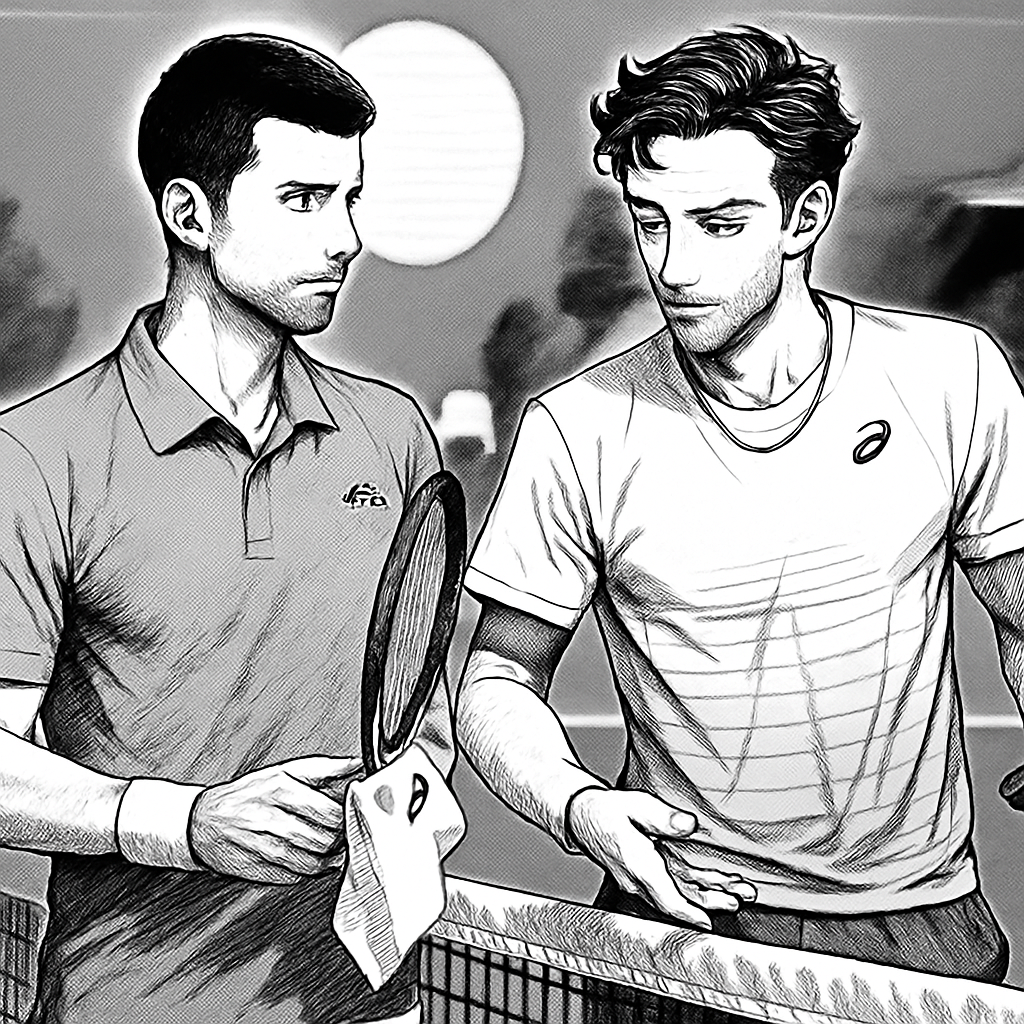
MELBOURNE — The tennis world was left in a state of bewildered silence last month when Italian star Lorenzo Musetti, on the cusp of a monumental upset, suddenly retired from his Australian Open quarter-final against Novak Djokovic. Leading two sets to one and with the 10-time champion visibly struggling, Musetti’s decision to walk to the net and concede the match sent shockwaves through Rod Laver Arena. Now, weeks after the controversial exit, the 22-year-old has broken his silence with a detailed statement, offering a candid and emotional explanation for his actions.
The match on January 23rd had all the makings of a classic. Djokovic, the undisputed king of Melbourne Park, was uncharacteristically error-prone and physically below par. Musetti, playing with fearless, one-handed backhand flair, seized the opportunity, taking the first set and, after dropping the second, dominating the third. As the fourth set began, the tennis universe buzzed with the possibility of a seismic shift. Then, abruptly, it was over. With Musetti trailing 4-1 in the fourth, he approached the chair umpire, shook Djokovic’s hand, and retired, citing a combination of physical ailments.
The Aftermath and Mounting Speculation
In the immediate post-match press conference, a dejected Musetti offered only brief comments, pointing to a right hip problem and significant blistering on his feet. Djokovic, who advanced to what would become his record-extending 11th Australian Open semi-final, expressed sympathy but also admitted his own physical struggles. The brevity of Musetti’s explanation, however, fueled intense speculation and criticism across social media and punditry. Accusations of a "mental capitulation" or an inability to handle the pressure of closing out a wounded giant began to circulate.
The narrative was particularly potent given the stakes. Beating Djokovic at the Australian Open is one of the sport’s ultimate challenges; doing so from a winning position in a major quarter-final would have been the crowning achievement of Musetti’s young career. The decision to retire, rather than fight through to the bitter end, left many fans and former players questioning his competitive fortitude. For weeks, Musetti remained quiet, allowing the conjecture to build.
Musetti's Full Account: A "Perfect Storm" of Issues
This week, in a lengthy post on his official Instagram account, Musetti provided the comprehensive explanation many had been waiting for. He described the situation as a "perfect storm" of physical setbacks that culminated in an impossible choice. His statement went into granular detail about the specific problems that derailed his historic opportunity:
- Blister Catastrophe: He revealed the foot blisters were far more severe than initially let on, describing them as forming in an "unlucky and unusual position" that made every lateral movement and serve toss agonizing.
- Hip Injury Flare-Up: The pre-existing issue in his right hip, which he had managed through the early rounds, became acutely painful during the high-intensity exchanges against Djokovic, limiting his power and rotation.
- Cramping and Systemic Failure: As the match extended into a fourth set, the compensation for his other injuries led to full-body cramping. He stated, "My muscles were beginning to seize up. I was no longer able to move to the ball, to push off on my serve, or to recover position."
Musetti emphasized that the decision was not a sudden surrender to pressure, but a medical inevitability. "Continuing would not have been brave; it would have been reckless and dangerous," he wrote. He expressed particular anguish over the timing, acknowledging the unique position he was in. "To be in that position against the greatest champion in that arena, and to have my body fail me, is a pain I will carry for a long time."
The Psychological Toll and Looking Ahead
Beyond the physical, Musetti’s statement delved into the mental and emotional aftermath. He admitted the incident triggered a period of deep frustration and self-doubt. "The hardest part has been reading the interpretations of my character, my heart, and my love for this sport," he confessed. He stressed that retiring from any match, let alone one of that magnitude, is a player’s absolute last resort, taken only when the body has completely broken down.
The Italian also used the platform to address the broader perception of athletes and pain. In an era where players are sometimes criticized for being less resilient than past generations, Musetti pushed back, arguing for a more nuanced understanding. "We play a global schedule with immense physical demands. Listening to our bodies and managing long-term health is not weakness; it is professionalism."
The Road to Recovery and Redemption
Now, with the clay-court season—his preferred surface—on the horizon, Musetti’s focus is on rehabilitation and redemption. He reported that the hip injury required a period of complete rest and targeted physiotherapy, while the blister damage has finally healed. His goal is to return to peak form for the European clay swing, where he has previously recorded his best results, including a title in Hamburg and a fourth-round run at Roland Garros.
The experience, while brutal, seems to have forged a new perspective. He concluded his statement with a note of resolve: "This chapter hurts, but it is not the end of my story. I learned more about myself in that loss than in many victories. I will work every day to ensure that when the next chance comes, my body is ready to see it through."
A Lesson in Empathy for the Tennis World
Musetti’s detailed account serves as a poignant reminder of the unseen battles athletes face. While the spectacle of a retiring front-runner will always provoke debate, his explanation paints a picture of a cumulative physical breakdown rather than a mental lapse. For Novak Djokovic, the path cleared by Musetti’s retirement led to another semi-final, though he ultimately fell to eventual champion Jannik Sinner. For Musetti, the journey is about processing a unique kind of "what if" and channeling that frustration into future performances.
The incident has sparked conversations about the fine line between perseverance and prudence in modern sport. As Musetti prepares for his comeback, the tennis community is left with a more complete, human understanding of that jarring January evening—a night where triumph was eclipsed not by an opponent’s winner, but by the cruel limitations of the human body.