
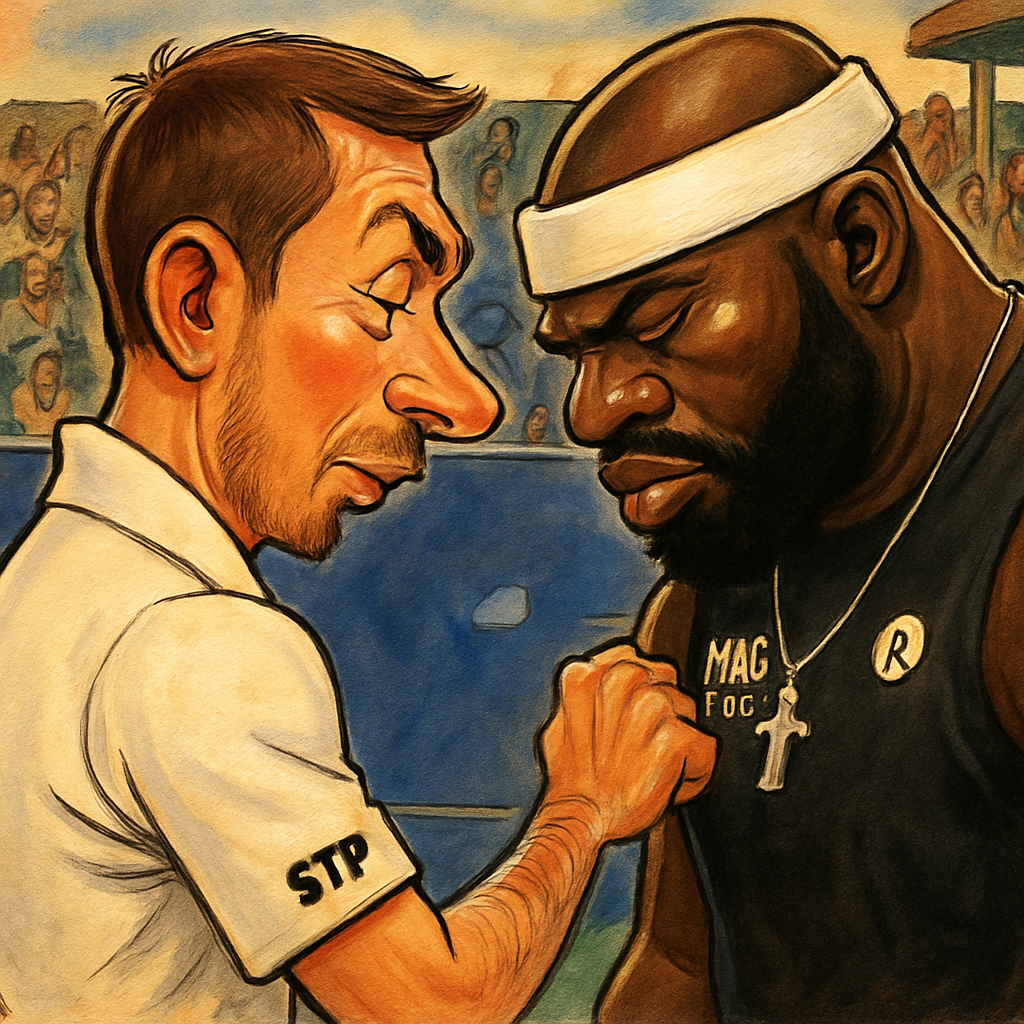
NEW YORK — A bizarre and contentious scene unfolded at the U.S. Open on Tuesday, as a first-round men’s singles match was delayed for several minutes after the chair umpire took a black marker to American star Frances Tiafoe’s shirt. The unusual intervention, which drew loud and sustained boos from the Arthur Ashe Stadium crowd, was prompted by a logo violation, forcing officials to physically obscure a sponsor’s branding before play could begin.
The incident occurred just moments before Tiafoe was set to face Croatian qualifier Borna Coric. As the players warmed up, chair umpire Alessandro Germani noticed that the logo for the financial services company "For Hims" on the left chest of Tiafoe’s match kit was larger than the permitted size for on-court advertising. According to Grand Slam rules, a player’s personal sponsor logo cannot exceed a specific square-inch measurement, and Tiafoe’s was deemed out of compliance.
With the match about to start and no time for a shirt change, tournament officials were left with a stark choice: delay the match further or find an immediate solution. Germani, after consultation with a Grand Slam supervisor, produced a black permanent marker and approached Tiafoe at his chair. The surreal sight of an umpire drawing on a player’s clothing sent a ripple of confusion through the stadium, which quickly turned to vocal disapproval as fans realized what was happening.
A Stadium's Roar of Disapproval
As Germani meticulously colored over the "For Hims" logo, the capacity New York crowd erupted in a chorus of boos. The delay stretched on, with Tiafoe sitting patiently but visibly bemused, while Coric paced the baseline. The booing intensified, not directed at the players, but squarely at the officiating team and the perceived pettiness of the enforcement. Tennis broadcaster and analyst Jon Wertfeld captured the sentiment, posting on social media, "Ump just took a Sharpie to Frances Tiafoe’s shirt to blot out a logo. Crowd booing. What a weird sport."
The awkward process took multiple minutes, as Germani attempted to fully cover the white lettering on Tiafoe’s black shirt. Once finished, the match proceeded, but the strange opening cast a shadow over the contest. Tiafoe, the 22nd seed and a fan favorite known for his charismatic interactions, channeled the crowd's energy to rally from a set down and win the match 4-6, 6-2, 6-3, 7-5.
The Rules Behind the Marker
The strict regulation of on-court branding is a long-standing feature of professional tennis, designed to protect the investments of tournament sponsors and the tours themselves. Players are allowed to wear logos for personal sponsors, but these are tightly governed by size and placement rules set by the ATP, WTA, and Grand Slam board. Key aspects of these regulations include:
- Size Limits: A single sponsor logo is typically restricted to a maximum area, often around 3 square inches (19 square centimeters).
- Placement: Logos are generally permitted only on the chest or sleeve of a shirt and on the shorts or skirt.
- Pre-Approval: All clothing and logos must be submitted for approval before a tournament. It appears Tiafoe's shirt, which he had worn in previous tournaments, was either newly deemed non-compliant or had escaped notice until the match's start.
In a statement after the incident, the U.S. Tennis Association clarified the sequence of events: "During the warm-up, the chair umpire noticed that the size of the logo was out of compliance. He brought it to the attention of the player, who did not have a replacement shirt. The chair umpire then attempted to rectify the situation by covering the logo with a marker." The statement emphasized that the rules are applied uniformly to all players.
Player and Public Reaction
Following his victory, Tiafoe addressed the incident with a mix of humor and frustration. "It was wild. I’ve never seen that before," he told reporters. "I mean, the guy’s literally drawing on me before I go out to play. The crowd is booing. I’m like, ‘This is a crazy moment.’ But it is what it is. Rules are rules. I guess my logo was too big. I don’t know. I’m just happy we could put on a show after that weird start."
The public and media reaction largely sided with Tiafoe and the crowd, viewing the enforcement as overly rigid and poorly handled. Many questioned why the issue wasn't identified and resolved before the player walked onto one of the sport's biggest stages. The visual of an umpire defacing a player's attire was seen as undignified and antithetical to the spectacle of a night session at a Grand Slam. Tennis journalist Ben Rothenberg noted, "The marker fix was the least elegant solution possible, turning a minor logo violation into a major, crowd-alienating spectacle."
A History of Logo Drama
While the Sharpie incident was unprecedented in its execution, conflicts over branding are not new in tennis. The sport has a history of clashing over the "patch," from early battles between clothing manufacturers and tournaments to modern disputes.
- In the 1990s, Andre Agassi was famously fined for wearing denim shorts and non-approved Nike shirts at Wimbledon, challenging the tournament's all-white rule and sponsorship strictures.
- More recently, Naomi Osaka faced scrutiny during the 2021 Australian Open for wearing a mask bearing the name of a Black man killed by police, which required delicate negotiations with tournament sponsors.
- Venus Williams once designed her own tournament dress with a too-large "EleVen" logo (her own brand), leading to a similar, though less theatrical, pre-match correction.
These incidents highlight the constant tension between player expression, personal branding, and the commercial machinery of the sport. The Tiafoe episode, however, stands out for its very public, almost comical method of resolution.
Conclusion
The abrupt delay of Frances Tiafoe's U.S. Open match will be remembered less for the result and more for the surreal image of an umpire acting as a censor with a permanent marker. While the enforcement of sponsorship rules is a commercial necessity for the sport, the incident exposed a flaw in the protocol. The resulting crowd backlash and global media attention have undoubtedly prompted tournaments and tours to review how such violations are handled in the future. The hope will be to find a solution that upholds necessary regulations without creating a public spectacle that detracts from the athletic contest itself. For Tiafoe, the story had a happy ending—a victory marked not just by his resilience on the court, but by an unforgettable, ink-stained beginning.