
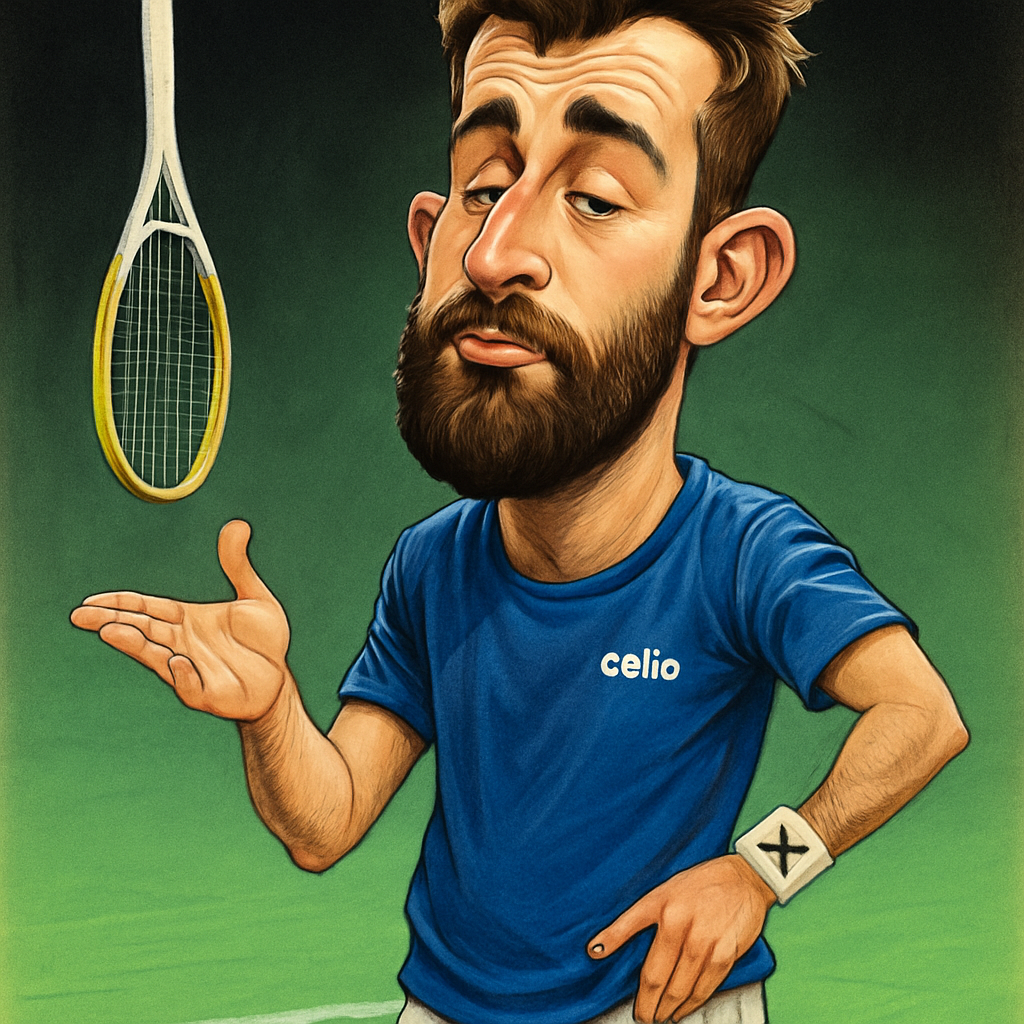
MANCHESTER — French tennis player Corentin Moutet delivered a raw and emotional self-assessment after a critical error in his Davis Cup qualifying tie against Belgium, a mistake he described as "stupid" and one that left him feeling "like a clown," ultimately contributing to France's shock elimination from the 2024 Davis Cup Finals.
The dramatic scene unfolded at the AO Arena in Manchester, where France, a ten-time champion, faced a must-win situation against Belgium to keep their hopes alive in the group stage. With the overall tie level at 1-1 after Adrian Mannarino's win and Grégoire Barrère's loss, the pressure fell squarely on Moutet's shoulders in the decisive rubber against Belgium's Raphael Collignon.
A Costly Moment of Frustration
The match was a tense, gritty affair from the start. Moutet, known for his flamboyant style and fiery temperament, struggled to find his rhythm against the 64th-ranked Collignon. Deep into the first set, with the score at 5-5 and Moutet serving at 30-30, the Frenchman attempted a delicate drop shot. The ball clipped the tape of the net and fell back on his own side, handing Collignon a critical break point. In a moment of pure frustration, Moutet violently smashed his racket into the court surface, not once but twice, completely destroying the frame.
The outburst proved immediately costly. Chair umpire Renaud Lichtenstein promptly issued a code violation for racket abuse. Because this was Moutet's second code violation of the match—he had earlier received a warning for an audible obscenity—it resulted in an automatic point penalty. Consequently, Collignon was awarded the point, giving him the break and a 6-5 lead. Collignon would go on to serve out the first set 7-5, seizing a momentum from which Moutet never fully recovered.
In his post-match press conference, a despondent Moutet did not mince words: "I feel like a clown. It was a stupid, stupid reaction. At this level, you cannot lose control like that. I cost my team, my country, a chance to win. It's unacceptable."
The Aftermath and Belgian Triumph
The point penalty and the loss of the first set seemed to shatter Moutet's composure. While he fought valiantly in the second set, the damage was done. Collignon, buoyed by the gift-wrapped break and feeding off the energy of the Belgian team, played with increasing confidence. He broke Moutet's serve late in the second set and closed out the match 7-5, 6-3, sending the Belgian squad into wild celebrations and the French team into a state of stunned silence.
The victory sealed a 2-1 win for Belgium in the tie and, combined with other results in the group, mathematically eliminated France from advancing to the knockout stage of the Davis Cup Finals. For a nation with such a rich history in the competition, the early exit was a significant disappointment. Belgian team captain, Steve Darcis, acknowledged the turning point: "It was a very tight match, but that moment changed everything. Raphael kept his head cool and took his chance."
A Pattern of On-Court Demons
This incident is not an isolated one for the 25-year-old Moutet. Throughout his career, his immense talent—evidenced by his current ranking inside the world's top 70 and his recent run to the fourth round of the French Open—has often been accompanied by volatile on-court behavior. His emotional outbursts have sometimes been a weapon, but as this Davis Cup tie demonstrated, they can also be a profound liability.
French captain, Paul-Henri Mathieu, a former player himself, looked crestfallen in his post-match comments. While supportive of his player, he could not hide the gravity of the error. "It's a very difficult moment for Corentin and for the whole team. We win and we lose together, but of course, that point was crucial. It's a very hard way to learn a lesson."
The loss highlights the immense psychological pressure of Davis Cup, where players compete for national pride rather than individual ranking points. The key factors that converged to create this high-stakes failure include:
- The Pressure Cooker Environment: The team nature of the Davis Cup amplifies the consequences of every point.
- Previous Infractions: The initial warning for an audible obscenity set a precarious precedent.
- The Match Situation: The 30-30 point at 5-5 was a pivotal moment in the set.
- Emotional Trigger: The unlucky net cord on a tactical shot was the immediate catalyst.
Looking Ahead: Repercussions and Reflection
Beyond the immediate team elimination, Moutet could face further sanctions from the International Tennis Federation (ITF), which governs the Davis Cup. While the point penalty was applied immediately, the accumulation of code violations can lead to fines and even potential suspensions for future ties, though the latter is less common for racket abuse incidents.
For Moutet, the path forward is one of painful introspection. His candid admission of fault is a first step, but channeling his passion without self-destruction remains the central challenge of his career. "I let everyone down," he reiterated, "I have to be better. There is no other excuse."
The defeat marks a low point for French men's tennis, which has struggled to consistently challenge for the biggest team prize despite a depth of talent. The failure to advance from a group containing Belgium, Australia, and Germany will undoubtedly prompt a period of evaluation for the French Tennis Federation.
As the Belgian team celebrated their historic achievement, Moutet's words echoed the fine line between passion and peril in professional sports. His "clown" comment, while hyperbolic, underscores the profound shame and responsibility he feels for a momentary lapse that cost his nation a place in the Davis Cup Finals. The incident serves as a stark reminder that in elite competition, the battle is as much against one's own demons as it is against the opponent across the net.