
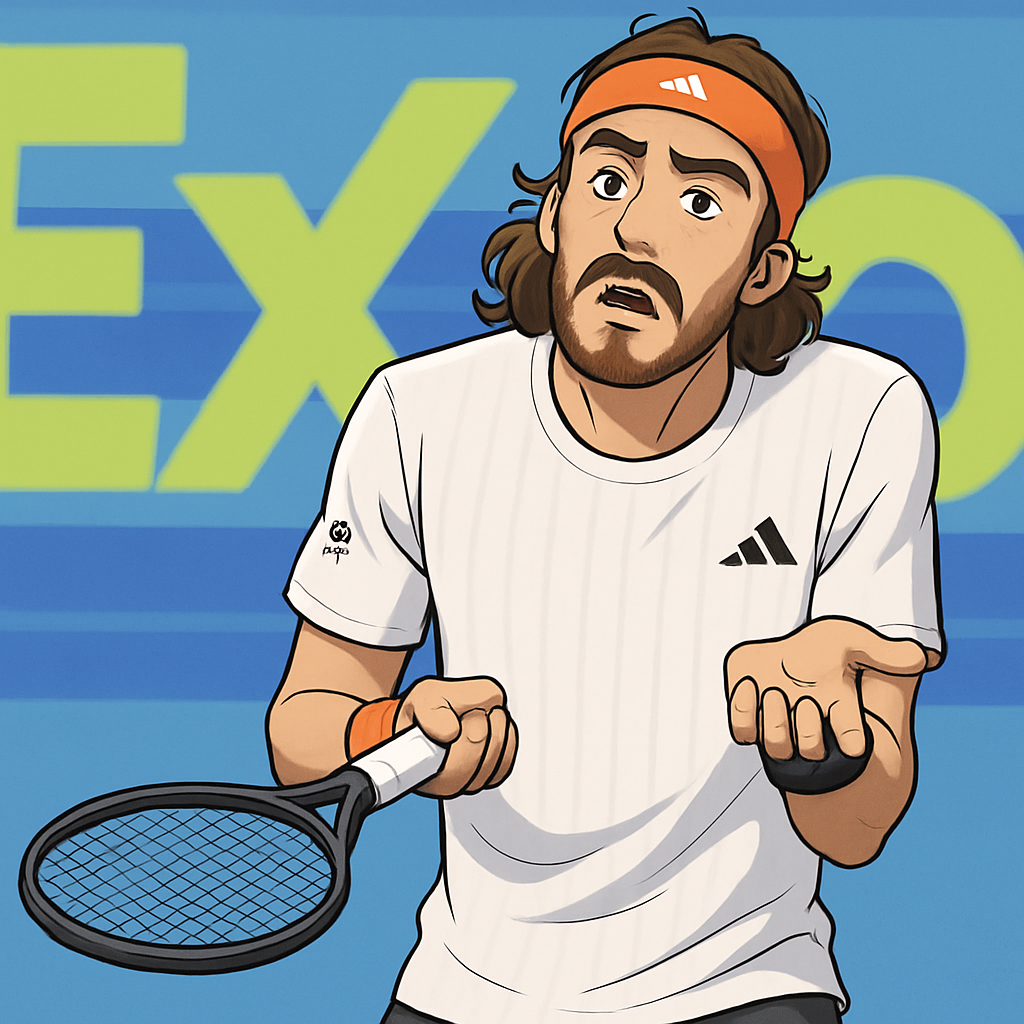
MONTE CARLO — The world of professional tennis coaching is a complex ecosystem of egos, expectations, and delicate partnerships. That complexity was thrown into sharp relief this week when Stefanos Tsitsipas, the Greek world No. 12, appeared to deliver a thinly-veiled retort to his former coach, Goran Ivanisevic, following public criticism from the Croatian legend.
The simmering tension stems from comments Ivanisevic made in a recent interview with Sport Klub. Reflecting on his high-profile split from Novak Djokovic, Ivanisevic was asked about other players he’d worked with, including Tsitsipas. His assessment was blunt. He stated that Tsitsipas, whom he briefly consulted in 2022, was a "fantastic guy" but questioned his ultimate potential, suggesting a ceiling had been reached.
"With Stefanos, I don't know," Ivanisevic said. "He has fantastic tennis, he is a fantastic guy, but I think he has already reached his maximum. He can win a Grand Slam if someone gets injured or something like that, but to dominate... I don't see it." The remarks, circulating widely on social media and tennis news outlets, were a stark and public critique from a respected figure who had been in the player's inner circle.
Tsitsipas's Philosophical Counterpoint
Tsitsipas, currently competing at the Monte-Carlo Masters, did not mention Ivanisevic by name when he addressed the media. However, his chosen topic and the timing of his comments were conspicuous. When asked about the dynamics of player-coach relationships, Tsitsipas embarked on a philosophical discourse about the nature of coaching expertise, making a pointed distinction between playing greatness and teaching ability.
"I believe there are two different categories," Tsitsipas explained. "There are coaches who maybe have never held a tennis racket in their life and are excellent coaches, and there are coaches that have been Grand Slam winners that have no clue how to coach." He emphasized that a coach's value lies not in their trophy cabinet, but in their capacity for empathy, communication, and strategic insight.
He elaborated further, arguing that the skills required to win at the highest level are not automatically transferable. "Just because you have won a Grand Slam doesn't necessarily mean you are a good coach. It is not a given. It is a completely different profession, a completely different skill set that is required." This perspective served as a direct counter to the authority often automatically granted to former champions in coaching roles.
A History of Brief Collaboration
The backstory adds layers to the current exchange. Tsitsipas and Ivanisevic collaborated briefly in the summer of 2022. At the time, Tsitsipas was seeking an additional voice to complement his father and long-time primary coach, Apostolos Tsitsipas. Bringing in a Grand Slam champion, especially one famed for his monstrous serve and work with Djokovic, seemed a logical move.
However, the partnership was short-lived, lasting only a few months. While never fully detailed, it was reported that the combination of coaching styles—Ivanisevic’s direct approach alongside the entrenched family team—proved challenging to integrate seamlessly. The experiment ended without major fanfare, with Tsitsipas reverting to his established coaching structure.
Ivanisevic’s recent comments, therefore, can be seen as a post-mortem of that failed collaboration from his perspective. His "maximum reached" analysis suggests a frustration or a belief that Tsitsipas is unwilling or unable to make the fundamental changes required to leap from consistent top-10 player to dominant Slam champion. Tsitsipas’s response reframes the narrative: perhaps the issue was not the player’s ceiling, but the coach’s methodology.
The Core of Tsitsipas's Argument
Beyond the personal dig, Tsitsipas’s comments touch on a genuine debate in tennis. The history of the sport is filled with legendary players who struggled to coach others to similar heights. The ability to intuitively execute a skill and the ability to deconstruct, communicate, and instill that skill in another person are fundamentally different. Tsitsipas highlighted the essential, non-technical qualities he believes define a successful coach-player partnership:
- Empathy & Psychology: Understanding the player's mental state and motivations.
- Clear Communication: Conveying complex tactics in an actionable way.
- Strategic Acumen: Developing game plans tailored to specific opponents.
- Man-Management: Navigating the pressures of the tour and player ego.
"It's a very sacred relationship that you create with this person," Tsitsipas said of the ideal coach. "You have to feel that this person is contributing to your cause, to your dream, in a way that is measurable and in a way that you can feel it." This statement subtly contrasts a collaborative "contributor" with a top-down authority figure who relies solely on past playing glory.
Broader Implications and the Road Ahead
This public, indirect spat reveals the often-unspoken tensions in tennis's coaching carousel. Players are increasingly vocal about what they need, pushing back against traditional hierarchies. For Tsitsipas, who has faced criticism for his conservative coaching setup, it is also a defense of his chosen path. He is asserting that the continuity and deep understanding within his team—flawed as it may seem to outsiders—hold more value than the prestige of a big-name champion coach.
The episode also highlights Ivanisevic’s candid, unfiltered style, which was celebrated during Djokovic’s success but can cause ripples when directed at former charges. His assessment, while harsh, reflects a common question in tennis circles: has Tsitsipas, with his formidable all-court game but occasional strategic rigidity, already peaked? The Greek star’s mission is now twofold: to prove his former coach’s prediction wrong, and to validate his own philosophy on what makes a coach truly great.
As the clay-court season intensifies, all eyes will be on Tsitsipas, a two-time Monte-Carlo champion and former French Open finalist. His performance on his favorite surface will be the most substantive reply to Ivanisevic’s doubts. Whether his nuanced take on coaching expertise is a principled stance or a defensive deflection will ultimately be determined not by words in a press conference, but by results on the court. The dig has been thrown, and the counterpunch delivered. The next move is Tsitsipas’s to make with his racket.