
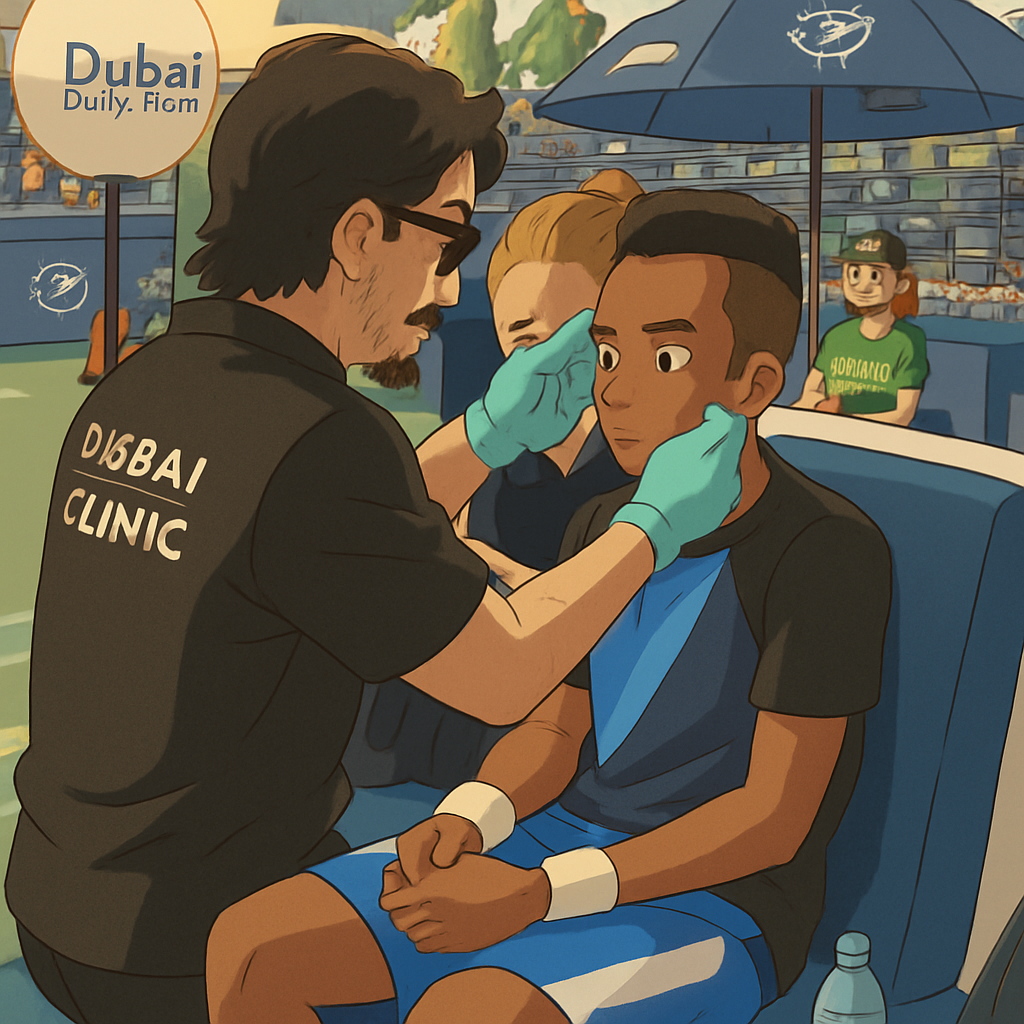
LONDON — The serene, grass-court atmosphere of the cinch Championships at Queen's Club was unexpectedly disrupted on Tuesday when a medical emergency halted a highly anticipated first-round match. French rising star Giovanni Mpetshi Perricard, the towering 6'8" serve-and-volley specialist, was forced to take an extended medical timeout after suffering a sudden and profuse nosebleed during the first changeover, leaving his opponent, former world No. 7 and local favorite Dan Evans, waiting in a state of confusion and frustration.
The incident occurred just minutes into the match, with Mpetshi Perricard leading 2-1 on serve. As the players sat down for the first change of ends, the 21-year-old Frenchman, who had been moving fluidly and showing no signs of distress, began to bleed from his nose. The chair umpire immediately called for the tournament physio, who rushed to the court with a medical kit. For several minutes, the physio worked to stem the bleeding with cotton and ice, while a concerned Evans looked on from his chair, periodically getting up to practice his serve to stay loose.
A Bizarre and Unsettling Interruption
The sight of a player dealing with a nosebleed mid-match is a rare one in professional tennis, where stoppages are typically for muscle strains, cramps, or bathroom breaks. The lengthy delay, which stretched beyond the standard allotted time for a medical timeout, created an awkward and tense atmosphere on Court 1. Evans, known for his competitive fire, was visibly perturbed by the length of the interruption so early in the contest. He was seen discussing the situation with the umpire, likely questioning the protocol and the impact on the match's rhythm.
Mpetshi Perricard eventually returned to the court, the bleeding apparently under control, and managed to hold his serve to extend his lead to 3-1. However, the bizarre episode seemed to have a lingering effect on both players. The French giant's usual explosive power was slightly muted, while Evans struggled to find any consistency in his game. The British No. 3 later admitted the stoppage was a significant mental hurdle, stating in his post-match press conference, "It's very difficult. You're ready to go, you're pumped up, and then you have to sit for 10-12 minutes. It's not ideal for either player, really."
The Match Resumes Amidst Uncertainty
Despite the disruption, the match continued, though it never quite settled into a classic grass-court duel. Evans, perhaps still rattled by the stop-start nature of the proceedings, was broken again and ultimately lost the first set 6-4. The second set followed a similar pattern, with Mpetshi Perricard's massive serve—regularly clocking over 135 mph—proving too much to handle on the fast London grass. Evans fought valiantly, saving multiple match points, but ultimately succumbed 6-4, 6-4 in just over 90 minutes of actual playing time.
For Mpetshi Perricard, the victory marked a significant milestone—his first ATP Tour-level win on grass—and advanced him to a second-round clash with Lorenzo Musetti. Yet, the match will be remembered less for the tennis and more for the unusual medical drama that punctuated its opening stages. The Frenchman addressed the incident briefly after the match, downplaying its severity but acknowledging the strangeness of the situation: "It just started bleeding. I don't know why. Maybe the air is dry. It's okay, it happens. I was just focused on stopping it and getting back to play."
Medical Protocols and Player Frustration
The episode has sparked discussion around the ATP's rules regarding medical timeouts for non-musculoskeletal issues. According to tour regulations, a player is entitled to treatment for a "medical condition," which can include bleeding. The physio and doctor have discretion to determine the necessary treatment time, even if it exceeds the typical three minutes allowed for an evaluation. This can lead to situations, like the one Evans faced, where a player is left cooling his heels for an extended period. Key points of the rule include:
- A medical timeout can be called for any legitimate medical condition, including bleeding, dizziness, or illness.
- The clock starts when the physio/doctor begins treatment, not when they arrive on court.
- The opponent has no recourse but to wait, though they may practice serves to stay warm.
Evans' experience highlights a grey area in the sport's regulations. While player health is paramount, the competitive integrity of the match can be compromised by a lengthy, unforeseen delay so early in play. Some analysts and former players have suggested that for non-impact, acute issues like a nosebleed, a more streamlined process or even a point penalty for excessive delay might be considered to maintain fairness. Evans himself stopped short of criticizing Mpetshi Perricard, but his body language and post-match comments clearly conveyed a sense of unfair disruption.
A History of Unusual Mid-Match Stoppages
While nosebleeds are uncommon, tennis history is dotted with other bizarre mid-match medical interruptions. These incidents often become defining moments of the tournaments in which they occur:
- At the 2005 Australian Open, Serena Williams was famously hindered by severe seasickness during a match, requiring multiple visits from the doctor.
- In a 2013 match in Bogotá, Varvara Lepchenko suffered from altitude sickness, needing oxygen courtside between points.
- More recently, players have cited breathing difficulties due to wildfire smoke or extreme humidity as causes for medical intervention.
These cases underscore the myriad physical challenges athletes face beyond pure athletic strain. The Mpetshi Perricard incident joins this peculiar catalog, a reminder that the human body can present unexpected obstacles at the most inopportune times, turning a strategic battle into a test of adaptability and composure for both individuals on the court.
Looking Ahead: Composure Over Adversity
For Giovanni Mpetshi Perricard, the victory was a testament to his ability to regain focus after a distracting and personal medical event. To steady himself after the timeout, manage the potential embarrassment, and then deliver a commanding, straight-sets victory against an experienced grass-court opponent speaks volumes about his mental fortitude. This trait will be crucial as he continues his rapid ascent up the rankings, powered by one of the most feared serves in the game.
For Dan Evans, the match serves as another frustrating chapter in a difficult season. The disruption, however unusual, is part of the sport's unpredictable fabric. In his post-match reflections, he struck a philosophical note, albeit with a hint of lingering irritation: "It's one of those things. You have to deal with it. It wasn't normal, but it happened. I have to be better at dealing with the 'not normal' when it comes." The incident at Queen's, while a minor footnote in the broader tennis calendar, perfectly encapsulates how a single, random moment—a nosebleed on a changeover—can alter the narrative, rhythm, and mental landscape of a professional tennis match, leaving one player triumphant yet bewildered, and the other defeated and waiting.