
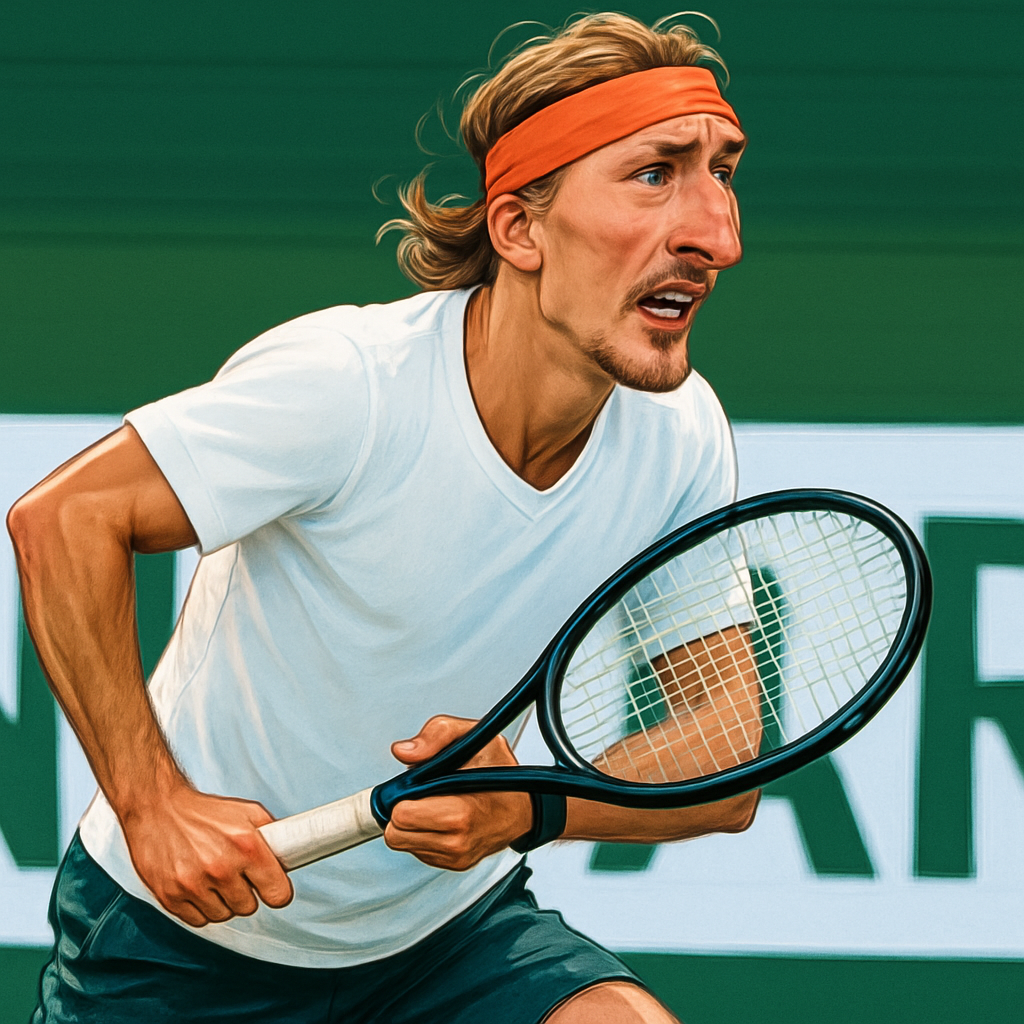
MONTE CARLO — Alexander Zverev etched his name into the tennis history books on Friday at the Rolex Monte-Carlo Masters, achieving a feat so rare it places him among the absolute legends of the modern game. By defeating Stefanos Tsitsipas 6-4, 6-2 to reach the semi-finals, Zverev became just the fifth player to reach the last four at all nine ATP Masters 1000 tournaments.
The German star joined an exclusive club whose only other members are Novak Djokovic, Rafael Nadal, Roger Federer, and Andy Murray – a quartet collectively known as the "Big Four" who dominated men's tennis for nearly two decades. For Zverev, a player who has long been touted as a future Grand Slam champion and world number one, this milestone represents a profound validation of his elite consistency and versatility across all surfaces.
A Monumental Milestone in the Shadow of Giants
The ATP Masters 1000 series represents the pinnacle of the tour outside the four Grand Slams. Winning one is a career-defining achievement for most players; mastering all nine different events is a Herculean task that demands excellence on hard courts (indoor and outdoor), clay, and grass. The tournaments vary wildly in speed, bounce, and atmosphere, from the slow, heavy clay of Monte-Carlo to the lightning-fast indoor courts of Paris-Bercy and the unique, high-altitude conditions of Madrid.
Speaking to the press after his quarter-final victory, a visibly moved Zverev reflected on the significance of his accomplishment. "It means a lot," he said. "This is something that, you know, very few players have been able to do. Obviously, the Big Four are the four best players of all time, and I'm the fifth player to do that. It's very special to me."
The journey to complete this particular set was a long one. Zverev had previously reached the semi-finals at eight of the nine Masters events, with Monte-Carlo being the stubborn final hurdle. His best previous result in the Principality was a quarter-final appearance in 2022. Breaking through that barrier against a two-time former champion in Tsitsipas made the moment all the sweeter.
The Elite Company: A Testament to All-Court Prowess
The list of players Zverev now joins is a testament to the achievement's difficulty. Djokovic, Nadal, and Federer, the trio with 66 Grand Slam titles between them, completed the set years ago, a natural extension of their all-surface dominance. Andy Murray, despite his career being hampered by injury, also managed the feat, underscoring his incredible adaptability and tactical intelligence.
What makes this group – and now Zverev – stand apart is the requirement for sustained excellence. It's not about a single flash of brilliance but about being a perennial threat at every major stop on the ATP calendar for years. To contextualize the rarity, consider that other modern greats and multi-Masters winners like Stan Wawrinka, Juan Martín del Potro, and Marin Čilić have not accomplished it.
The specific challenges of the nine Masters 1000 tournaments that a player must conquer include:
- Indian Wells & Miami: The grueling "Sunshine Double" of slow hard courts, testing endurance early in the season.
- Monte-Carlo, Madrid & Rome: The clay-court trilogy, each with distinct characteristics, preparing players for Roland Garros.
- Canada & Cincinnati: The summer hard-court swing, often played in humid conditions, crucial for US Open preparation.
- Shanghai: The fast-paced Asian hard-court Masters, requiring quick adjustment after the North American season.
- Paris-Bercy: The season-ending indoor Masters, known for its fast court and unique atmosphere.
Zverev's Path: Resilience and Refined Clay-Court Game
Zverev's Monte-Carlo breakthrough is particularly poignant given his recent history. Just over two years ago, he suffered a horrific ankle injury during his Roland Garros semi-final against Nadal, casting doubt on his ability to return to the top of the sport. His comeback has been a story of gradual rebuilding, both physically and mentally. This milestone serves as the most powerful statement yet that he is not just back, but perhaps better and more complete than ever.
His performance in Monte-Carlo showcased a refined clay-court game. Against Tsitsipas, he served with authority, controlled rallies with his heavy, deep groundstrokes, and moved with a confidence that had sometimes been missing since his injury. "I'm happy with how I'm playing," Zverev assessed. "I'm happy with how I'm moving. I'm happy with how I'm competing. And, you know, I'm in the semi-finals of a Masters 1000 on clay, so it can't be bad."
This achievement also reinforces Zverev's status as a constant in the latter stages of the biggest tournaments. He is a two-time ATP Finals champion, an Olympic gold medalist, and a perennial presence in the second week of Grand Slams. The Masters 1000 milestone fills a crucial line on his resume, one that separates the very good from the truly historic players of an era.
Looking Ahead: A Springboard for Greater Goals
While celebrating the historical significance, Zverev was quick to pivot his focus to the immediate future. The semi-final achievement is a point of pride, but the ultimate goal remains winning titles, particularly the elusive Grand Slam. This milestone, however, can serve as a significant mental springboard.
"It shows that I'm capable of playing well on all surfaces, in all conditions, and that I've been doing that for many years now," Zverev explained. The confidence gained from solving the Monte-Carlo puzzle could prove invaluable as the clay season progresses toward the ultimate prize at Roland Garros, where he has been a semi-finalist three times.
In the end, Alexander Zverev's entry into this most exclusive of clubs is more than just a statistical footnote. It is a testament to his resilience, his all-court skill, and his enduring place among the world's best players over a significant period. By matching a feat unique to the Big Four, he has, in one sense, officially bridged the gap between the legends of the past and the champions of the present. As he stated himself, summing up the feelings of a career-defining afternoon, "It's a great milestone. I'm happy to be in that kind of group."