
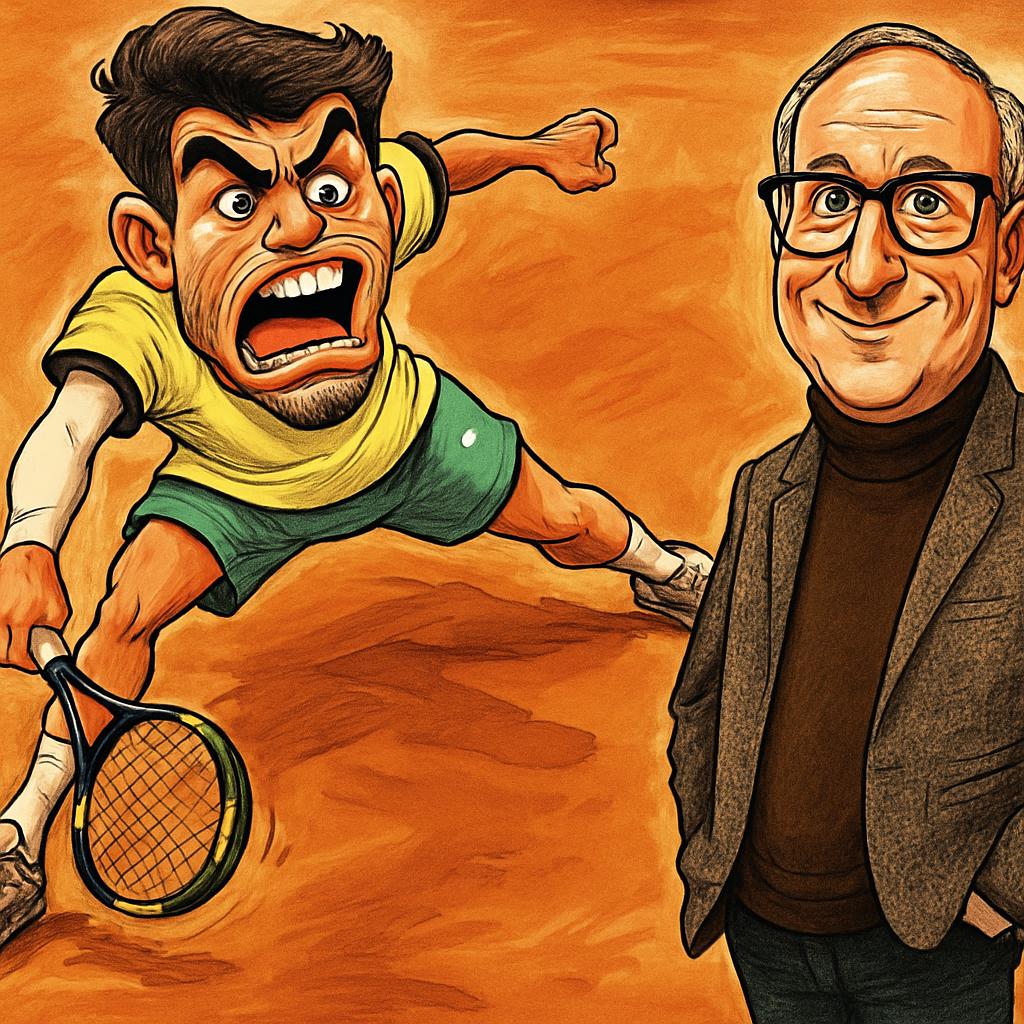
LONDON — In my two decades covering this sport for Sky Sports, from the baseline of Centre Court to the commentary box overlooking Arthur Ashe Stadium, I’ve witnessed the entire arc of modern tennis. I’ve charted the rise of icons, the evolution of rivalries, and the subtle shifts in technique and mentality that define eras. I thought I’d seen it all. Then along came Carlos Alcaraz, and the young man from Murcia has done nothing but surprise me, challenge my assumptions, and reignite my passion for the game in a way I hadn’t felt in years.
When you’ve been around the tour long enough, you develop a kind of radar for prodigious talent. You see the junior champions, the players with the explosive forehand or the unbreakable serve. You make mental notes, predictions. With Carlos, the raw tools were undeniable from the moment he emerged—the ferocious power, the athleticism that defies physics, the drop shot that seems plucked from a bygone clay-court era. But what has truly caught me off guard, what separates him from every other ‘next big thing’ I’ve encountered, is the complete and instantaneous synthesis of those tools under the most extreme pressure.
A Champion's Mind in a Teenager's Body
We often speak of a player’s ‘tennis IQ,’ but Alcaraz’s seems preternatural. To win a Grand Slam, you need the physical weapons. To win your first major at 19, as he did at the 2022 US Open, you need that, plus the mental fortitude of a veteran. To then follow it up by dethroning the king of grass, Novak Djokovic, in a Wimbledon final for the ages at just 20, you need something else entirely: a fearless, joyful, and tactical genius that appears fully formed. I recall speaking to his coach, Juan Carlos Ferrero, who said, "Carlos doesn't see pressure, he sees opportunity." That is a rare, rare lens.
His game is a breathtaking anachronism. He possesses the brutal, baseline-blasting power that defines this era, yet he marries it with a net-rushing volleyer’s instinct and a magician’s touch. In an age of specialization, he is a throwback to a more complete, all-court style. This isn’t a gradual evolution; it’s a revolution packaged in a neon headband. Consider the facets of his game that leave veterans and analysts alike shaking their heads:
- The Drop Shot: Deployed not as a trick, but as a strategic weapon from positions no one else dares.
- The Defensive-to-Offensive Switch: He doesn't just retrieve; he retrieves with such violent topspin that he immediately seizes control.
- The Emotional Transparency: He plays with a visible, infectious joy that seems to fuel him, not distract him, in the biggest moments.
The Matches That Redefined Possible
His 2023 Wimbledon victory was the ultimate validation of my surprise. Grass was supposed to be his final frontier, the surface requiring years of adaptation. Djokovic on Centre Court was supposed to be an insurmountable puzzle. What did Alcaraz do? He played a five-set masterpiece of tactical variety, emotional resilience, and sheer audacity. After losing a grueling, 85-minute first set, a lesser spirit would have folded. Carlos adapted, problem-solved in real-time, and ultimately prevailed. In the commentary box, we were searching for new superlatives. It was the performance of a player who had no business being so complete, so soon.
This is not to say his journey is without the expected bumps. The 2024 season has illustrated the brutal consistency required at the very top. A right arm injury hampered his clay season, and the pressure of defending titles is a new weight to carry. Yet, even in moments of struggle, the response is telling. After a tough loss, his focus is immediately on learning, on improving. There’s no tantrum, just analysis. As he told the press after a recent defeat, "You have to lose to learn. I leave the court with my head high, knowing what I must work on." That maturity, at 21, is staggering.
The New Axis of the Sport
What Alcaraz has done, perhaps most surprisingly, is force a recalibration of the entire men’s game. For nearly two decades, the narrative was defined by the Big Three—Federer, Nadal, and Djokovic. Now, a new, thrilling axis has formed: Alcaraz versus Jannik Sinner. Their rivalry, built on blistering pace and mutual respect, feels like the heartbeat of tennis’s next chapter. It’s a rivalry that has pushed Sinner to new heights, as seen in his Australian Open triumph, and one that promises to define major finals for years to come. Alcaraz isn’t just part of the next generation; he is its charismatic, standard-bearer.
The Intangible: Joy as a Weapon
Beyond the technique and the trophies, the most surprising and refreshing element of Carlos Alcaraz is the palpable joy he exudes. In a sport often marked by intense, internalized pressure, his smile between points, his fist-pumps to his team, and his sheer love for the battle are a tonic. It’s not naivety; it’s his fuel. He reminds us that sport, at its best, is spectacular entertainment. He plays as if he’s still that kid on the public courts of El Palmar, dreaming of these very moments. That authenticity is impossible to manufacture and incredibly powerful to watch.
So, after 20 years, what has Carlos Alcaraz taught this old commentator? He has taught me to expect the unexpected. He has reminded me that genius can arrive not in a predictable linear path, but in a dazzling, disruptive explosion. He has proven that the future of tennis can be both unimaginably powerful and delightfully creative. The sport is in a period of transition, but with Alcaraz at the forefront, its future is not just secure; it’s electrifying. My only prediction now is that he will continue to surprise us all, and I, for one, cannot wait to call every minute of it.