
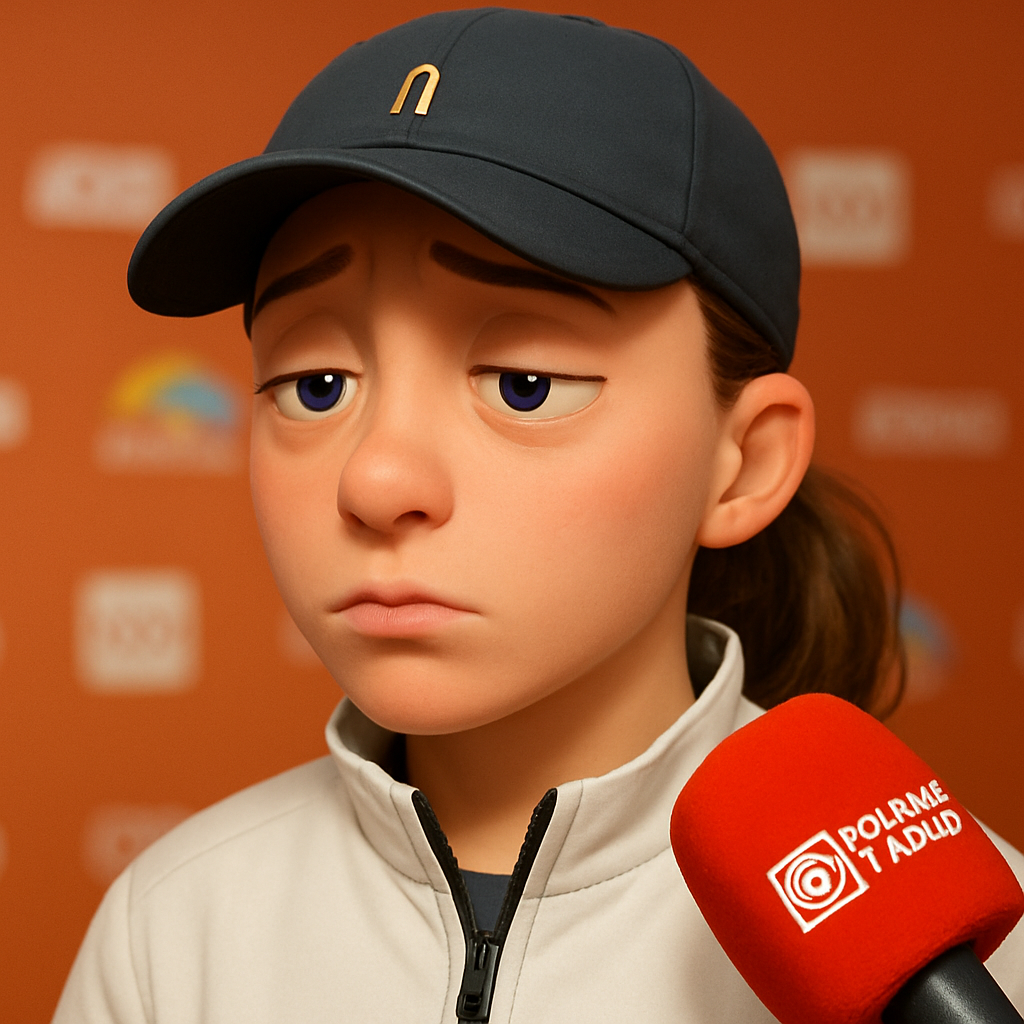
ROME — In a rare and raw display of vulnerability, world No. 1 Iga Swiatek gave an emotional interview following a stunning third-round defeat at the Italian Open, admitting to feelings of inadequacy and lamenting her recent performances on the WTA Tour.
The four-time Grand Slam champion, who had been on a 12-match winning streak that included back-to-back titles in Madrid and Stuttgart, was comprehensively beaten 6-4, 6-3 by Kazakhstan’s Yulia Putintseva. The loss marks Swiatek's earliest exit from a tournament since January and has prompted a period of intense self-reflection for the typically dominant Pole.
Speaking to reporters in Rome, a visibly shaken Swiatek did not hold back her frustration and disappointment. "Honestly, I haven't felt like I'm playing the best tennis. I know I did in Madrid and Stuttgart, but here I didn't feel that confidence," she confessed, her voice heavy with emotion. "For sure, I need to just work harder. Maybe I need to change some things. I'm open to that."
A Sudden Stumble on Favorite Clay
The defeat is particularly jarring given the context. The Italian Open is a key warm-up for the French Open, a tournament Swiatek has won three times and where she is the overwhelming favorite to defend her title later this month. The clay courts of Rome’s Foro Italico have also been a happy hunting ground, as she lifted the trophy here in 2021 and 2022.
Swiatek’s performance against the 41st-ranked Putintseva was uncharacteristically error-prone. She struggled with her serve, faced relentless pressure from Putintseva’s aggressive and varied game, and was unable to impose her trademark heavy topspin groundstrokes. The match statistics painted a bleak picture, with Swiatek committing 22 unforced errors to just 11 winners.
In her post-match analysis, Swiatek pointed to a specific tactical and mental failing. "For sure, the main thing was I couldn't return her serve properly. I was making mistakes on my return. I was trying to find solutions, but I couldn't. I just felt like I'm not good enough today."
The Weight of Expectation and Exhaustion
The admission of not feeling "good enough" from a player who has spent over 100 weeks at the top of the rankings and has been the most consistent force in women's tennis for two years is striking. It underscores the immense psychological burden carried by top athletes, even those as seemingly unflappable as Swiatek.
While she did not use it as an excuse, Swiatek hinted at the physical and mental toll of a grueling schedule. Her recent success in Madrid and Stuttgart required a deep run in both prestigious events, leaving little time for recovery before switching to another high-stakes tournament in Rome.
This sentiment was echoed in her broader assessment of her current form. "I feel like I've been making more mistakes than usual. My decision-making is not as good. I feel a bit rushed on court. It's something I need to analyze. Maybe it's just fatigue, maybe it's pressure—I don't know yet."
The challenges Swiatek currently faces are multifaceted. They include:
- Physical Fatigue: The compacted clay-court swing demands peak fitness.
- Tactical Adaptation: Opponents are increasingly studying and targeting her game.
- Mental Pressure: The expectation to win every match on clay is immense.
- Emotional Load: Maintaining intensity over a long season is a constant battle.
A Crucial Juncture Before Roland-Garros
The timing of this setback, while jarring, may prove to be a blessing in disguise. With the French Open beginning on May 26th, Swiatek now has an unexpected and valuable week to rest, reset, and address the issues that surfaced in Rome. Historically, she has used defeats as powerful fuel for improvement.
Her coach, Tomasz Wiktorowski, is known for his meticulous planning and calm demeanor. He will likely use this time to fine-tune her game and rebuild the confidence that seemed momentarily shaken. The key will be to transform this moment of doubt into a renewed sense of purpose.
Swiatek herself acknowledged the need for perspective and hard work. "It's not the first time I've lost a match. It's part of the job. I need to take the lessons from it. I'm going to go back to practice and work on the things that didn't work today. Roland-Garros is a different story, a different tournament."
The Reaction from the Tennis World
The tennis community reacted with a mix of surprise and sympathy to Swiatek's candidness. Many analysts and former players noted that such honesty is rare at the elite level and reflects her immense drive for perfection. Rival players, while undoubtedly seeing an opportunity, also recognized the unique pressure she carries as the tour's standout champion.
The defeat also throws the women's draw at the upcoming French Open wide open. While Swiatek remains the favorite, players like Aryna Sabalenka, Coco Gauff, and Elena Rybakina—all of whom have challenged her on clay—will now approach Paris with increased belief.
Conclusion: Vulnerability as a Strength
Iga Swiatek's emotional press conference in Rome was more than just a reaction to a bad loss. It was a profound glimpse into the psyche of a champion grappling with the relentless demands of her sport. Her admission, "I'm not good enough," was not a statement of permanent fact, but a snapshot of a moment of intense frustration.
History suggests that Swiatek is at her most dangerous when she has a point to prove. This moment of public vulnerability may well be the catalyst that sharpens her focus and reignites her competitive fire. As she heads to Paris to defend her crown, the tennis world will be watching to see how the game's most dominant clay-court player responds to this rare and public moment of doubt.
The final word from the champion herself offered a blend of realism and resolve. "It's one tournament. I'm not going to make a drama out of it. I'll just go back to work. I know what I have to do." For her rivals hoping to dethrone her at Roland-Garros, that may be the most ominous statement of all.