
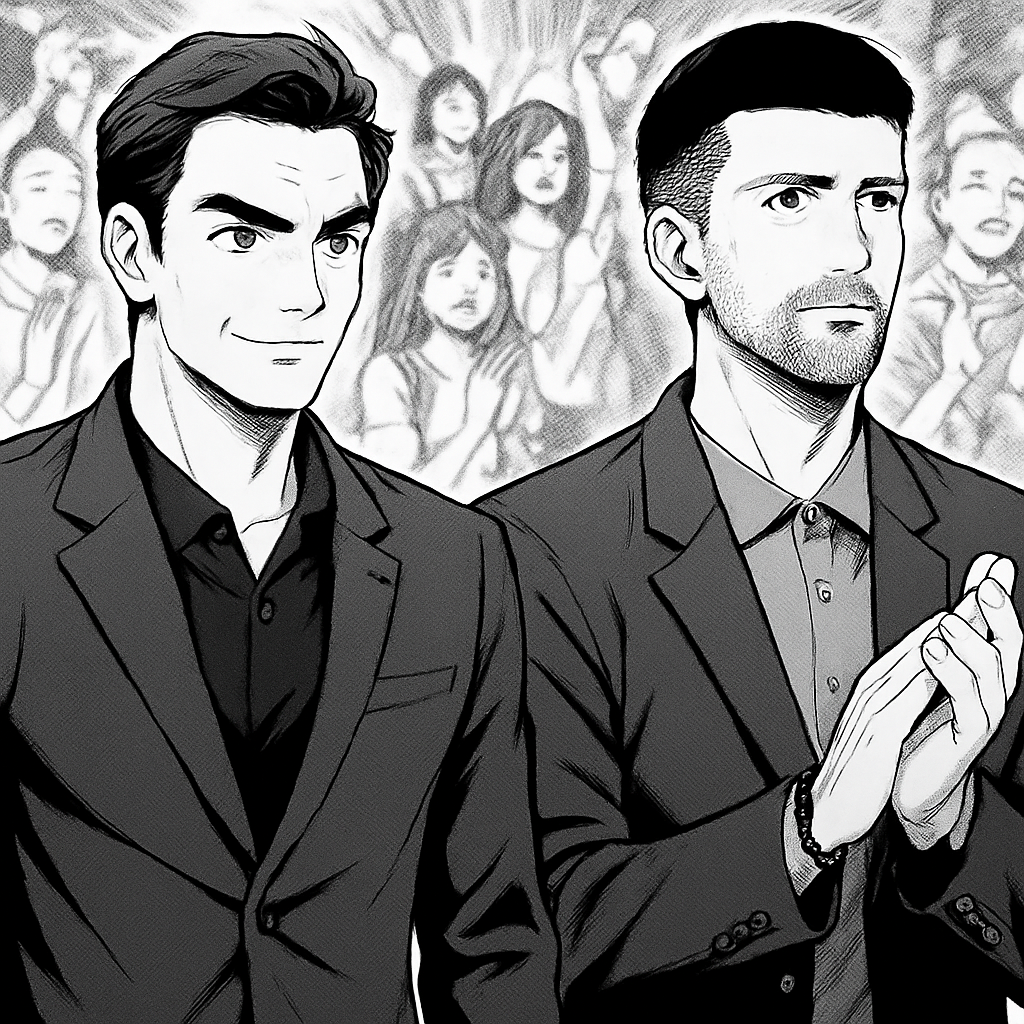
LONDON — In a recent and wide-ranging interview, tennis legend Roger Federer has definitively closed the door on one of the most tantalizing hypotheticals in the sport: the possibility of him coaching his longtime rival, Novak Djokovic.
The 20-time Grand Slam champion, who retired in 2022, was asked what his response would be if the current World No. 1 and record-breaking 24-time major winner were to call him up and ask him to join his team.
Federer’s answer was polite, flattering to Djokovic, but ultimately an unequivocal no. He revealed that he has ruled out a return to the professional tour in any coaching capacity for the foreseeable future, regardless of who makes the request.
The Allure of the Hypothetical
The idea of one of the "Big Three" coaching another is a fantasy scenario that has captivated tennis fans for years. The tactical insights, the understanding of pressure at the highest level, and the sheer narrative drama would be unparalleled. Federer, known for his elegant and attacking style, guiding Djokovic, the master of baseline efficiency and mental fortitude, is a concept almost too compelling to ignore.
When posed with the question directly, Federer acknowledged the honor inherent in such a request. He stated, "If Novak called me, of course, I would be incredibly flattered. To be asked by one of the greatest players of all time to help him would be a massive compliment."
However, the Swiss maestro was quick to temper any excitement, immediately following up with his firm stance. "But my answer would have to be a clear no. It’s just not something I see myself doing. Coaching is a massive commitment, and it’s not where my life is headed right now."
A Life Beyond the Baseline
Since hanging up his racket, Federer has embraced a life away from the daily grind of the tour. He has been relishing time with his family, managing his foundation, and engaging in various business and sponsorship activities. The relentless travel, the pressure of the player's box, and the intense focus required to coach at the elite level are commitments he is no longer willing to make.
He elaborated on his current priorities, explaining, "I’ve just spent 25 years of my life on the road, in hotels, at tournaments. I loved every minute of it, but that chapter is closed. My priorities are my wife, my four children, and my other projects."
Federer’s perspective highlights a common theme among all-time greats who transition away from competition. The desire to step away completely and define a new identity separate from the sport is powerful. For Federer, coaching would represent a partial return to the very world he chose to leave.
Why Coaching Doesn't Appeal to the Maestro
Beyond the lifestyle, Federer expressed doubts about whether his particular skillset and personality are suited for a coaching role. He suggested that being a great player does not automatically translate to being a great coach, a sentiment echoed by many former champions.
"I was always a player who operated a lot on instinct and feel," he explained. "How do you teach that? How do you convey that to another player, even one as brilliant as Novak? It’s a different skillset entirely."
He also hinted at the potential awkwardness of trying to dissect the game of a player he battled so fiercely for two decades. The dynamics of such a relationship would be complex, moving from a peer-to-peer rivalry to a teacher-student hierarchy.
Federer identified several key reasons why a coaching role, for any player, is not in his future:
- Time Commitment: The job is all-consuming, requiring near-constant travel and attention.
- Family Focus: He is dedicated to being present for his children as they grow up.
- Different Skill Set: He questions his ability to translate his innate talent into teachable tactics.
- Personal Fulfillment: His foundation and business ventures provide a new sense of purpose.
The Djokovic Coaching Carousel
Federer's comments come at a time when Djokovic’s coaching situation is a topic of discussion. After splitting with longtime coach Goran Ivanišević in March 2024, Djokovic has been competing without a formal head coach, working with a more fluid team.
This has led to rampant speculation about who might fill the role, with names like former Wimbledon champion and countrywoman Nenad Zimonjić being floated. The idea of Federer stepping in was always a long shot, but it was a dream scenario for many, now firmly extinguished by the man himself.
A United "Big Three" Front on Coaching
Interestingly, Federer is not alone in his reluctance to coach. His other great rival, Rafael Nadal, has also consistently stated that he does not see himself as a future coach. This creates a united front among the trio, suggesting that the unparalleled insights of this golden generation may remain largely within them.
Nadal has often said he would prefer to focus on his academy and his family, mirroring Federer's sentiments almost exactly. It appears that after giving so much to the sport, the desire for a clean break is a shared one.
The Door Isn't Entirely Closed, Just Locked
While Federer was definitive about the "foreseeable future," he did leave a tiny, almost imperceptible crack in the door, refusing to say "never" in the very long term. However, he made it clear that any such move would be decades away, if it ever happened at all.
"Maybe when I’m much older, and my kids are all grown up, and I’m looking for a new challenge, who knows?" he mused. "But right now, it’s a zero percent chance."
He did, however, express his continued love for the game and his belief that he can contribute in other ways, perhaps through mentorship or exhibition events, rather than the high-stakes environment of the ATP Tour.
Conclusion: A Firm No to a Dream Scenario
Roger Federer’s clear and candid remarks put to rest one of the most fascinating "what if" questions in modern tennis. While the image of Federer in Djokovic's player's box is a captivating one, it will remain in the realm of fantasy.
His decision underscores a fundamental truth about life after sport: the greatest champions have the right to define their own retirement on their own terms. For Roger Federer, those terms involve family, philanthropy, and a permanent step away from the coaching sidelines, even for the most illustrious of potential clients.
The final word from the man himself was characteristically gracious but firm: "I have the ultimate respect for Novak and everything he has achieved. But I will be cheering for him, and everyone else, from a distance, as a fan."