
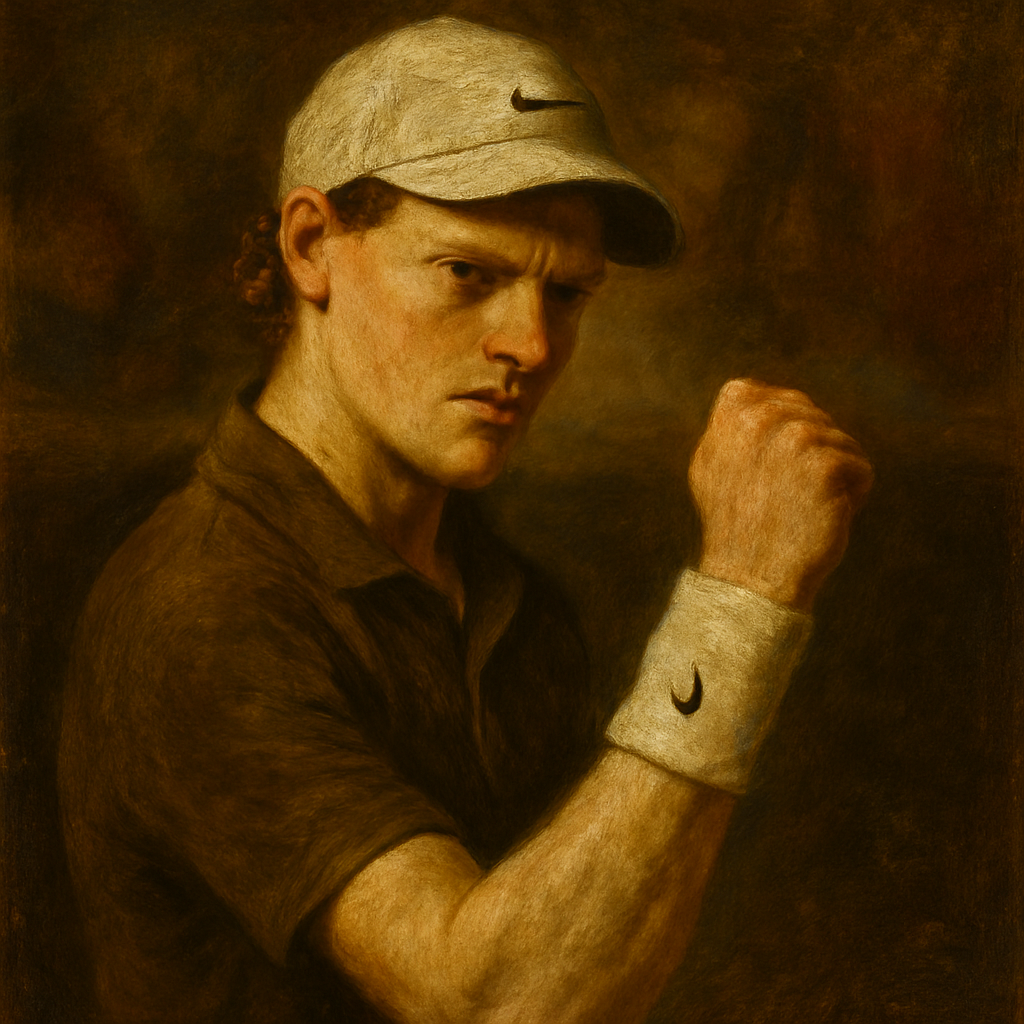
MELBOURNE — The Jannik Sinner who stepped onto Rod Laver Arena on Monday for his fourth-round clash looked like a man unburdened. Gone was the tentative, sometimes weary figure who navigated the early rounds with a lingering illness. In his place was the world No. 4, a player of serene confidence and devastating power, who dispatched fellow Italian Luciano Darderi 6-4, 6-4, 7-5 to sail into the Australian Open quarter-finals.
This was a statement victory, not just for the scoreline but for the manner of its execution. Sinner, who admitted to feeling "a bit sick" in his previous match against Sebastian Baez, moved with a fluid grace, struck the ball with crisp authority, and controlled the tempo from the baseline with an almost casual assurance. Facing the 48th-ranked Darderi, who was playing in his first Grand Slam fourth round, Sinner showcased the form that makes him a favorite for the title, dismantling his opponent's game with surgical precision.
A Masterclass in Controlled Aggression
From the opening games, Sinner established a blueprint for dominance. His serve, a weapon he has meticulously improved, was firing, allowing him to hold with ease and apply immediate pressure on Darderi's delivery. The forehand, a whip-like stroke of topspin and pace, was the engine of his attack, but it was the backhand—a rock-solid, flat missile—that consistently broke down Darderi's defenses. Sinner’s movement, often underrated, was a highlight; he glided across the blue court, transitioning from defense to offense in a single, seamless motion.
Darderi, to his credit, fought valiantly. The 21-year-old possesses a heavy forehand and a fighting spirit, and he managed to create a handful of break point opportunities. Yet, each time, Sinner’s composure under pressure shone through. On the critical points, he elevated his game, finding unreturnable serves or painting the lines with breathtaking winners. This clutch performance underscored a key evolution in Sinner’s mentality. As he noted in his post-match interview, "I felt much better today. I moved better, I hit the ball better. I was just trying to stay focused on my game, point after point."
The Path to Peak Form
Sinner’s journey through the first week in Melbourne has been a tale of steady ascension. His first-round win was efficient, his second-round match was a test of patience, and his third-round victory was a battle against his own physical limitations. The victory over Darderi, however, signaled he has arrived at his peak at the perfect moment. The statistics tell a compelling story of his dominance:
- Winners: 31 to Darderi's 18
- Unforced Errors: A remarkably low 18
- Break Points Saved: 4 out of 5 faced
- Net Points Won: 16 out of 18 attempts
This data reflects a player in complete command of his game and his emotions. His coach, Darren Cahill, watched from the player’s box with a look of quiet satisfaction. The work done in the off-season—focusing on physical resilience, tactical variety, and mental fortitude—was manifesting on the sport’s biggest stage. Sinner’s ability to raise his level when threatened, a hallmark of champions, was the most encouraging sign for his supporters.
The Quarter-Final Hurdle: Rublev Awaits
The road, of course, gets exponentially tougher from here. Awaiting Sinner in the quarter-finals is the formidable Andrey Rublev, the No. 5 seed, who survived a monumental five-set battle against Alex de Minaur. Rublev represents a seismic shift in challenge. He possesses one of the most explosive forehands on tour, a relentless, power-based game, and the experience of having reached this stage at a major nine times before. Their head-to-head is narrowly in Sinner’s favor at 4-2, but their matches are invariably brutal, physical affairs decided by fine margins.
Sinner is acutely aware of the test ahead. "Andrey is an incredible player, so strong mentally and physically," Sinner said. "Every match we play is a huge battle. I will have to recover well, be prepared for long rallies, and try to play my tennis, to be aggressive and make him move. It’s going to be a very tough match." The clash promises to be a highlight of the tournament, a duel between two of the cleanest ball-strikers in the game, with a coveted semi-final spot on the line.
A Glimpse of a Grand Slam Champion
Beyond the tactics and the power, what was most striking about Sinner’s performance against Darderi was his demeanor. There was a palpable sense of calm, a champion’s aura that has been growing since his triumphs at the end of 2023, which included winning his first Masters 1000 title in Toronto and leading Italy to the Davis Cup championship. He played not with the frantic energy of a contender trying to prove himself, but with the quiet certainty of a man who knows he belongs at the very top.
Conclusion: A Statement Made
Jannik Sinner’s assured passage into the last eight of the Australian Open was more than just a victory; it was a declaration of intent. Having shaken off the vestiges of illness, he now appears rejuvenated, physically sharp, and tactically astute. The machine is humming. In a tournament already marked by stunning upsets and dramatic exits, Sinner has provided a model of serene progression. The question is no longer if he can win a Grand Slam, but when. The next chapter of that answer will be written against Andrey Rublev, in what promises to be a quarter-final for the ages.
As the Melbourne sun sets on another day of tennis, Sinner’s performance stands out as a beacon of clarity. He has navigated the tricky waters of the first week and now finds himself in familiar territory, the quarter-finals, but with a new level of belief and a game firing on all cylinders. The Italian’s voyage at Melbourne Park continues, and for his rivals, the warning is clear: a rejuvenated Jannik Sinner is a formidable force, sailing with full wind in his sails toward the ultimate prize.