
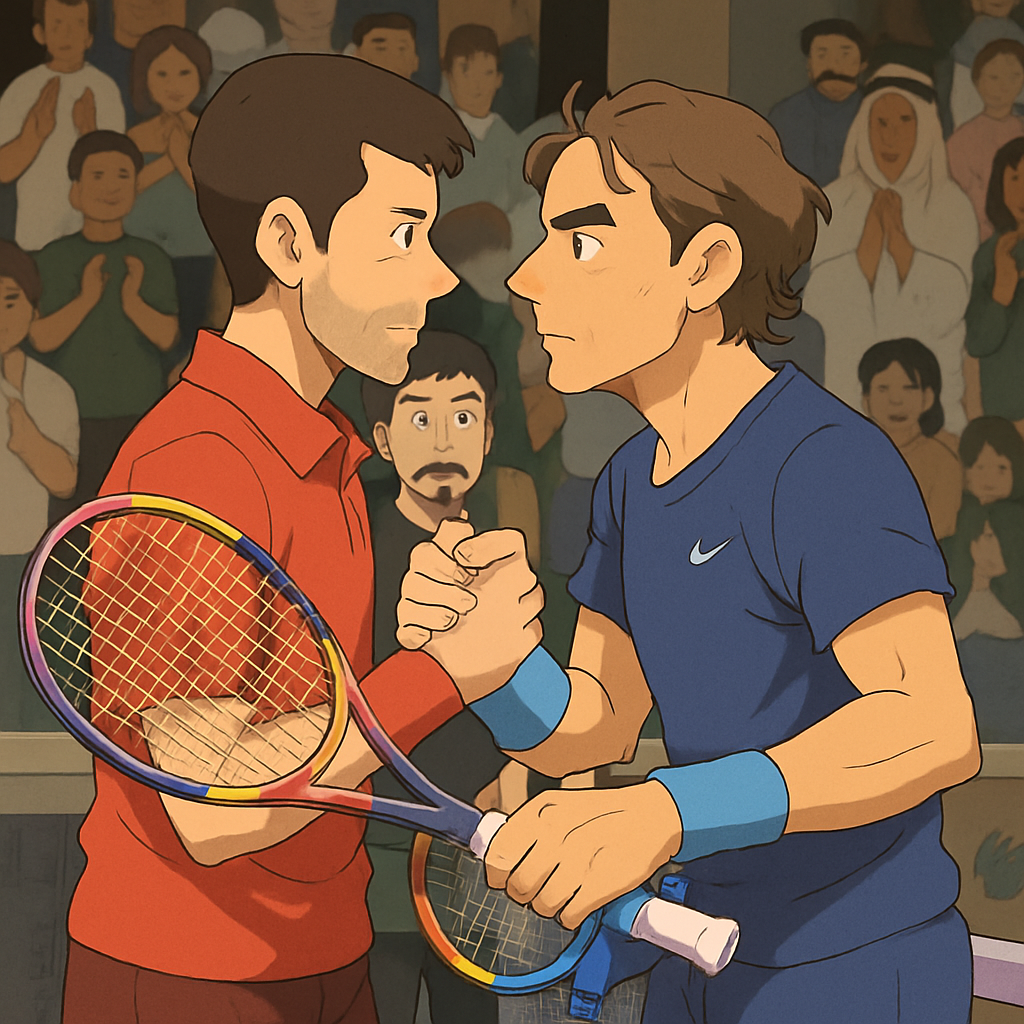
In the storied history of men's tennis, the "Big Three" rivalry between Rafael Nadal, Roger Federer, and Novak Djokovic stands as the sport's defining epic. For nearly two decades, fans and pundits have dissected their contrasting styles, personalities, and legacies. Now, in a revealing segment from the upcoming documentary series 'Nadal' on Amazon Prime, the Spaniard himself offers a candid and nuanced perspective on what truly distinguished his two greatest rivals from one another.
The Essence of the Rivalry: A Personal Reflection
Nadal, whose career has been a relentless pursuit of perfection, frames the difference not merely in technical terms, but through the prism of personal challenge and emotional response. He explains that while both Federer and Djokovic pushed him to his absolute limits, the nature of that push, and his reaction to it, were fundamentally different. "With Roger, the rivalry was more aesthetic," Nadal reflects.
He describes the Federer matches as a clash of diametrically opposed styles—his own ferocious topspin and physicality against Federer's effortless grace and attacking flair. It was a contrast that captivated the world. "Our games connected in a way that was beautiful for the spectators," Nadal admits, acknowledging the unique spectacle they created together.
The Djokovic Dynamic: A Psychological Frontier
When the conversation turns to Djokovic, Nadal's tone shifts to one of profound respect for a battle that occurred on a different plane. With Djokovic, the aesthetic gave way to the absolute. The Serbian's emergence, particularly from 2011 onward, presented Nadal with a challenge he had never faced: an opponent whose defensive prowess, mental fortitude, and physical resilience mirrored and often surpassed his own.
It is here that Nadal delivers his most telling insight. "With Novak, the rivalry was more intense, more extreme in every way. There was more tension, more anxiety. I didn't like it," he states plainly. This admission is not a critique of Djokovic, but a raw acknowledgment of the psychological toll their matches exacted.
Nadal elaborates that facing Djokovic meant confronting a version of himself—a player who would not yield a single centimeter, who could retrieve impossible balls, and who thrived in the pressure cooker of grand slam finals. The margins for error vanished. This created a unique strain:
- Relentless Pressure: Every point felt like a monumental struggle, with grueling, 30-shot rallies becoming the norm.
- Mental Exhaustion: The need for constant, peak concentration from the first point to the last was draining.
- Strategic Parity: There were no easy tactical solutions, as Djokovic had an answer for every weapon.
A Contrast in On-Court Personas
This intensity was amplified by their contrasting on-court demeanors. Federer's rivalry was characterized by a classic, almost stoic sportsmanship. With Djokovic, the emotional currents were more visible and volatile. Their epic battles, like the nearly six-hour 2012 Australian Open final, were wars of attrition that laid bare every ounce of their competitive spirit. Nadal suggests this very rawness, while a testament to their commitment, was what he "didn't like"—the sheer, unforgiving brutality of the competition.
Mutual Respect Forged in Fire
Crucially, Nadal is quick to frame this "dislike" within the context of ultimate respect. He clarifies that his sentiment is directed at the suffocating nature of the competition itself, not at Djokovic the person or champion. "It's not about not liking Novak. I have a good relationship with him," Nadal says. "It's about not liking the feeling of facing someone who takes you to your absolute limit in that way."
This distinction is vital. It underscores that for Nadal, the Djokovic rivalry represented the ultimate test—one that forced him to evolve constantly, to dig deeper than ever before, and to confront his own psychological boundaries. In many ways, it was the purest form of competition, stripped of artistry and reduced to a primal clash of wills.
Legacy Defined by Both
Nadal's reflections provide a fascinating key to understanding the three-way rivalry. Federer was the inspiration, the benchmark of elegance he sought to dethrone. Djokovic became the mirror, the relentless force that challenged his very identity as the sport's ultimate competitor. Each rivalry shaped his legacy in complementary ways:
- Federer: Elevated Nadal's game on grass and hard courts, proving his versatility beyond clay.
- Djokovic: Hardened his mental resilience and pushed his physical game to unprecedented extremes.
In concluding his thoughts, Nadal pays homage to the unique fortune of his career. "To have two rivals of this magnitude is something historic. I consider myself very lucky to have lived through this era," he states. His candid admission—that he didn't like the intense, anxious feeling of facing Djokovic—is not a sign of weakness, but a powerful testament to the Serbian's unparalleled ability as a competitor.
It reveals that beyond the titles and the records, the true legacy of the Big Three is etched in these personal, psychological battles. Nadal's explanation ultimately highlights a profound truth: Roger Federer was the rival he admired and was thrilled to challenge, while Novak Djokovic was the rival he respected and was forced to survive. Together, they created a golden age where the quest for greatness was as much an internal struggle as it was a battle against the opponent across the net.