
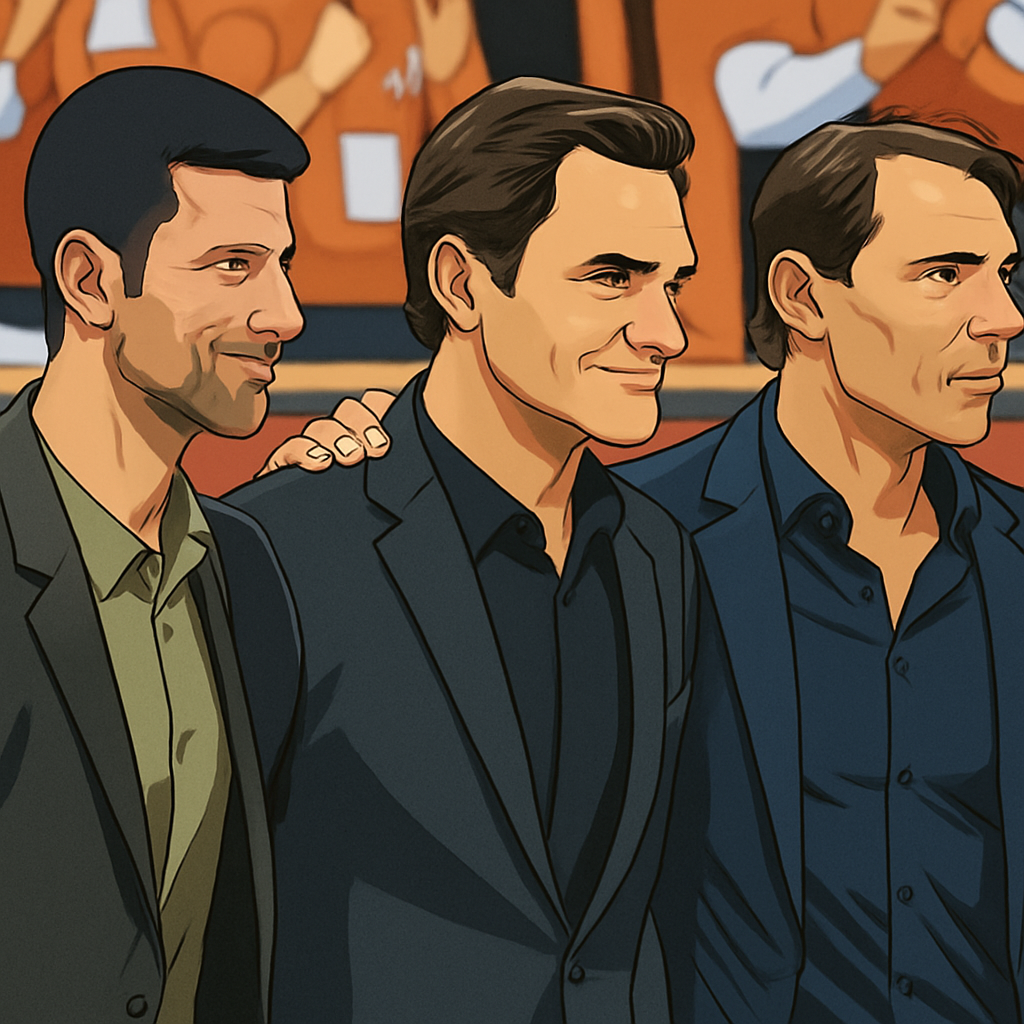
In the storied history of men's tennis, few debates have captivated fans and pundits quite like the question of the Greatest of All Time, the "GOAT." For nearly two decades, this debate has been primarily centered on three legendary figures: Rafael Nadal, Roger Federer, and Novak Djokovic. While the statistical crown for the most Grand Slam titles has been decisively claimed by Djokovic, the qualitative discussions about style, rivalry, and pure difficulty of play continue to rage. In a revealing admission, Rafael Nadal himself has now shed light on which of his two colossal rivals he found to be a slightly more manageable challenge on the court.
The Unparalleled Rivalry of the Big Three
The numbers alone are staggering. Together, Nadal, Federer, and Djokovic have accumulated 66 Grand Slam singles titles, dominated the World No. 1 ranking for over 900 weeks collectively, and have faced each other in countless epic finals that have defined the sport. Nadal's clay-court supremacy, particularly at Roland Garros, is unmatched. Federer's artistry and grace on grass and hard courts set a new standard. Djokovic's relentless precision and flexibility have made him a threat on every surface imaginable. Their head-to-head records are a testament to their enduring excellence and competitive balance.
Throughout his career, Nadal has been uniquely positioned as the great disruptor. He emerged as the primary challenger to Federer's early dominance, and later, formed a historic rivalry with Djokovic that has become the most prolific in the Open Era. Having faced both men over 50 times combined in official tour matches, Nadal possesses an intimate understanding of the unique challenges each one presents. His perspective carries an authority that few others can claim.
Nadal's Candid Admission
In various interviews and in his own documentary, Nadal, the Spaniard has opened up about the psychological and physical toll of these rivalries. While he has always spoken of both Federer and Djokovic with the utmost respect, he has drawn a distinct contrast between the two. The core of his revelation is that he found a clearer, more straightforward tactical path when facing Roger Federer. Nadal explained that his heavy-topspin forehand, particularly to the one-handed backhand of Federer, provided a consistent and exploitable pattern. He stated, "Against Roger, I had a clear tactic. My forehand to his backhand was a key for me. It was something I could always go to."
This specific matchup advantage, forged on the clay of Roland Garros but effective across all surfaces, gave Nadal a mental anchor. He knew that if he could execute his fundamental game plan—pounding that cross-court forehand—he could exert constant pressure and force Federer into uncomfortable positions. This is not to say beating Federer was easy; their matches were often brutal contests of will. However, for Nadal, the blueprint for victory was conceptually clearer.
The Djokovic Conundrum
In stark contrast, Nadal described facing Novak Djokovic as a far more complex and mentally draining puzzle. Where Federer's game was built on aggressive, quick-strike tennis, Djokovic's style was a mirror of Nadal's own relentless, physical, and defensive prowess. Nadal admitted that Djokovic's key strengths directly neutralized his own. He highlighted several factors that made Djokovic the more difficult opponent:
- Elastic Defense: Djokovic's unparalleled flexibility and ability to retrieve balls meant that Nadal's typical "winner-making" shots were often put back in play, extending rallies to exhausting lengths.
- The Backhand Wall: Unlike Federer's one-hander, Djokovic possesses one of the greatest two-handed backhands in history. It is a rock-solid, aggressive shot that could not be targeted in the same way. Nadal's topspin forehand sat up perfectly for Djokovic to attack.
- Mental Fortitude: Nadal has often pointed to Djokovic's almost inhuman ability to remain clutch under pressure, particularly in the biggest moments of the biggest tournaments.
Nadal summarized the challenge by saying, "With Novak, you are playing against a player who has everything. He doesn't have a clear weakness. You cannot find a pattern that gives you a real advantage. You have to play to the limit, physically and mentally, for every single point, for four, five, six hours. There is no rest." This absence of a clear, repeatable tactic meant every match against Djokovic was a war of attrition with no guaranteed outcome.
A Statistical Reflection
The head-to-head records, while close, subtly reflect Nadal's sentiment. Against Federer, Nadal held a distinct 24-16 advantage, with a dominant 14-2 record on clay. The matchup was famously lopsided in Nadal's favor for much of their careers. Against Djokovic, however, the Serbian leads their series 30-29. Furthermore, Djokovic holds a winning record against Nadal in both Australian Open and Wimbledon finals, and has beaten him more times at Roland Garros (2) than any other player. The numbers underscore the more balanced and, for Nadal, more precarious nature of the Djokovic rivalry.
A Legacy Defined by Both
It is crucial to understand that Nadal's admission is not a slight against Federer's greatness. Instead, it is a nuanced analysis of matchups and styles. Federer's game was built on risk and reward, creating spectacular winners but also allowing for periods of unforced errors. Djokovic's game is built on minimizing risk, eliminating errors, and forcing his opponent to hit closer and closer to the lines to win a point. For a baseliner like Nadal, facing another ultimate baseliner in Djokovic created a perfect storm of difficulty. As one analyst put it, "Facing Federer was like solving a beautiful, complex equation. Facing Djokovic was like running into a brick wall, over and over again."
This dynamic elevated their matches to a different plane. Their 2012 Australian Open final, a near-six-hour marathon won by Djokovic, is often cited as the greatest Grand Slam final ever played. Their 2021 French Open semifinal, another four-set epic won by Djokovic, was a brutal display of physical tennis. These contests were not just about points and trophies; they were tests of human endurance, and Nadal found himself pushed to his absolute limit each time.
Conclusion: A Testament to Three Legends
Rafael Nadal's candid reflection on who was the "easier" opponent provides a fascinating glimpse into the mind of a champion. It underscores that greatness in tennis is not a monolithic concept. It is defined by contrasting styles, personal matchups, and the relentless pursuit of a solution to an unsolvable problem. For Nadal, the problem of Roger Federer had a known, though difficult, solution. The problem of Novak Djokovic, however, was a constantly evolving challenge that demanded everything he had, every single time. In the end, his admission only deepens the respect for all three icons. It highlights that within this historic triumvirate, the slight edges and subtle disadvantages are what forged the greatest rivalries the sport has ever seen, pushing each man to heights they could never have reached alone.