
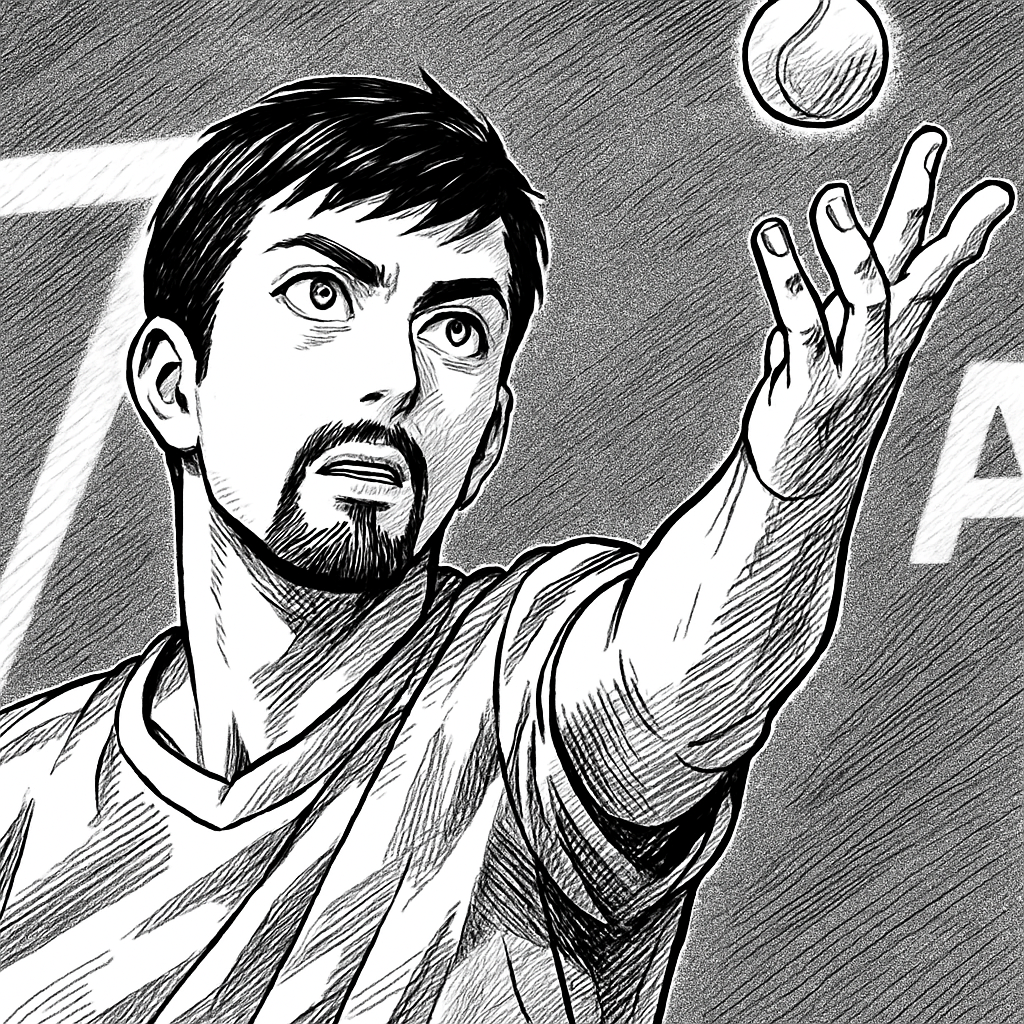
MELBOURNE — In the high-stakes, pressure-cooker environment of Grand Slam qualifying, where dreams of the main draw are forged or shattered, Austrian tennis player Sebastian Ofner experienced a moment of pure, unadulterated agony. His journey at the 2024 Australian Open qualifiers ended not with a heroic last stand, but with a catastrophic mental lapse that will be replayed in blooper reels and serve as a cautionary tale for generations. Ofner, forgetting a fundamental rule, celebrated victory a single point too early, only to watch his chances evaporate in a stunning collapse, losing eight of the next nine points.
The 27-year-old world No. 118 was locked in a tense battle against Czech youngster Josef Švanda, ranked outside the top 300. After splitting the first two sets, the match reached a dramatic climax in the final set tie-break. Ofner fought his way to a 6-3 lead, earning himself three consecutive match points. The stage was set for a routine conclusion. On his first match point, Ofner unleashed a powerful serve that Švanda could only return into the net. Believing he had won, Ofner roared in triumph, raising his arms to the sky and turning to his player box to celebrate a hard-fought victory.
There was just one, devastating problem. In a standard tie-break, you must win by two points. The score was 7-3, not 7-4 or 7-5. The point he had just won only gave him a 7-3 lead; he needed one more. The chair umpire, the linespeople, and his opponent all knew the rule. Ofner, in the heat of the moment, had forgotten. The celebration was premature, and the reality came crashing down moments later. The umpire was forced to interrupt the jubilant scene, informing a confused Ofner that the match was not over.
The psychological whiplash was immediate and total. The emotional release of victory was violently yanked back, replaced by crushing embarrassment and disorientation. Visibly shaken, Ofner had to recompose himself and try to win the point he thought he already had. The momentum had not just shifted; it had performed a full somersault and landed squarely in Švanda's court. The Czech player, handed an incredible lifeline, seized the opportunity with both hands.
What followed was a collapse of epic proportions. The sequence of play after the premature celebration tells the story of a player whose game completely unraveled:
- Point 1 (7-3): Ofner double-faults. 7-4.
- Point 2 (7-4): Švanda wins a quick rally. 7-5.
- Point 3 (7-5): Ofner nets a forehand. 7-6.
- Point 4 (7-6): Švanda hits a clean winner. 7-7.
- Point 5 (7-7): Ofner makes another unforced error. 8-7 for Švanda.
Suddenly, Švanda had a match point of his own. Ofner managed to save that one, scraping together a point to level at 8-8. But the damage was irreparable. The Czech player won the next two points emphatically, sealing an improbable 6-7(5), 6-4, 7-6(8) victory. From 6-3 up with three match points in the tie-break, Ofner had lost eight of the final nine points played.
The Anatomy of a Mental Meltdown
Tennis is as much a mental battle as it is a physical one, and Ofner's blunder is a textbook example of how a single mental error can cascade into a total system failure. Sports psychologists often speak of "momentum" and "focus windows." Ofner's premature celebration shattered his own focus window—the intense, point-by-point concentration required at elite levels. By celebrating, he triggered a neurological shift from competition mode to completion mode. Re-engaging the former is notoriously difficult, akin to trying to re-accelerate a car that has already been put into park.
Furthermore, the public nature of the error compounded the stress. The embarrassment of being corrected by the umpire in front of a crowd, with cameras rolling, likely flooded his system with cortisol, the stress hormone, impairing fine motor skills and decision-making. This physiological response directly contributed to the immediate double fault and the series of rushed, uncharacteristic errors that followed. As one analyst put it, "He didn't just lose the next point; he lost the ability to play the next point."
Historical Context and Rare Precedents
While heartbreaking, Ofner's ordeal is not entirely without precedent in the annals of tennis history. The most famous parallel is arguably from the 2003 French Open, where Greg Rusedski, serving for the match against Arnaud Clément, celebrated a winning volley on match point, only to be told the ball had been called out. He lost the point and eventually the match. More recently, in 2020, Borna Ćorić celebrated a win over Cristian Garín at the US Open after a missed final shot, but Hawk-Eye review showed the ball was in by a millimeter, and Garín went on to win.
However, Ofner's case is uniquely brutal because the error was not based on a line call or technology, but on a fundamental misunderstanding of the score in the most crucial moment. It highlights a rare but critical gap in match management. Tennis rules expert Mike Morrissey noted, "Players are responsible for knowing the score. The umpire will announce it, but in the din of a tie-break, with adrenaline pumping, it's the ultimate test of mental clarity. This is a brutal lesson in that."
Reaction and the Road Ahead
The tennis world reacted with a mix of sympathy and astonishment. Social media was flooded with clips of the incident, with fans using facepalm and crying emojis to describe the gut-wrenching turn of events. Ofner, to his credit, faced the media afterwards and shouldered the blame. While clearly devastated, he offered no excuses. "It's my mistake, completely," he stated bluntly. "I lost my focus for a second, celebrated, and then couldn't find my game again. It's a tough one to take, but it's on me."
For Josef Švanda, it was the biggest win of his young career, propelling him into the final round of qualifying (where he would ultimately fall short). In his post-match interview, he expressed sympathy for his opponent's plight but acknowledged the mental fortitude it took to capitalize. "I saw him celebrate and I knew the score. I just thought, 'Okay, now I have nothing to lose. Just play.' It's strange, but you have to stay ready."
Conclusion: A Lesson Etched in Pain
Sebastian Ofner's Australian Open despair is a stark reminder of the razor-thin margins in professional sport. It underscores that talent and physical preparation can be undone in an instant by a lapse in concentration or a break in protocol. The incident will be remembered not as a mark against Ofner's ability—he is a proven tour-level competitor—but as an almost Shakespearian tragedy of a single, fateful error.
For aspiring players and veterans alike, it reinforces the oldest clichés in the book: play until the final point is called, and never, ever assume. The image of Ofner's triumphant roar morphing into confused horror, and then defeat, will serve as a powerful visual lesson in the importance of mental discipline. In the end, his premature celebration didn't just cost him a point; it cost him a match, a potential main-draw berth at a Grand Slam, and a piece of tennis infamy he never sought.