
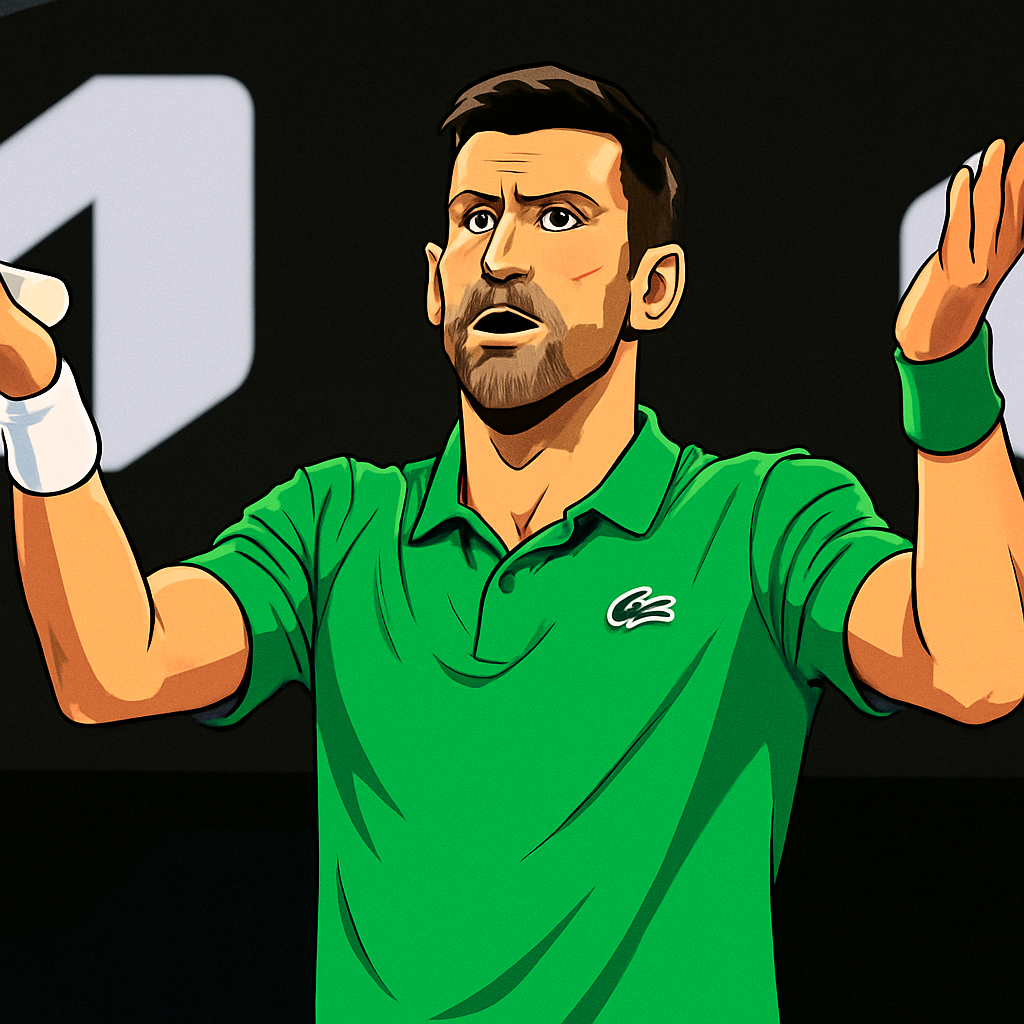
MELBOURNE — The Australian Open is renowned for its brutal heat and grueling five-set epics, but for Novak Djokovic’s next opponent, the challenge is already immense before a single ball is struck in anger. The Serbian champion’s fourth-round clash on Sunday will be against Frenchman Adrian Mannarino, a player whose camp has been rocked on the eve of the biggest match of his tournament.
Mannarino, the 20th seed, has confirmed he will face the 10-time champion without his regular coach, Sebastien Grosjean, and his physiotherapist by his side. Both key members of his team have been forced to depart Melbourne due to personal emergencies, leaving the 35-year-old veteran to navigate the Djokovic challenge with a significantly depleted support system.
A Camp in Disarray on the Grandest Stage
The news broke after Mannarino’s impressive third-round victory over American Ben Shelton. In his post-match press conference, the typically understated Frenchman revealed the difficult situation. “My coach had to go back to France for personal reasons. My physio also had to leave for a family emergency,” Mannarino stated, his tone matter-of-fact but underscoring the significant disruption. “So I'm here with my sparring partner. That's it. We are going to try to figure out something for the next match.”
The absence of Grosjean, a former world No. 4 and Australian Open semifinalist, is a particularly heavy blow. Grosjean’s tactical acumen and experience in deep Grand Slam runs are invaluable assets, especially when formulating a plan to tackle a puzzle as complex as Djokovic. A coach’s role in these high-pressure moments extends beyond strategy; they provide crucial emotional steadiness and in-match guidance during changeovers, a lifeline Mannarino will now be without.
Mannarino’s Unorthodox Path and Mental Fortitude
Ironically, Mannarino’s unique career trajectory may have inadvertently prepared him for this moment of solitude. Known for his flat, compact strokes and exceptional timing, he has always marched to the beat of his own drum. He is famously low-profile, avoids the traditional tennis training hubs, and has cultivated a reputation for remarkable mental resilience. This will be tested like never before in Rod Laver Arena.
His journey to this fourth round itself was a testament to his grit. In the second round, he fought back from two sets down to defeat Spain’s Jaume Munar. Then, against the powerful Shelton, he displayed tactical brilliance, using his slice backhand and impeccable depth to neutralize the American’s explosive game. This mental toughness will be his primary weapon against Djokovic.
Mannarino was pragmatic about the monumental task ahead, acknowledging the Djokovic aura while refusing to be daunted. “It's going to be a tough match, for sure,” he said. “He's one of the best players ever. I have nothing to lose. I will just go on court, try to do my best, and we'll see how it goes.”
The Djokovic Juggernaut Rolls On
For Djokovic, the scenario presents a different dynamic. The world No. 1 has been progressively building form through the tournament, overcoming a wrist concern and a tough battle against qualifier Dino Prizmic in the first round. His third-round performance against Tomas Martin Etcheverry was a commanding display, a clear signal that the champion is shifting through the gears. He will be well-aware of Mannarino’s team upheaval, but his focus will remain ruthlessly internal.
Djokovic has historically capitalized on such moments of opponent vulnerability. His preparation is legendary, and his team, including coach Goran Ivanisevic and physio Ulises Badio, is a well-oiled machine. The contrast in the two locker rooms before the match could not be more stark. When asked about Mannarino, Djokovic offered respect but no quarter: “He's a very unorthodox player. He's got a very flat backhand, uses the slice very well. I have to be ready.”
Key Absences for Mannarino's Camp:
Sébastien Grosjean (Coach): The former top-5 player provides critical tactical planning and in-match emotional management. His experience in Grand Slam latter stages is irreplaceable.
Personal Physiotherapist: Essential for recovery between matches, especially after Mannarino’s consecutive long battles. Managing physical fatigue against Djokovic’s relentless style is a monumental task without dedicated physio support.
Result: Mannarino is left with only a sparring partner for on-court practice and moral support, a stark reduction in resources for a match of this magnitude.
A Battle of Mind and Resources
This fourth-round encounter has thus transformed into more than a tennis match. It is a study in contrast: Djokovic’s quest for an unprecedented 25th Grand Slam title, supported by his full arsenal of experts, versus Mannarino’s solitary quest for the biggest upset of his career, borne from self-reliance and a unique mental fortitude. The Frenchman’s game, with its low errors and ability to disrupt rhythm, can be troublesome on a fast court.
However, defeating Djokovic at the Australian Open is a holistic challenge requiring peak physical, tactical, and psychological performance. The loss of his coach and physio strips away two pillars of that structure. Mannarino must now rely entirely on his own problem-solving during the match and his body’s innate ability to recover, a daunting proposition against the sport’s ultimate endurance test.
Tennis history is littered with stories of players overcoming personal adversity to produce heroic performances. Mannarino, in his understated way, now has that opportunity. Whether this disruption becomes a crippling disadvantage or a liberating catalyst for a fearless performance remains to be seen. One thing is certain: as he walks onto Rod Laver Arena, Adrian Mannarino will be one of the most isolated figures in the sporting world, facing its most dominant force, armed with little more than his racket and a formidable will.
The Australian Open often writes its most compelling narratives from such adversity. While the odds have lengthened immeasurably for the Frenchman, the stage is set for a match that will test the very limits of individual resolve against the cold, efficient machinery of a champion’s reign. The tennis world will watch to see if Mannarino’s unorthodox path has led him to this moment of solitary, and perhaps spectacular, defiance.