
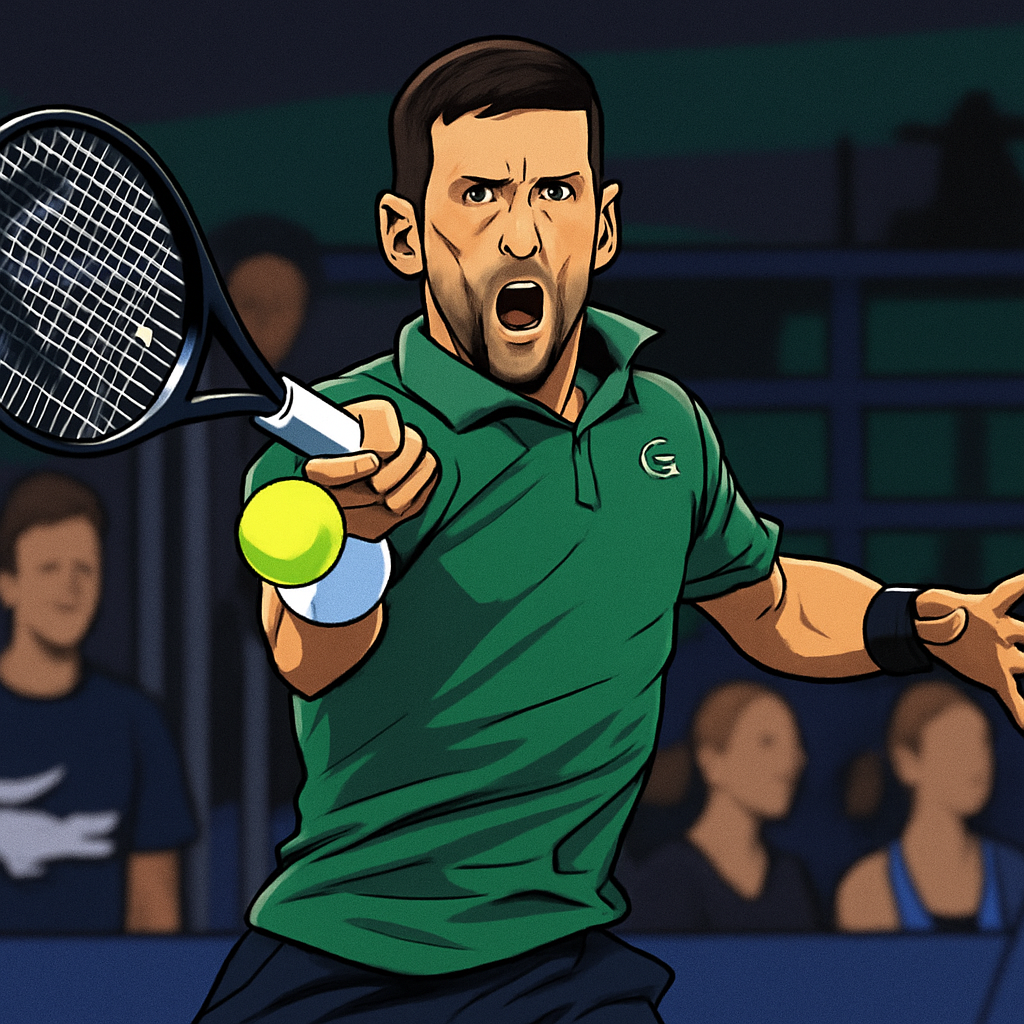
TENNIS — The tennis world is no stranger to fiery rivalries and blunt commentary, but a recent exchange of words between two legends of the sport has captured headlines for its brutal honesty. Novak Djokovic, the 24-time Grand Slam champion, found his public comments swiftly and publicly shot down by former World No. 1 and US Open champion, Andy Roddick.
The controversy stems from Djokovic's appearance on the 'Courageous Leadership' podcast, where he discussed the current state of men's tennis. The Serbian superstar suggested that a significant factor in the so-called "Big Three" era's dominance was a perceived lack of ambition and belief from the chasing pack, a comment that did not sit well with one of its most prominent members.
Djokovic's Controversial Claim
During the podcast, Djokovic reflected on his rivalries with Roger Federer and Rafael Nadal, positing that their sustained success was partly due to the mentality of other players on tour. He stated, "I don’t want to sound arrogant, but I think most of the players… didn’t really believe that they could win." He elaborated that facing Federer, Nadal, or himself was a "mental hurdle" that many of their contemporaries could not overcome, suggesting a psychological gap was as decisive as any technical or physical one.
This perspective, while offering an insight into the champion's mindset, was interpreted by many as a dismissal of the talents and competitive fire of an entire generation of players. These were athletes who, while often falling short in Grand Slam finals, pushed the "Big Three" to their absolute limits and crafted highly successful careers in the most competitive era the sport has ever known.
Roddick's Instant Rebuttal
The response was not long in coming. Andy Roddick, a man who reached four Grand Slam finals—losing three to Federer and one to Djokovic himself—took to his 'Served with Andy Roddick' podcast to deliver a point-by-point rebuttal. He didn't mince words, calling Djokovic's comments "a cop-out" and "lazy."
Roddick’s core argument was simple and direct: the "Big Three" were just historically, undeniably better. He shot back, "It’s not that they didn’t believe it. It’s that you were better... It’s not a belief thing." He framed the issue not as a failure of mentality from the challengers, but as a testament to the unprecedented skill, physicality, and consistency of the trio.
To illustrate his point, Roddick didn't rely on abstract concepts but on cold, hard statistics. He highlighted the sheer dominance of the three legends, pointing out that their collective success created a statistical anomaly that made it nearly impossible for anyone else to break through. His argument was grounded in the reality of their achievements, which include:
- A combined 66 Grand Slam singles titles between them.
- Holding the World No. 1 ranking for the vast majority of two decades.
- Winning numerous titles on all surfaces, showcasing complete and versatile dominance.
Roddick emphasized that players like himself, David Ferrer, Tomas Berdych, and Jo-Wilfried Tsonga were not lacking in self-belief. Instead, they were competing against what he termed "the three best players of all time," who were all active simultaneously. He argued that reducing their losses to a simple lack of belief was a disservice to their own careers and the extraordinary level of their opponents.
A Deeper Look at the Rivalry
The history between Roddick and Djokovic adds a layer of personal context to this exchange. While Roddick's most famous rivalry was with Federer, his head-to-head record with Djokovic was a competitive 5-4 in the Serbian's favor. Their matches were often physical and mentally taxing battles.
One of their most memorable encounters was the quarterfinal of the 2008 US Open, which Roddick won in four sets. Following that match, Roddick famously critiqued Djokovic's numerous mid-match medical timeouts, a comment that sparked a brief but public feud. This latest exchange shows that while the on-court battles are over, the competitive spirit and willingness to engage in verbal sparring remain fully intact.
The Broader Reaction
Roddick was not alone in his criticism. The tennis community on social media and in analysis circles largely echoed his sentiment. Many fans and pundits sided with the American, agreeing that Djokovic's comments, while perhaps not intended to be malicious, overlooked the objective reality of the situation.
The consensus was that it is far easier to attribute losses to a competitor's superior skill than to a personal failure of nerve. By framing the debate around the sheer greatness of Federer, Nadal, and Djokovic, Roddick's rebuttal was seen as both a defense of his peers and a more accurate historical assessment.
The Psychology of a Champion
Djokovic's perspective, however, offers a fascinating window into the psychology that fuels an all-time great. His entire career has been built on an unshakable belief in his own abilities, often in the face of a crowd supporting his opponent. For him, the mental battlefield is paramount.
His comments likely stem from his own lived experience of overcoming the "invincible" auras of Federer and Nadal. From his viewpoint, the key to toppling giants is first believing it is possible—a mindset he had to cultivate himself. Where Roddick sees a statement that diminishes others' achievements, Djokovic may see a fundamental truth about the prerequisites for success at the very highest level.
This clash of perspectives highlights the eternal debate in sports: how much of elite performance is mental versus physical and technical? Djokovic, the ultimate mental warrior, leans heavily into the former. Roddick, representing the practical challenges faced by the opposition, argues for the latter.
Conclusion: A Truth Delivered
In the court of public opinion, Andy Roddick's instant and brutal rebuttal appears to have won the day. By reframing the narrative from a failure of belief among the challengers to a celebration of the historic greatness of the "Big Three," he provided a compelling and statistically-backed counter-argument.
His comments serve as a powerful reminder that while self-belief is a crucial component for any champion, it is not a magic bullet against once-in-a-generation talent. The era of Federer, Nadal, and Djokovic was defined not by the weakness of their competition, but by their own superhuman strength, consistency, and skill. As Roddick so succinctly put it, the other players didn't lose because they didn't believe; they lost because, quite simply, they were playing against the best.