
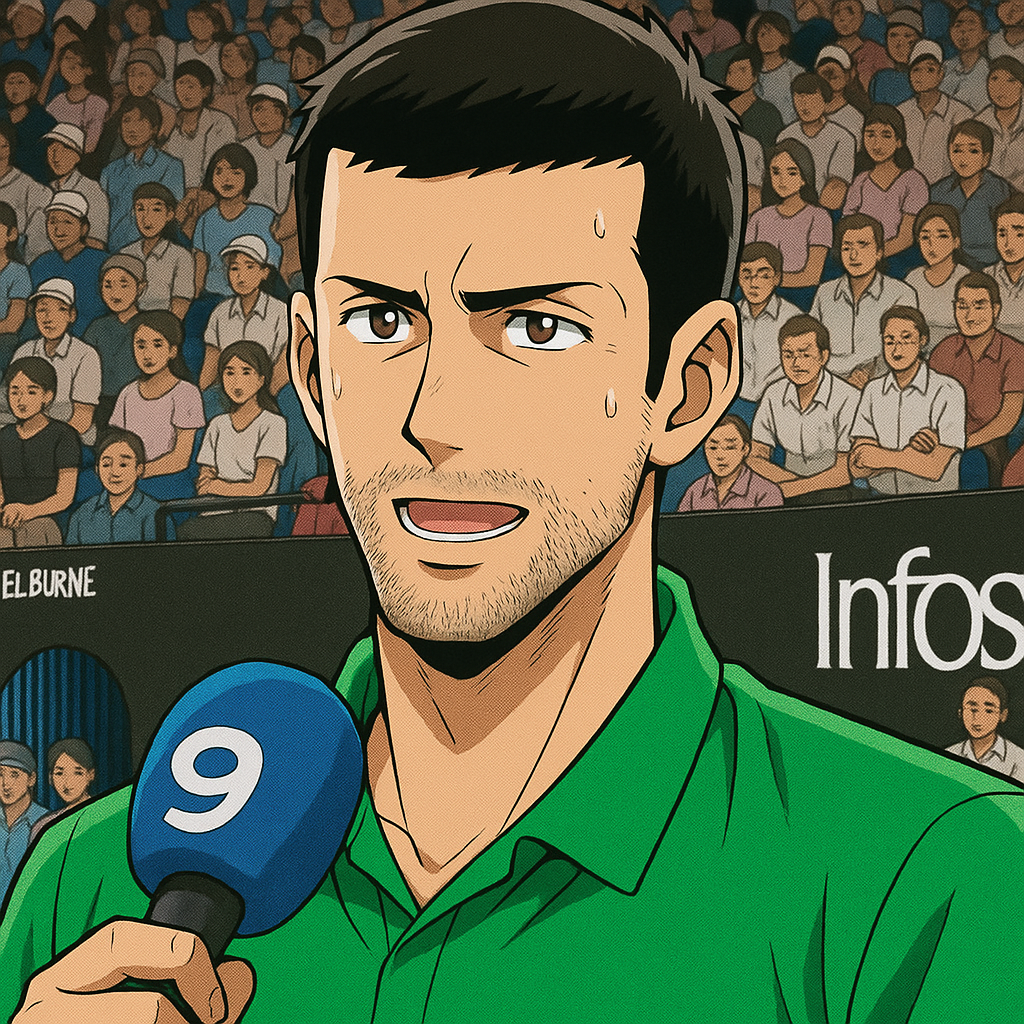
MELBOURNE — In a moment of raw, unfiltered emotion that captivated the Australian Open crowd, Novak Djokovic found himself in a heated exchange with his support box during a tense fourth-round match. The 24-time Grand Slam champion, visibly frustrated, shouted and gestured before turning to the audience, placing a hand over his heart, and offering a sincere apology. The incident, followed by a commanding victory, became a powerful vignette of a champion still evolving, applying hard-earned wisdom to his own competitive fire.
Facing the 20-year-old Frenchman Adrian Mannarino on Rod Laver Arena, Djokovic was expected to cruise through. While he won in straight sets 6-0, 6-0, 6-3, the match was not without its turbulence. The third set saw Mannarino break Djokovic's serve and build a 3-1 lead, disrupting the Serb's rhythm. It was during this stumble that Djokovic's frustration boiled over. He yelled toward his player's box, demanding more energy and support, his voice echoing in the stadium.
A Public Moment of Self-Reflection
After regaining his composure to break back and ultimately close out the match, Djokovic did something that resonated deeply with fans and commentators alike. During his on-court interview, he directly addressed the incident. "I want to apologize to the fans, to the crowd," he stated, his tone contrite. "I was really loud, I was really loud on the court. I want to say that. I know the kids were watching a lot of tennis, a lot of matches, and I was not on my best behavior."
This public apology was more than just damage control; it was a window into Djokovic's current mindset. At 36, he is not only chasing records but also grappling with the legacy he leaves as a competitor. He explained that his outburst was born from a desire for perfection, a trait that has driven his success but also requires careful management. "I wanted to be perfect. It's a wish, it's a desire, but it's not possible," he admitted.
Wisdom for His Younger Self
The most poignant part of his reflection came when he was asked what advice he would give to his younger self. Djokovic paused, then offered a simple, profound mantra: "Calm down. Relax. Everything is fine. Everything is going in the right direction. Just trust the process." This advice, directed at the fiery young champion who once smashed rackets and struggled with his public image, highlighted a significant personal journey.
Djokovic elaborated, acknowledging that his younger self would likely have ignored such counsel. "I know that the young me would probably not listen to that because the young me was very feisty and wanted to go, go, go, and that's what got me to where I am today," he said. This duality—recognizing that his intensity forged his greatness while now seeking to temper it with perspective—is the central conflict of his later career.
The Evolution of a Champion's Demeanor
Djokovic's relationship with crowds, particularly at Melbourne Park, has been complex. He has faced hostility, most notably during the 2022 deportation saga, but has also been embraced as a beloved ten-time champion. His conscious effort to connect and apologize signifies a maturation. He is acutely aware of his role model status, especially for children watching. This incident and his handling of it demonstrate a shift from a player sometimes perceived as defiant to one actively engaging in public accountability. His approach now includes:
- Immediate Acknowledgment: Addressing the behavior directly in the post-match interview, not ignoring it.
- Public Accountability: Apologizing to the specific audience present, showing respect for their experience.
- Contextual Explanation: Offering insight into the high-pressure mindset that led to the outburst, without using it as an excuse.
- Broader Perspective: Connecting his actions to their impact on young fans, considering his legacy beyond winning.
This evolution is not about diminishing his competitive fire, but about channeling it more constructively. As he stated, "I have high expectations for myself, and I was not playing at the level I wanted to. I felt it was necessary to vocalize my frustration, but I also know there is a better way to handle it." This self-awareness is a tool as crucial to his longevity as his famed flexibility and return of serve.
Channeling Intensity into Victory
The match itself proved that the momentary lapse in demeanor did not equate to a lapse in focus. After his outburst and subsequent apology to the crowd, Djokovic reeled off five consecutive games to seal the victory, demonstrating his unparalleled ability to harness emotion and redirect it into his performance. This "switch-flipping" capability has long been a hallmark of his greatness. The sequence of events perfectly illustrated the Djokovic paradox:
- The Trigger: A dip in performance and loss of control against an opponent finding his range.
- The Release: A vocal, frustrated outburst directed at his team.
- The Correction: A conscious, public apology and moment of self-reflection.
- The Execution: An immediate and decisive return to dominant, focused tennis to close the match.
Tennis psychologist Dr. Ann Quinn, commenting on the incident, noted its significance: "What we saw was a masterclass in emotional regulation, albeit a messy one. The old Novak might have let that frustration fester and spiral. The current Novak acknowledged it, addressed it publicly to release the tension, and then used the cleared mental space to execute. It's a more mature, if not perfectly polished, strategy."
A Lesson in Legacy and Longevity
As Djokovic progresses deeper into tournaments and the history books, these moments become part of his enduring narrative. The apology in Melbourne was not a sign of weakness, but a powerful display of strength—the strength to be vulnerable, to admit imperfection, and to prioritize his connection with the sport's future fans. It underscores that his quest is no longer solely about titles, but about the manner in which he wins them and the example he sets.
In the end, the image of Novak Djokovic telling his younger self to "calm down" is a fitting symbol for this chapter of his career. It is the wisdom of experience speaking to the passion of youth, a dialogue happening in real-time on the world's biggest tennis stages. His journey now is as much about internal mastery as it is about external dominance, proving that even for the most decorated player of all time, the greatest battles—and the most profound growth—often happen between the ears.