
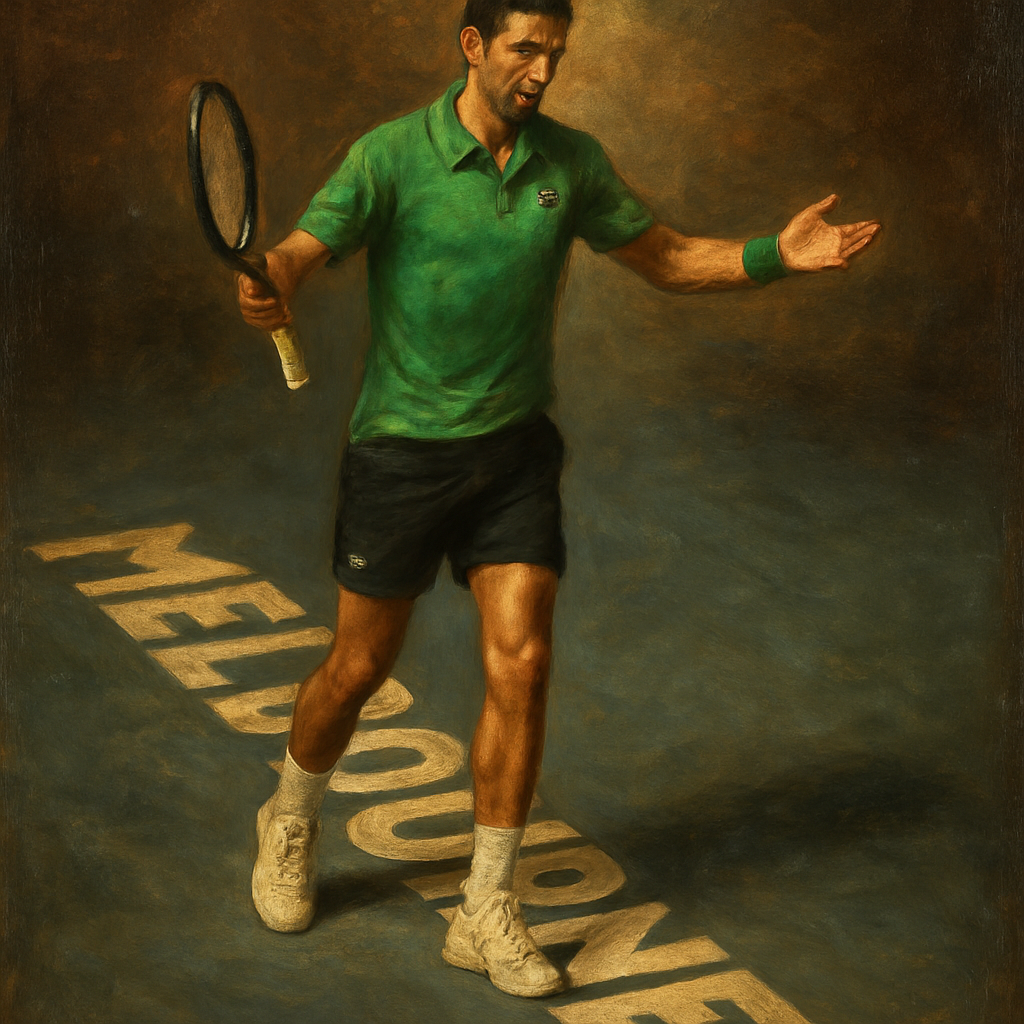
MELBOURNE — The 2024 Australian Open concluded with Novak Djokovic lifting a historic tenth title, but the echoes of a pre-tournament controversy involving the Serbian champion have refused to fade. A fresh storm has erupted following the publication of an interview where Djokovic made pointed comments about the atmosphere and crowd support at Melbourne Park, sparking a fierce backlash from Australian tennis legends, fans, and media, and threatening to overshadow his monumental achievement.
The controversy stems from an interview with the BBC, published shortly after Djokovic's semifinal victory, in which he reflected on his complex relationship with the Australian Open crowd. Djokovic stated, "The majority of the crowd just wanted to get a value for their ticket. They were cheering for me or against me, whatever, but it was fine. When you compare it to Wimbledon or Roland Garros or US Open, then the crowd is the most respectful in Roland Garros and Wimbledon."
He elaborated further, drawing a direct comparison that has ignited the firestorm: "Here in Australia, they have more freedom to say and do what they want. Sometimes they step over the line. In the heat of the moment, you react too, and you show that you don't allow this kind of behaviour." These remarks, interpreted by many as a critique of Australian crowds being less respectful and more unruly than their European counterparts, were seen as ungrateful by a nation that had readmitted him after the 2022 deportation saga.
A Firestorm of Reaction
The reaction from Australian tennis icons was swift and severe. Former world No. 1 and seven-time Grand Slam champion John McEnroe, commentating for ESPN, labeled the comments a "cheap shot" at the Australian public. However, it was the criticism from homegrown heroes that carried the most weight.
Todd Woodbridge, a 16-time Grand Slam doubles champion and a staple of Australian tennis broadcasting, expressed his disappointment on Channel Nine. "It surprises me that he's said it, and it disappoints me," Woodbridge stated. "This is a place that's given him so much success... To be critical of what I think is the best sporting public in the world feels like a misstep."
The sentiment was echoed by former Australian player and analyst Sam Groth, who wrote in a column for the Herald Sun: "After everything Australia has given Novak Djokovic, he has returned serve with a whinging volley straight at the crowd."
The backlash extended beyond the commentary box. Social media platforms were flooded with responses from Australian fans, many highlighting the irony of the criticism given the tournament's history of embracing Djokovic. Key points of the public rebuttal included:
- The record-breaking crowds that have watched his matches for over a decade.
- The standing ovations he received upon his return in 2023 after the deportation.
Djokovic's History with Crowds
This is not the first time Djokovic's relationship with the Melbourne crowd has been under the microscope. His career at the Australian Open has been a paradox of unparalleled success punctuated by moments of palpable tension. Analysts point to several flashpoints that have contributed to this dynamic:
- The Dominance Factor: His sheer dominance, often at the expense of local hopes like Nick Kyrgios or beloved figures like Roger Federer, has naturally created a "villain" narrative for some sections of the crowd.
- The 2022 Deportation: The politically charged event created a deep rift. While many Australians supported the government's decision on public health grounds, the tennis community was divided, leaving a complex legacy.
- On-Court Demeanor: Djokovic's occasional displays of frustration, such as yelling at his support box or smashing racquets, have sometimes been met with boos or criticism.
In the same BBC interview, Djokovic acknowledged this history, saying, "I got along very well with the Australian crowd for most of my career. But the last few years, it's been a rollercoaster ride." He suggested that the events of 2022 had a lasting impact on public perception, a wound that he feels has not fully healed despite his victorious return in 2023.
The Champion's Clarification
Facing the escalating controversy, Djokovic addressed the issue in his post-final press conference after defeating Jannik Sinner. He sought to clarify his comments, insisting they were taken out of context and that his love for the tournament remains undimmed. "My statement was paraphrased and taken out of context," he asserted.
He then offered a more conciliatory tone, praising the Australian fans: "I have a great relationship with the Australian crowd. I have played here in this tournament more than any other in my career. I owe the gratitude to a lot of people for making me feel welcome, for making me feel at home... There are times when you have frustration on the court, that's all it is."
This attempted clarification, however, did little to quell the discussion. Critics argued that his original comments to the BBC were detailed and specific, leaving little room for misinterpretation. Supporters, meanwhile, contended that Djokovic was simply expressing a heartfelt, if blunt, assessment of his lived experience and that the intense reaction proved his point about the uniquely passionate—and sometimes harsh—nature of Australian sporting crowds.
A Lasting Legacy or a Temporary Storm?
The fallout raises significant questions about the lasting impact on Djokovic's legacy in Australia. Tennis Australia has remained diplomatically silent on the specific comments, instead focusing on congratulating him on his historic tenth title. Privately, however, there is understood to be disappointment that the narrative shifted from celebrating a decade of dominance to re-litigating crowd dynamics.
The incident underscores the delicate balance global sports stars must strike in the era of constant media scrutiny. A candid moment in an interview, intended to provide nuanced insight, can be distilled into a headline that sparks international controversy. For Djokovic, a player who has often worn his emotions on his sleeve and spoken his mind, this is a familiar pattern.
As the dust settles, the consensus among observers is that while the storm may temporarily damage his popularity with certain fans, it is unlikely to affect his competitive fervor at Melbourne Park. If anything, history suggests Djokovic has often used perceived slights or adversarial crowd energy as fuel. The ultimate irony may be that the very "freedom" and passion of the Australian crowd he commented on is what has helped forge him into the resilient, record-breaking champion he is today. The 2025 Australian Open, should he return, will now be watched with an added layer of intrigue: how will the champion and the crowd respond to each other in the wake of this latest, self-inflicted controversy?