
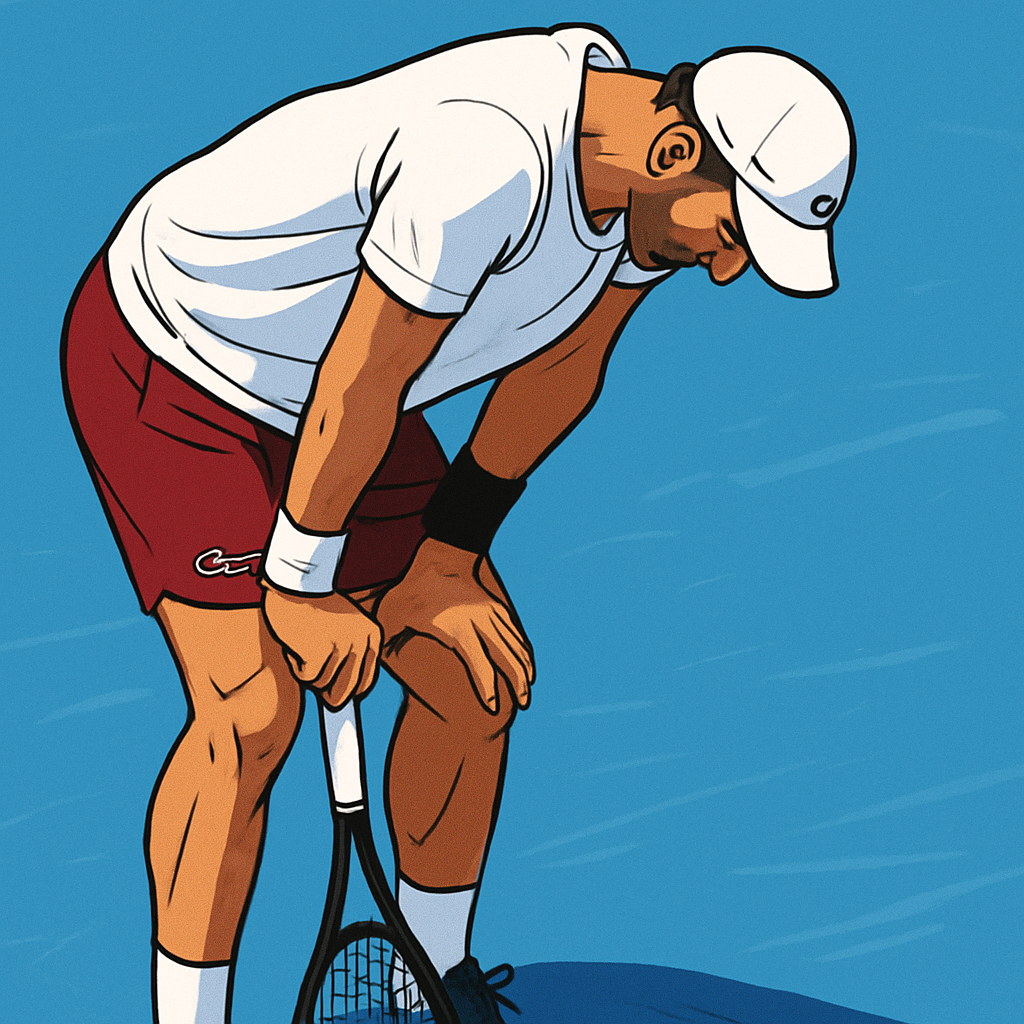
NEW YORK — The air of invincibility that has long surrounded Novak Djokovic was pierced by a moment of startling vulnerability on Tuesday at the US Open. The 24-time Grand Slam champion, who has made a career of defying physical limits, was forced to abandon a scheduled practice session with Czech star Jiri Lehecka after a mere 12 minutes, sending shockwaves through Flushing Meadows and raising monumental questions about his fitness to defend his title.
Djokovic, who underwent surgery for a torn meniscus in his right knee just two months ago, arrived on Court 17 for what was expected to be a rigorous hitting session. Dressed in a grey t-shirt and black shorts, he began rallying with the 23-year-old Lehecka. Observers noted his movement appeared cautious from the outset. After a short period of baseline exchanges, Djokovic called a halt. He was seen speaking with his coaching team, including Goran Ivanisevic, before shaking hands with a bemused Lehecka and departing the court, leaving a crowd of stunned onlookers and a practice court eerily silent.
A Concerning Sequence of Events
This abrupt cancellation is not an isolated incident but the latest in a series of alarming signs. Djokovic’s preparation for the final Grand Slam of the year has been uncharacteristically sparse and troubled. He withdrew from the Canadian Open and suffered a surprise defeat to Ben Shelton in Cincinnati, a match where his movement, particularly his sliding on hard courts, was visibly compromised. The decision to play a mixed doubles exhibition with Maria Sharapova in Los Angeles last week now appears, in hindsight, a significant risk. "He just didn't look right from the first ball," one eyewitness at the practice session reported.
The core of the concern lies in the nature of his injury. A meniscus repair, while common, requires extensive rehabilitation to restore the explosive lateral movement and load-bearing capacity essential for elite tennis. The timeline from June surgery to late-August Grand Slam competition is exceptionally aggressive. Tennis physiotherapist, quoted anonymously due to client confidentiality, explained, "The knee might be structurally sound, but the proprioception, the muscle memory for those micro-adjustments at full stretch, takes time. Pushing too hard, too soon, risks a compensatory injury elsewhere."
The Stakes Could Not Be Higher
For Djokovic, the 2024 US Open represents a historic opportunity. A victory would not only secure a record-extending 25th major singles title but would also complete a three-peat in New York, a feat last achieved by Roger Federer from 2006-2008. Furthermore, it would reassert his dominance after a season disrupted by injury and the rise of young rivals like Carlos Alcaraz and Jannik Sinner. The pressure to compete, even at less than 100%, is immense.
His projected path through the draw is daunting. Potential early-round opponents include powerful, big-hitting players capable of extending rallies and testing his movement to the maximum. The key worries for his team and fans are multifaceted:
- Lateral Movement: Can he defend the wide forehand and backhand without hesitation or pain?
- Load Management: How will the knee hold up over best-of-five sets, potentially in humid conditions?
- Mental Toll: Will the fear of re-injury inhibit his legendary mental fortitude?
The History of Knee Issues
This is not Djokovic’s first dance with knee problems. He has previously managed chronic issues in his left elbow and, more recently, has worn strapping on his right knee during several tournaments prior to the tear. His game, built on inhuman flexibility and an ability to slide on all surfaces, places extraordinary demands on his joints. The current situation suggests the cumulative toll of a 20-year professional career may be presenting its most significant physical challenge yet. "The body keeps the score," as one veteran coach remarked, referencing the inevitable accumulation of wear and tear.
Official Statements and Speculation
Djokovic’s team has been characteristically tight-lipped, offering no official medical update following the truncated practice. Tournament officials simply listed it as a "schedule change." This vacuum of information has fueled intense speculation. Some within the player lounge suggest it may have been a precautionary measure—a "load management" decision rather than a reaction to a specific new pain. Others fear it was a direct response to a sharp pain or instability in the knee.
The contrast with his rivals is stark. Carlos Alcaraz, the 2023 Wimbledon champion, has been practicing with visible joy and explosive energy. Jannik Sinner, the Australian Open champion, looks physically imposing. Daniil Medvedev, the 2021 US Open champion, is grinding through long sessions in the heat. Against this backdrop, Djokovic’s 12-minute session stands out as a glaring red flag. As sports analyst Brad Gilbert noted on ESPN, "You can hide a lot of things in practice, but you can't hide not practicing. This is the most concerning sign I've seen for Novak in a decade."
What Happens Next?
All eyes are now on Djokovic’s next scheduled practice and, ultimately, his first-round match. The tennis world is left weighing several possibilities:
- The Ultimate Gamble: He takes the court, manages the pain with anti-inflammatories and adrenaline, and relies on his superior skill and experience to navigate early rounds, hoping the knee "warms up" into the tournament.
- A Shock Withdrawal: Faced with overwhelming evidence the knee is not competition-ready, he makes the heartbreaking decision to withdraw, prioritizing his long-term health and the 2025 season.
- A Valiant but Limited Campaign: He competes but is visibly diminished, unable to summon his trademark defensive prowess, leading to an early exit to a player he would typically dispatch with ease.
The aura of Novak Djokovic has been built on a foundation of physical and mental resilience that borders on the supernatural. He has won matches with torn abdominal muscles, while vomiting, and in states of extreme dehydration. Yet, a compromised knee on the hard courts of New York is a different kind of adversary. It directly attacks the engine of his game. Tuesday’s 12-minute practice was not just a cancelled session; it was a silent alarm. As the tournament begins, the greatest drama may not be in the result of the matches, but in whether the sport’s ultimate warrior will even be able to answer the bell for the fight. The entire tennis world holds its breath, waiting to see if the king can once again defy the laws of physiology, or if, for the first time, time and injury have presented a challenge even he cannot overcome.