
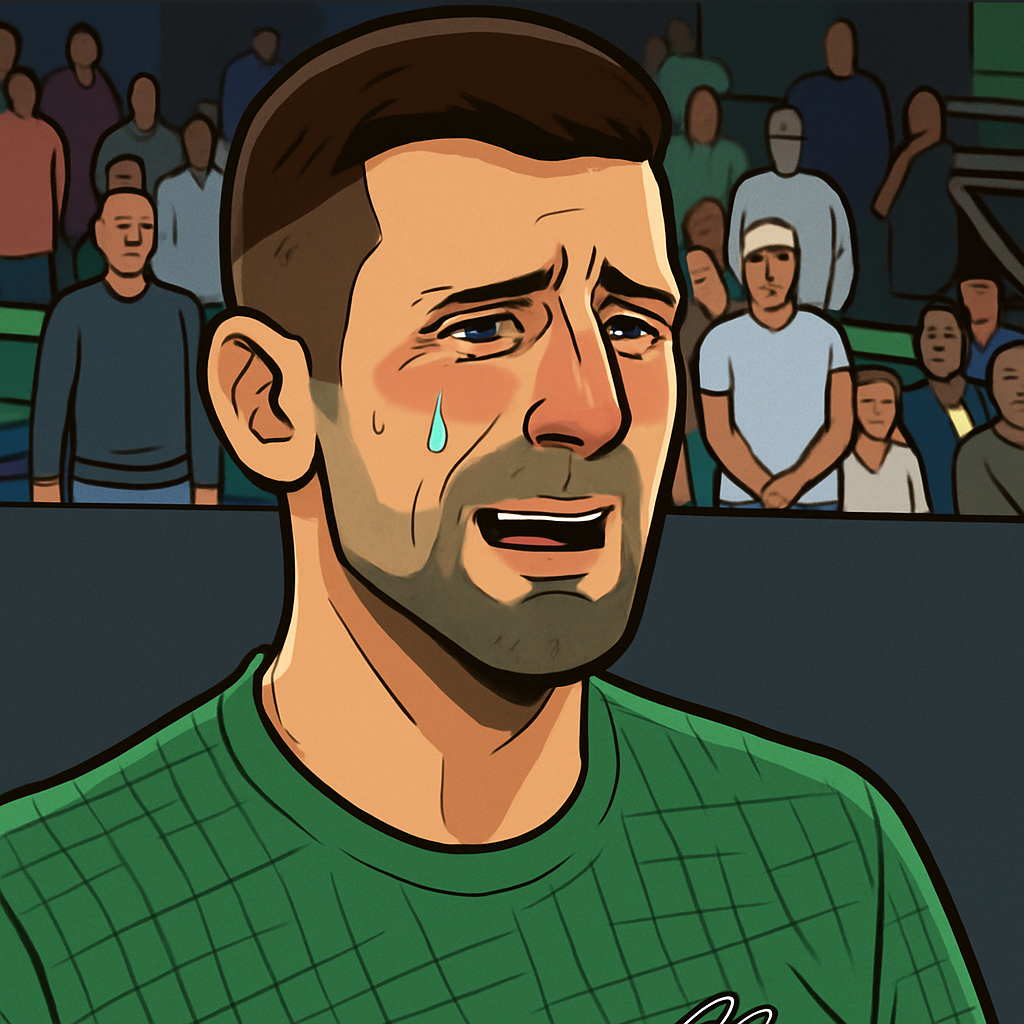
ATHENS, Greece — In a rare and deeply emotional moment that stunned the tennis world, Novak Djokovic, the 24-time Grand Slam champion known for his mental fortitude, broke down in tears on court during a ceremony at the Hellenic Championship in Greece, a scene that laid bare the immense pressure and emotional toll of his recent struggles.
A Champion Overwhelmed
The incident occurred not during a match, but following his straight-sets victory over Alexandros Skorilas at the Lyttos Beach tournament. Djokovic was being honored in a special on-court ceremony for his historic career when he was overcome with emotion. As a local official presented him with a traditional Greek wreath and praised his contributions to the sport, the Serbian star, who had just moments before been composed, visibly began to weep, turning away from the crowd and covering his face with a towel. The raw display of vulnerability from one of the sport's most dominant figures was a poignant reminder of the human behind the champion.
This public breakdown comes at a critical juncture in Djokovic's season. For a player who has built a legacy on an almost superhuman level of focus and resilience, the tears seemed to signal a release of pent-up frustration and disappointment from a challenging 2024. The year has been marked by uncharacteristic early exits from major tournaments and a persistent search for his peak form, creating a perfect storm of pressure that finally found its outlet on a court in Greece.
A Season of Unprecedented Challenges
Djokovic's 2024 campaign has been unlike any other in his recent career. He arrived at the Australian Open as the defending champion and overwhelming favorite but was unseated in the semifinals by Jannik Sinner in a comprehensive defeat. This was followed by a shocking loss to lucky loser Luca Nardi at the Indian Wells Masters, a tournament where he was expected to dominate. The most telling blow, however, came at Roland Garros, where a knee injury forced him to withdraw before his quarterfinal match, ceding the court and surrendering his World No. 1 ranking.
The cumulative effect of these setbacks cannot be overstated. For an athlete whose identity is so intertwined with winning, this period has been a test of not just physical recovery but mental fortitude. The specific challenges he has faced this year include:
- The Loss of the No. 1 Ranking: After a record-breaking 428 weeks at the summit, dropping to World No. 2 represents a significant symbolic shift.
- The Meniscus Tear at the French Open: This injury not only robbed him of a chance at a 25th major but also cast a shadow over his preparation for Wimbledon and the Paris Olympics.
- The Pursuit of Olympic Gold: The one major prize that has eluded him, the pressure to win in Paris is immense.
- The Rise of a New Generation: The consistent threat from players like Carlos Alcaraz and Jannik Sinner has ended his era of clear dominance.
The Weight of Expectation and Legacy
Beyond the immediate results, Djokovic carries the unique burden of a player actively building a legacy that many already consider the greatest in the history of the sport. Every match is played under the microscope of history, with each victory or defeat measured against the records of Roger Federer and Rafael Nadal. This self-imposed, yet very real, pressure to continually prove his greatness is a psychological load few can comprehend. In a recent press conference, Djokovic had hinted at this internal struggle, stating, "The expectations are always sky-high for me, and I suppose that's the price of success. But you carry that weight with you every single day."
The knee injury has been a particular source of frustration. For a 37-year-old athlete, any physical setback is a stark reminder of mortality in a sporting context. The recovery process is not just about healing but about racing against time to be ready for the tournaments that matter most. The uncertainty surrounding his fitness for Wimbledon, a tournament he has won seven times, has clearly been weighing heavily on his mind. His team released a statement after the French Open withdrawal that read, "Novak is fully focused on his rehabilitation and doing everything possible to return to competition as soon as he is able."
A Glimpse of Humanity in a Sporting Titan
What made the scene in Greece so powerful was its stark contrast to the image Djokovic typically projects. He is the ultimate competitor, the player who thrives in high-pressure moments and often appears impenetrable. To see him so vulnerable humanized him in a way that statistics and trophies never can. The crowd, initially celebratory, fell into a hushed and respectful silence, understanding they were witnessing a private moment playing out in a very public arena. Fellow players took to social media to express their support, with Nick Kyrgios tweeting, "We all forget these superstars are human. Much love, @DjokerNole. The comeback will be legendary."
This is not the first time Djokovic has shown emotion on court, but it is arguably the most profound. It recalled his tearful 2021 Australian Open victory while dealing with an abdominal injury, but the context here is different. That was tears of triumph over adversity; this appeared to be a cathartic release of accumulated pressure, disappointment, and physical pain. Sports psychologist Dr. Eliza Bennett commented, "Even the most mentally strong individuals have a breaking point. For Djokovic, this public display is likely a healthy emotional release, a necessary step before he can mentally reset and rebuild."
The Road Ahead: Wimbledon and Paris
All eyes now turn to his recovery and his participation in the upcoming grass-court season and the Olympic Games. The Hellenic Championship was intended as a warm-up and a test for his knee, and while his movement on court appeared promising, the emotional breakdown signals that the journey back to the top is as much a mental battle as a physical one. The tennis world now waits to see if this moment of vulnerability will prove to be a turning point. Will it unburden him, allowing him to play with a newfound freedom? Or does it signal a deeper crisis of confidence for the champion?
His fans have rallied around him, flooding social media with messages of support using hashtags like #NoleFam and #StayStrongDjokovic. The general sentiment is one of understanding and admiration for his honesty. In a sport where athletes are often guarded, Djokovic's tears broke through the facade, reminding everyone of the immense personal cost of chasing greatness.
Conclusion: The Human Side of Greatness
Novak Djokovic's heartbreaking tears in Greece were more than just a reaction to a single loss or a single ceremony. They were a window into the soul of an athlete grappling with the inevitable challenges of age, injury, and the colossal weight of his own legacy. In that moment, the invincible champion was gone, replaced by a man confronting his limitations and his fears. As he continues his pursuit of more history at Wimbledon and the Olympics, this raw display of emotion may well be remembered not as a sign of weakness, but as a testament to the profound passion and humanity that fuels one of the greatest competitors the world has ever seen. The path forward is uncertain, but one thing is clear: the world will be watching, with more empathy than ever before.