
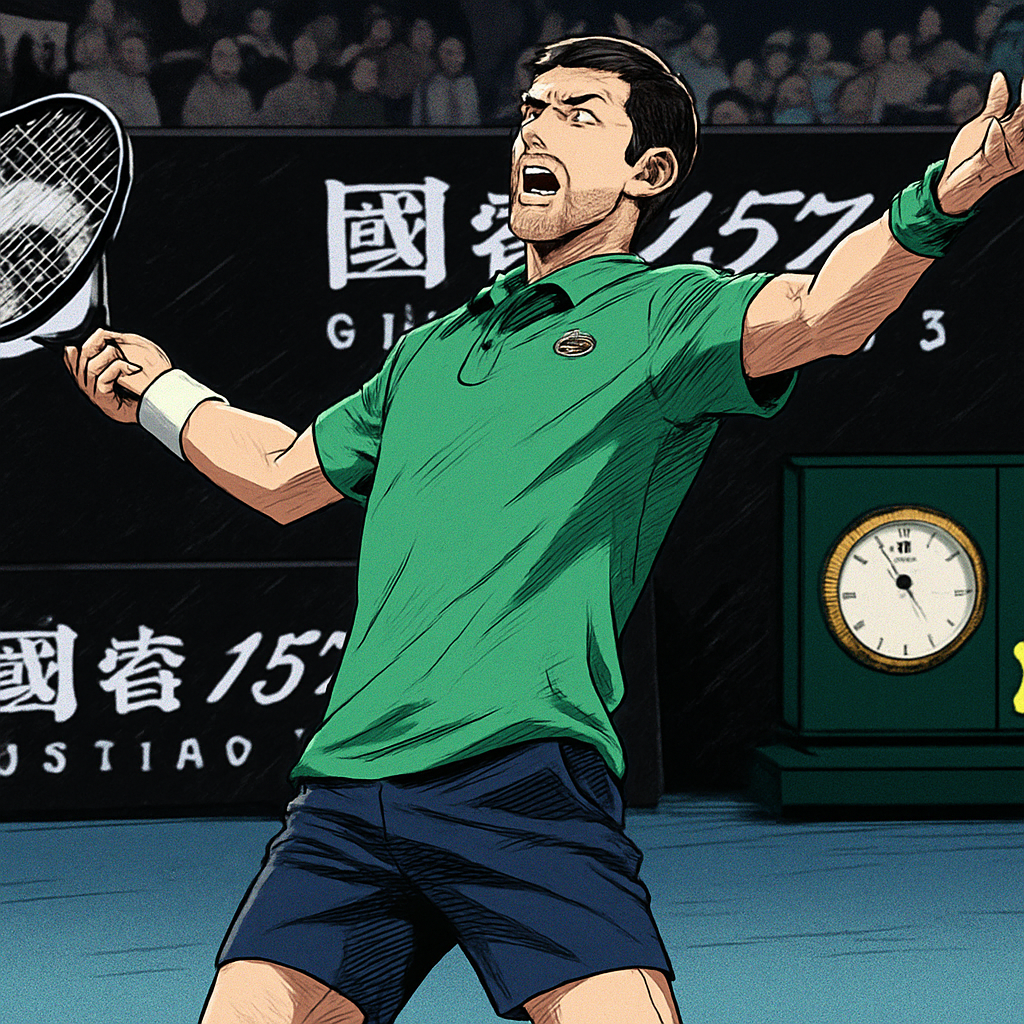
MELBOURNE — The usually serene night session on Rod Laver Arena was transformed into a cauldron of tension and noise on Friday as Novak Djokovic, the ten-time champion and king of Melbourne Park, engaged in a furious, prolonged argument with chair umpire Fergus Murphy, drawing loud and sustained boos from a divided Australian Open crowd.
The incident occurred during the third set of Djokovic’s third-round match against 30th seed Tomas Martin Etcheverry. Leading two sets to love but facing a sudden surge from the Argentine, Djokovic’s frustration boiled over regarding the serve clock, leading to a confrontation that overshadowed the tennis and highlighted the complex, often fraught relationship the world No. 1 has with the Melbourne faithful.
The Spark: A Dispute Over Time
The flashpoint came with Djokovic serving at 4-5, 30-30 in the third set. After a grueling rally, Djokovic was preparing to serve when he noticed the 25-second serve clock had already started counting down. He believed the clock had begun prematurely, before the umpire had officially called the score. Djokovic immediately stopped, pointing at the screen and appealing to Murphy. "Why did you start the clock so early? The crowd is still making noise," he protested, referring to the late applause from the previous point.
Umpire Murphy insisted the clock had started correctly, adhering to the rule that it begins once the previous point is decided, not when silence is achieved. Djokovic, feeling rushed, proceeded to double-fault, handing Etcheverry a set point. Visibly incensed, Djokovic approached the chair, initiating a debate that would last nearly four minutes.
A Heated Exchange at the Chair
The exchange grew increasingly heated. Djokovic, gesticulating emphatically, argued that the umpire’s management of the crowd noise and the serve clock was inconsistent and unfair. "You are not allowing me to serve. You are allowing him to serve, but not me. Explain to me why," Djokovic demanded, referencing earlier instances where he felt Etcheverry was given more leeway.
Murphy remained calm but firm, repeatedly stating, "The rule is the same for both players, Novak." The Serbian star, however, was unconvinced, his voice rising in frustration. "You think you're smart? You think you're smart?" he retorted at one point.
The crowd, initially murmuring, began to react more vocally. A significant portion started booing Djokovic for delaying the match, while others cheered in support. The mixed reaction created a charged atmosphere, with Djokovic at one point turning to the stands and spreading his arms in a gesture of disbelief and appeal.
Crowd Reaction and Psychological Impact
The booing intensified as the argument wore on. For Djokovic, who has historically enjoyed immense success but a sometimes complicated rapport with Australian crowds, the moment seemed to crystallize a sense of being misunderstood. After finally losing the third set 6-3, he took a long bathroom break. Upon returning, he appeared refocused, but the incident had clear ramifications:
- Shift in Momentum: The argument and lost set broke Djokovic’s rhythm, injecting belief into Etcheverry and energizing the crowd against the favorite.
- Mental Reset: The extended break between sets allowed Djokovic to compartmentalize the dispute, a mental strength for which he is renowned.
- Crowd Dynamics: The booing seemed to galvanize Djokovic’s resolve, a familiar pattern where perceived adversity fuels his performance.
In his post-match press conference, Djokovic addressed the incident directly. "I have high tolerance normally. But when you feel like the circumstances are against you, you have to speak up. I did, and probably a majority of the crowd didn't like it. That's why they booed. I was okay with it."
The Rules and Precedent
The core of Djokovic’s complaint touches on a perennial issue in modern tennis: the strict enforcement of the serve clock versus the umpire’s role in managing ambient conditions. The Grand Slam rules state the clock starts once the umpire announces the score and the previous point is concluded. However, umpires have discretion to pause the clock for significant crowd disruption. Djokovic’s argument was that Murphy did not use this discretion consistently.
This is not the first time Djokovic and umpire Fergus Murphy have clashed. A notable previous incident occurred at the 2020 ATP Cup, where Djokovic criticized Murphy’s handling of a similar situation. Furthermore, Djokovic has a history of tense moments with Australian Open crowds, most famously during his 2022 deportation saga and his fiery third-round match in 2023 where he told a heckler to "come down and say it to my face."
A Champion's Response
True to his champion’s mentality, Djokovic used the controversy as fuel. He emerged for the fourth set with renewed intensity, breaking Etcheverry early and cruising to a 6-3, 6-3, 7-6(2), 6-3 victory. The boos gradually faded, replaced by the appreciative applause that his sublime tennis invariably commands. He finished the match with a staggering 34 winners to just 9 unforced errors in the final two sets, a statistical testament to his ability to lock in under pressure.
When asked if the confrontation was a tactical move to disrupt Etcheverry’s momentum, Djokovic dismissed the idea. "No, not at all. I just felt I had to say something. I wasn't being treated the same as my opponent in certain situations. I defended myself. That's it."
Conclusion: Fire and Focus in Melbourne
The night’s events served as a potent reminder of the dual forces that drive Novak Djokovic: a fiery passion that can erupt in disputes with officials and crowds, and an almost superhuman focus that allows him to transmute that emotion into peak performance. While the boos may have been a jarring sound for a player of his stature on his most successful court, they ultimately became just another obstacle he navigated on his path forward.
As the tournament progresses, the argument will likely be filed as another dramatic chapter in Djokovic’s storied Australian Open legacy. For his opponents, however, the key takeaway remains unchanged: provoking Djokovic’s ire, whether through play or circumstance, often only awakens the most formidable version of the 24-time Grand Slam champion. The incident proved that even when at odds with the crowd and the chair, his tennis, in the end, does the loudest talking.