
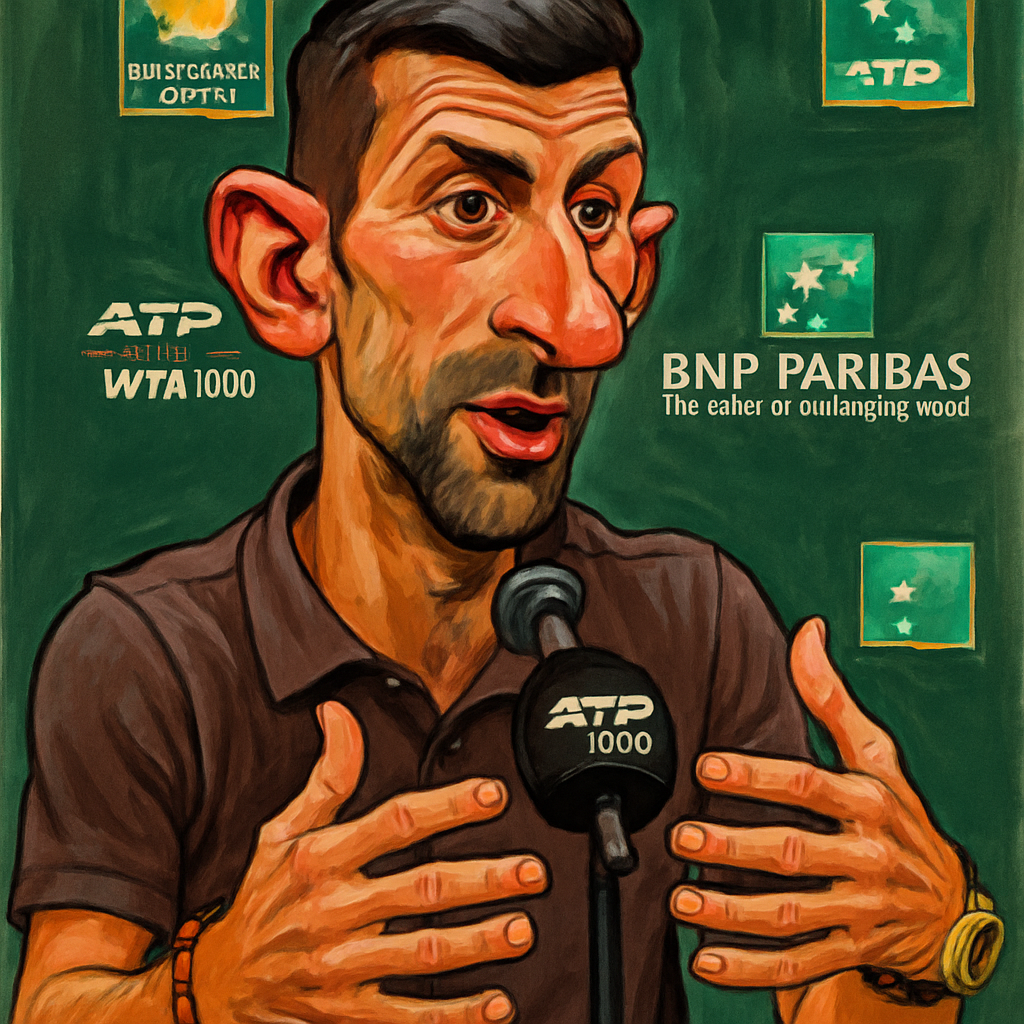
MELBOURNE — Novak Djokovic’s 2024 Australian Open campaign was a masterclass in adaptation. Arriving in Melbourne with questions swirling about a persistent wrist injury and a surprising loss to Alex de Minaur at the United Cup, the world No. 1 faced a scenario he hadn't encountered in a decade: he was not the undisputed, overwhelming favorite. Yet, by the tournament's end, he had secured a record-extending 11th title and a 25th Grand Slam crown, silencing doubters and reinforcing his legendary status. This victory, however, hinged on a crucial mid-tournament adjustment—one that, according to former British No. 1 Tim Henman, saved him from a potentially "embarrassing" verdict on his physical readiness.
A Rocky Start and Mounting Concerns
Djokovic’s path through the first week was uncharacteristically turbulent. While he navigated his opening rounds in straight sets, his level was far from the domineering perfection he often displays at Rod Laver Arena. His third-round match against 30th-seeded Tomas Martin Etcheverry exposed significant vulnerabilities. Djokovic’s movement appeared slightly labored, his trademark elastic defense was breached repeatedly, and most alarmingly, his serve lacked its usual potency. He was broken multiple times and struggled to find a consistent rhythm. The narrative solidified after a gripping four-set battle against young gun Adrian Mannarino: Djokovic was battling himself as much as his opponents. The wrist was a visible concern, with the Serbian seen frequently flexing it and receiving treatment. Tennis pundits began to openly question whether his body could withstand the escalating pressure of the second week.
The Pivotal Practice Session
The turning point came not during a match, but on a practice court ahead of his fourth-round clash with Taylor Fritz. Observers noted a significant technical tweak: Djokovic and coach Goran Ivanisevic were working meticulously on shortening his service motion. The usual elongated, flowing kinetic chain was tightened, with a focus on a more compact take-back and earlier ball strike. This adjustment was a clear concession to the wrist issue, designed to reduce stress on the joint while maintaining accuracy and enough power. Speaking on Eurosport, Tim Henman, a former world No. 4 renowned for his analytical eye, highlighted the critical importance of this change. "He made a big adjustment on his serve," Henman stated emphatically.
Henman's "Embarrassing" Verdict
Henman elaborated that without this modification, Djokovic’s campaign could have unraveled in a manner unbecoming of a champion of his caliber. "If he hadn't made that adjustment, I think he would have been in a lot of trouble. He might not have got through the Fritz match, and it could have been embarrassing for someone of his stature to lose because of a technical flaw he couldn't overcome." The word "embarrassing" here spoke not to the loss itself, but to the prospect of a tactical or physical inflexibility derailing his quest. For Henman, it was the ultimate testament to Djokovic’s problem-solving prowess—his ability to diagnose a weakness and engineer a solution under the brightest lights.
The Proof in Performance
The results were immediate and profound. Against the big-serving Fritz, a player capable of exposing any serving frailty, Djokovic was imperious. He faced not a single break point across four sets, a staggering statistic against a top-10 opponent. The streamlined serve allowed him to hold easily, conserving energy and applying relentless pressure on Fritz’s own service games. This pattern continued through the semifinal against Jannik Sinner, where he delivered a serving clinic, and culminated in the final against Daniil Medvedev. In the title match, Djokovic’s serve was a weapon once more, helping him recover from dropping the third set to ultimately overpower a fatigued Medvedev. The key improvements included:
- Reduced Double Faults: The erratic serving of the early rounds vanished.
- Increased First-Serve Percentage: He found more consistency, setting up easier points.
- Strategic Placement Over Pure Power: He used slice and kick serves effectively to open the court, protecting his wrist while outthinking his opponent.
This tactical shift did more than just win him free points; it reshaped the entire dynamic of his matches. As seven-time major winner John McEnroe noted in commentary, "He's taken what was a liability and turned it into a strength again. That's the sign of a true champion."
Beyond the Serve: A Mental Fortress
While the service adjustment was the technical headline, Djokovic’s victory was built on his unparalleled mental resilience. Each challenge in Melbourne seemed to strengthen his resolve. He spoke openly about using the "underdog" chatter and physical doubts as fuel. "I like it when people are doubting me, when they don't give me a big chance. It fuels me with even more motivation to work harder and prove them wrong," he said after the final. This mindset transformed the tournament into a personal mission. The early struggles against Etcheverry and Mannarino were not signs of decline, but rather necessary battles that sharpened his focus and competitive edge for the tougher tests ahead.
A Legacy-Defining Triumph
The 2024 Australian Open will be remembered as one of Novak Djokovic’s most significant triumphs. It was a victory not of sheer dominance, but of intelligent adaptation and stubborn will. He arrived with a visible weakness, allowed the world to scrutinize it, and then expertly corrected it in real-time. In doing so, he avoided the scenario Henman outlined—a scenario where physical limitation leads to an uncharacteristic and early exit. Instead, he authored a narrative that perhaps enhances his legacy more than a straightforward romp would have. He demonstrated that his greatness lies not just in his physical gifts, but in a cerebral approach to the game that few can match.
Reflecting on the tournament in his champion's press conference, Djokovic acknowledged the journey. "This is one of the most special Grand Slams I've ever won, considering the circumstances. The last four or five days have been really good on the court, but it started very poorly with the wrist and not feeling great on the court. To build from that and to be standing here with the trophy is incredibly satisfying."
The lesson for the tennis world is clear: writing off Novak Djokovic, even when he appears vulnerable, is a perilous endeavor. His capacity for mid-match and mid-tournament evolution remains peerless. Tim Henman’s "embarrassing" verdict was a real possibility, a testament to how fine the margins are at the sport’s pinnacle. But by making that key change, Djokovic didn't just save face; he reinforced the very qualities that make him arguably the greatest competitor the sport has ever seen. As the tour moves forward, his rivals are left with a daunting realization: a physically compromised Djokovic who can problem-solve is just as dangerous as a fully fit one.