
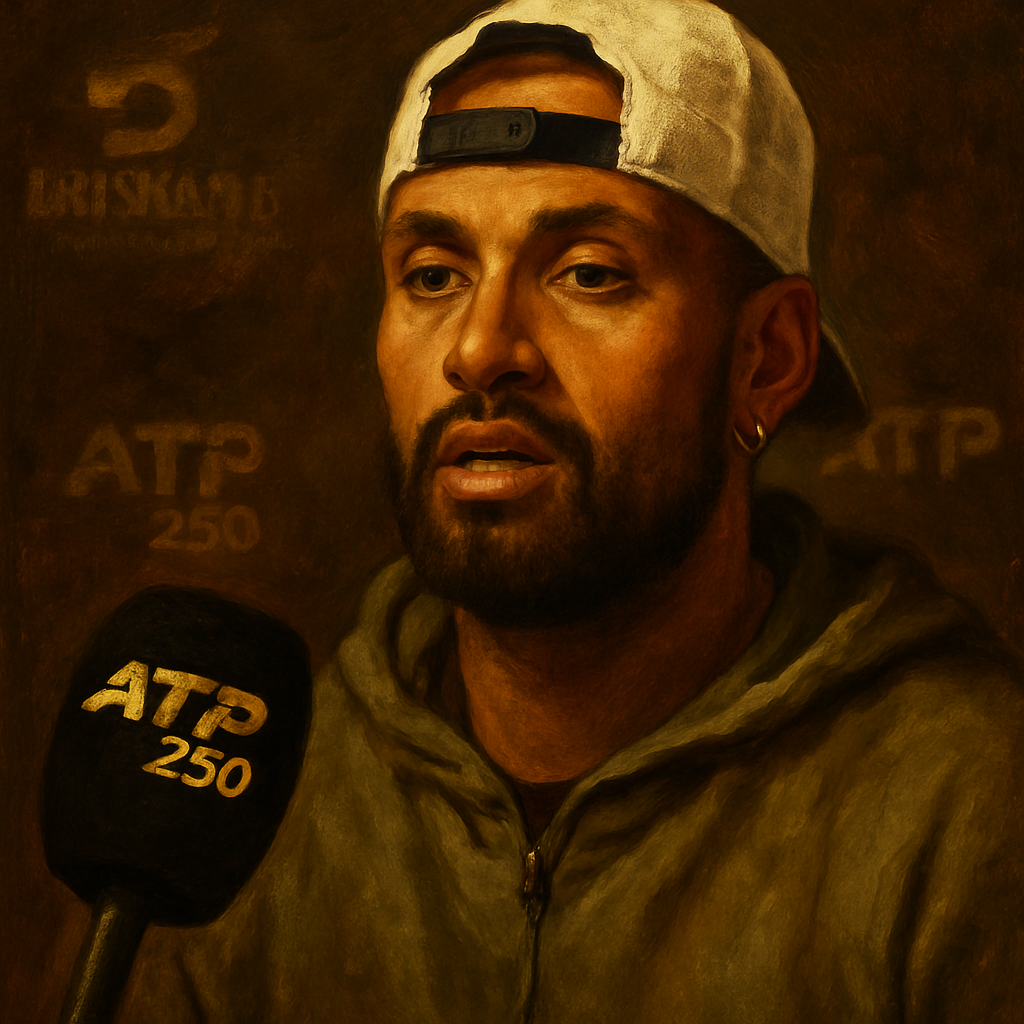
BRISBANE — The familiar sight of Nick Kyrgios, headphones on and racket bag slung over his shoulder, graced the practice courts at the Brisbane International this week, sending a ripple of anticipation through Australian tennis. For the first time in nearly a year and a half, the mercurial talent is back in a competitive environment. Yet, despite his physical presence in Queensland, a significant cloud of uncertainty still hangs over his participation in the season's first Grand Slam, with Tennis Australia's decision on a coveted Australian Open wildcard now officially made.
Kyrgios, 28, has been sidelined since June 2023, undergoing surgery on his left knee before a separate wrist injury cruelly delayed his planned return for last year's Australian Open. His absence has left a noticeable void in the sport's drama and shot-making brilliance. His return to practice in Brisbane, hitting with the likes of fellow Aussie Dane Sweeney, marks a critical step forward. However, the journey from practice intensity to best-of-five-set Grand Slam combat is a formidable one, a fact Kyrgios himself openly acknowledges.
The Long Road Back from Injury
The path to recovery has been a grueling test of patience for the 2022 Wimbledon finalist. In a candid interview with the Nine Network, Kyrgios laid bare the physical and mental challenges of the past 18 months. "The last year and a half has been tough," he admitted. "It's been hard. Just doing the rehab, doing the gym, doing the same thing over and over, not seeing the light at the end of the tunnel."
His knee, he revealed, required a significant arthroscopic procedure to repair a tear in the lateral meniscus and remove a cyst. Just as he was building momentum from that, a torn ligament in his wrist during his only tournament of 2023 – in Stuttgart – forced another reset. The cumulative effect has been a player stripped of his primary outlet and identity. "I'm just proud to be out here, to be honest," he said, surveying the Brisbane courts. "There were so many moments where I was just dealing with so much pain. I didn't know if I'd ever be back on the court."
The Australian Open Wildcard Decision
The central question on every Australian tennis fan's mind has now been answered. On Friday, January 5th, Tennis Australia announced its main draw wildcards for the 2024 Australian Open. The recipients included veterans like Caroline Wozniacki and returning champion Naomi Osaka on the women's side. For the men, the wildcards went to a mix of rising Australian talents and established players making comebacks from injury.
Notably, Nick Kyrgios's name was not on the list. The wildcards for Australian men were awarded to:
- Alexei Popyrin: The 24-year-old who claimed his maiden ATP title in 2023.
- Jordan Thompson: A consistent performer and Davis Cup stalwart.
- James Duckworth: Another hard-working Aussie veteran.
- Marc Polmans: Awarded for his strong performances on the ATP Challenger Tour.
- Adam Walton: The 2023 NCAA singles champion from the University of Tennessee.
- Patrick Kypson (USA): A reciprocal wildcard agreement with the USTA.
This decision indicates that Tennis Australia, while supportive of Kyrgios's comeback, is taking a cautious approach. It places the onus squarely on Kyrgios to prove his fitness and match readiness through the ATP Tour events in Brisbane and potentially the following week. It also protects the integrity of the wildcard system, rewarding players who have been active and successful on tour over the past year.
Kyrgios's Stance and Current Mindset
For his part, Kyrgios has expressed a philosophical understanding of the situation. He has broken his silence not with the fiery defiance of old, but with a tempered realism. "I know I have to be patient with my body," he stated. "The Australian Open… it's my favorite tournament, of course I want to play. But I'm not going to put myself and my team in a position where we rush and something happens again."
His immediate focus is laser-locked on Brisbane, where he is entered in both singles and doubles (with good friend Thanasi Kokkinakis, reviving the 'Special Ks' partnership). These matches will serve as vital litmus tests. "Brisbane is the first step," he explained. "I need to see how the body holds up under match pressure, how the knee reacts to changing direction, how the wrist feels on serve."
This measured approach represents a potential evolution in Kyrgios's relationship with the sport. The player once known for his combustible on-court demeanor now speaks like an athlete who has been humbled by the fragility of his physical gifts. The desire to compete at Melbourne Park burns brightly, but it is now tempered by a longer-term vision for his career.
The Path to Melbourne Park Remains Open
The absence of a wildcard does not eliminate Kyrgios from Australian Open contention. Several avenues remain:
- Protected Ranking: Due to his extended injury layoff, Kyrgios is eligible to use a Protected Ranking (PR) of No. 21, based on his average ranking during the first three months of his absence. This is high enough for direct entry into the main draw.
- Qualifying Tournament: A theoretically possible but highly improbable route where he would need to win three matches to reach the main draw.
- Late Wildcard: While the initial batch is announced, Tennis Australia sometimes holds one discretionary wildcard in reserve for exceptional circumstances.
The most likely scenario is Kyrgios using his Protected Ranking to gain direct entry before the deadline. However, this is a one-time use for the season's first Grand Slam and committing to it is a declaration that he is truly ready. His performances in Brisbane will be the decisive factor in that calculation.
What His Return Means for the Sport
Regardless of when he steps onto Rod Laver Arena, Kyrgios's return is a significant moment for tennis. Love him or loathe him, he moves the needle. Stadiums fill, television ratings spike, and social media erupts when he plays. His unorthodox style, featuring breathtaking touch, explosive power, and audacious shot-making, is a spectacle unlike any other on tour.
Furthermore, a fit and focused Kyrgios remains a legitimate threat at the highest level, as his 2022 run to the Wimbledon final—where he defeated then-world No. 1 Daniil Medvedev and took a set off Novak Djokovic—proved. In an era dominated by baseline consistency, he is a thrilling anarchist, a reminder of tennis's creative possibilities.
As the Brisbane summer sun beats down, Nick Kyrgios is back in the arena, albeit the practice one for now. The wildcard decision has been made, shifting the narrative from speculation to tangible challenge. His fate for the Australian Open now rests not in the hands of selectors, but in the resilience of his own body and his performance in the coming days. The silence has been broken, replaced by the sound of tennis balls being struck and the mounting buzz of anticipation. The next chapter of the Kyrgios story, one of potential redemption or frustrating setback, is about to be written in real time.