
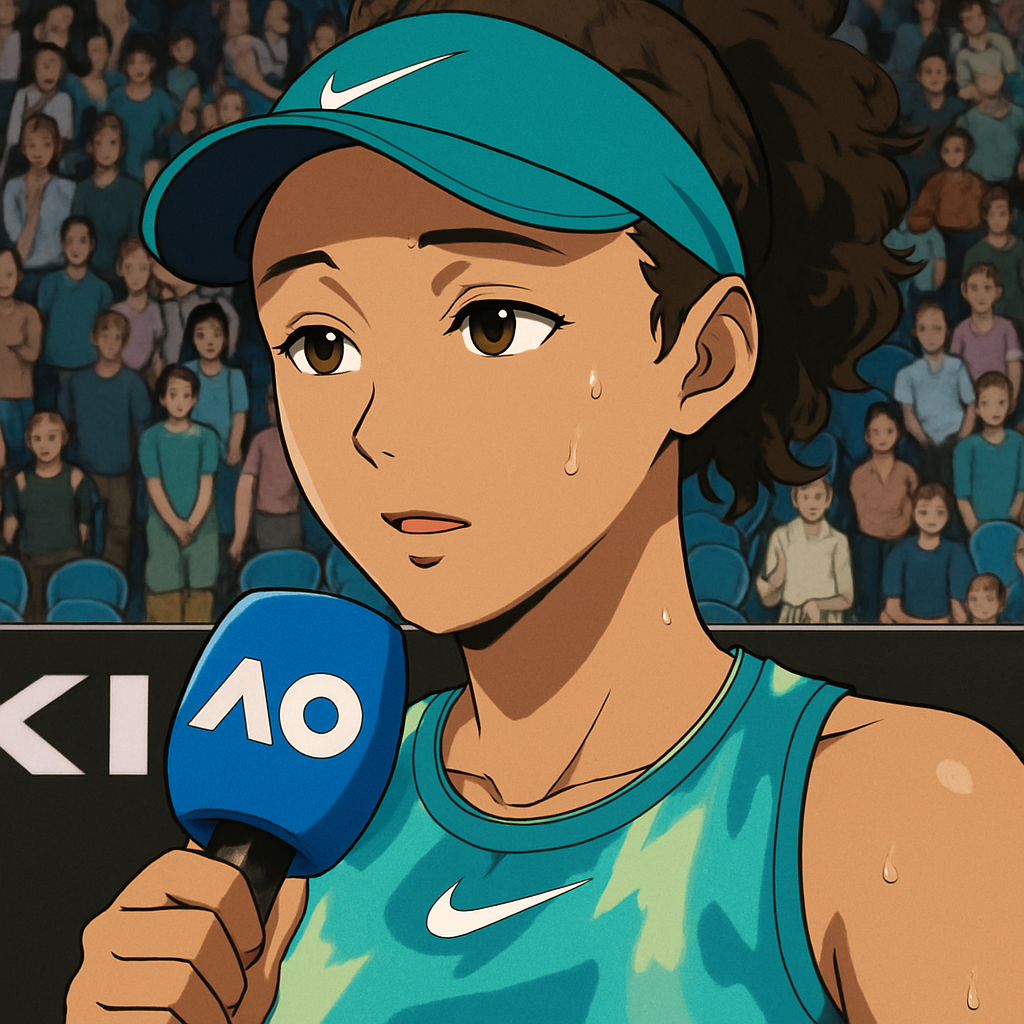
MELBOURNE — The 2024 Australian Open was already a highly anticipated comeback for Naomi Osaka, marking her return to Grand Slam tennis after maternity leave. However, her first-round victory over 16th seed Caroline Garcia was overshadowed by a post-match controversy that unfolded rapidly, showcasing the intense pressures of the sport and the power of social media to amplify and resolve disputes in real-time.
The incident occurred immediately after Osaka’s impressive 6-3, 7-6(2) win on Rod Laver Arena. As is customary, the players met at the net for a handshake. Osaka, however, appeared to snub her opponent, turning away quickly after a brief, seemingly dismissive tap of the rackets. The moment was captured on broadcast and swiftly circulated online, with many commentators and fans criticizing Osaka for a perceived lack of sportsmanship, especially given her status as a former world No. 1 and four-time major champion.
The narrative took a sharp turn less than an hour later. In her post-match press conference, Osaka was asked about the handshake. Her response revealed a significant misunderstanding. She explained that she believed her opponent, Sorana Cirstea, was in the stands. "I thought my opponent was Sorana Cirstea, and she’s a player that I’ve had a lot of history with," Osaka stated, referencing a tense third-round match at the 2020 US Open where Cirstea had criticized Osaka’s body language and attitude.
In reality, Osaka had just defeated France’s Caroline Garcia. The confusion, Osaka suggested, stemmed from the tournament’s draw sheet and her own pre-match mental preparation. "I was just so focused in the match, and I had it in my mind that I was playing Sorana. So when I went up to the net, I guess I was still thinking that," she admitted, expressing clear remorse for the unintended slight against Garcia.
The Immediate Apology and Social Media Clarification
Understanding the gravity of the perceived snub, Osaka moved swiftly to correct the record. Before even leaving the Melbourne Park grounds, she took to social media platform X (formerly Twitter) to issue a public apology directly to Caroline Garcia. Her post was candid and personal, cutting through the noise of the growing online debate.
"Hey Caroline, I want to apologize for my behaviour at the net today. I read the draw wrong and for some reason I was convinced I was playing Sorana Cirstea. I was just zoning out and trying to get ready for the next point. I really respect you and I’m so sorry it seemed like I was ignoring you!"
This direct communication was crucial. It transformed the story from one of alleged poor sportsmanship into a relatable human moment of mental error and public accountability. Garcia, demonstrating notable grace, responded promptly and warmly, accepting the apology and shifting the focus back to Osaka’s performance. "No problem! Congrats on the win and good luck for the rest of the tournament," Garcia tweeted, effectively defusing the situation.
A History of Tension with Sorana Cirstea
Osaka’s specific mention of Sorana Cirstea was not random. Their "history" dates back to the 2020 US Open, a tournament Osaka would ultimately win. During their third-round match, which Osaka won in six games, Cirstea was visibly frustrated by what she perceived as gamesmanship. In her own press conference afterward, Cirstea made pointed remarks that were widely interpreted as being directed at Osaka.
"Some players are more vocal, some are not. But the body language, the attitude, it’s there. I don’t think it’s OK to act like this," Cirstea said at the time. She further criticized a trend of players taking extended bathroom breaks, a tactic Osaka has occasionally employed. This public critique created an undeniable layer of tension between the two, which clearly lingered in Osaka’s competitive psyche years later.
The 2024 Australian Open draw did, in fact, set up a potential second-round clash between Osaka and Cirstea, adding a layer of poetic coincidence to the mix. Osaka’s mental mix-up, while a simple error, highlighted how deeply athletes internalize their upcoming challenges and past rivalries, sometimes to a fault.
Broader Context: Mental Focus and Public Scrutiny
This incident encapsulates the dual pressures faced by modern athletes, particularly one as introspective as Naomi Osaka. On one hand, there is the immense, singular focus required to compete at the highest level—a "zoning out" that blocks out everything but the immediate point. On the other, there is the relentless, instant scrutiny of their every action by a global audience armed with cameras and social media.
Osaka has been at the forefront of discussions about athlete mental health, having withdrawn from the 2021 French Open to protect her well-being and spoken openly about her struggles with depression and anxiety. The handshake row, while minor in isolation, touches on similar themes:
- The hyper-focus of competition: Athletes operate in a heightened state where a simple mental slip, like misreading an opponent's name, is entirely plausible.
- The magnification of micro-moments: A two-second interaction at the net can become a global news story within minutes.
- The expectation of perpetual grace: Players are expected to seamlessly transition from fierce competitor to gracious sportsman, a switch that is not always instantaneous.
Tennis legend Martina Navratilova commented on the situation, offering a veteran’s perspective. "It happens. You get so in the zone, you forget who you’re even playing sometimes. The important thing is she corrected it immediately. That shows character," Navratilova said on Tennis Channel, emphasizing the redemptive quality of Osaka’s quick apology.
Conclusion: A Swift Lesson in Accountability
The "handshake row" at the 2024 Australian Open was a storm that formed and dissipated within the span of a single news cycle, thanks largely to Naomi Osaka’s decisive personal intervention. What began as a potential stain on her comeback narrative evolved into a case study in modern crisis management—handled not by a PR team, but by the athlete herself through a genuine, direct apology.
The episode served as a reminder of the intense psychological landscape of professional tennis, where past rivalries can haunt present moments, and focus can become so narrow that it distorts simple facts. More importantly, it highlighted a positive pathway through such controversies. By taking full responsibility, clarifying her intent without excuse, and communicating openly, Osaka not only mended fences with Caroline Garcia but also reinforced a valuable lesson:
In an era where narratives can spiral out of control at lightning speed, authenticity and accountability remain the most effective tools for resolution. As Osaka’s tournament journey continued, the incident was left firmly in the past, a minor footnote to what she hopes will be a major and successful return to the sport she has already done so much to shape, both on and off the court.