
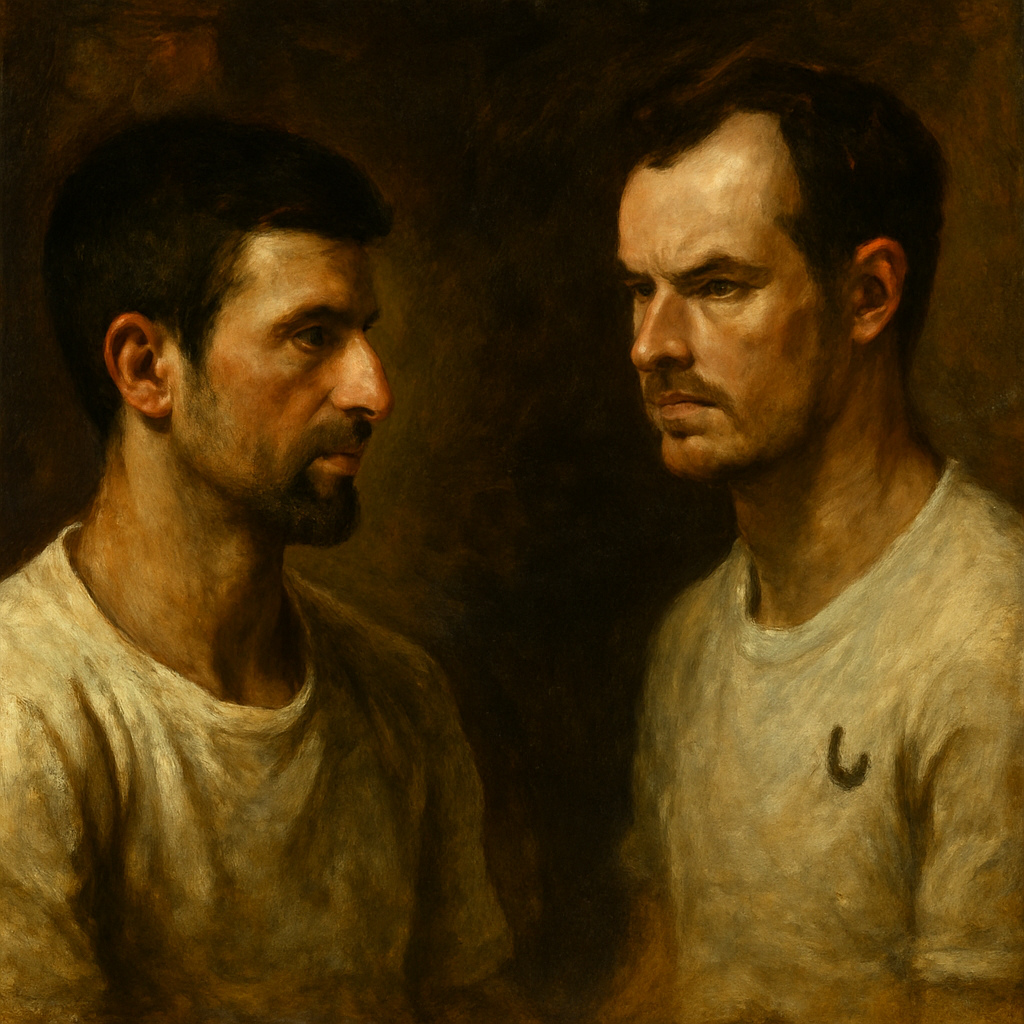
LONDON — In a candid reflection on a brief but high-profile coaching partnership, Andy Murray has admitted his work with Novak Djokovic earlier this year did not yield the on-court success he had hoped for. The former world number one, who joined Djokovic’s team for a trial period in the spring, stated he "probably didn't get the results I would have liked" for the 24-time Grand Slam champion.
The collaboration, which sent shockwaves through the tennis world, saw Murray—Djokovic’s long-time rival and friend—offer his insights during tournaments in Monte Carlo and Madrid. The move was seen as a bold experiment by Djokovic to reinvigorate his game during a challenging start to the 2024 season, which had been marked by early exits and a notable split with his previous coach, Goran Ivanisevic.
An Unprecedented Alliance
The notion of Murray coaching Djokovic was, for many fans, a surreal twist in one of tennis's defining rivalries. For over a decade, the "Big Four" of Murray, Djokovic, Roger Federer, and Rafael Nadal battled for supremacy, with Djokovic and Murray facing off in numerous finals, including multiple Grand Slam title matches. Their dynamic was one of mutual respect forged in fierce competition, making the coaching link-up a fascinating chapter in both their careers.
Speaking recently on the topic, Murray explained his motivation was purely to help. "When Novak asked, my immediate thought was just to try and support him," he said. "We’ve been through so much together on tour, and despite the rivalry, there’s a deep understanding there. I know what it’s like to fight back from challenges, and I wanted to bring that perspective."
A Season of Struggle for Djokovic
Djokovic’s call for Murray’s input came during a period of uncharacteristic uncertainty. The Serbian superstar, who enjoyed a historic 2023, began 2024 without a title and suffered surprising defeats at the Australian Open and Indian Wells. Key areas of concern that Murray was brought in to address included:
- Return Game Efficiency: Sharpening Djokovic’s legendary return of serve, which had shown slight vulnerabilities.
- Net Play & Transition: Adding more aggression and volleying precision to shorten points.
- Mental Refreshment: Providing a new voice and strategic viewpoint to break established patterns.
The trial period, however, did not produce an immediate turnaround. In Monte Carlo, Djokovic was defeated in the semi-finals by Casper Ruud. The following week in Madrid, he suffered a third-round loss to rising Czech star Jakub Mensik. These results fell short of the dominant standard Djokovic has set for himself, particularly on clay in the build-up to Roland-Garros.
Murray’s Honest Assessment
Murray, never one to shy away from blunt honesty, did not sugarcoat the outcomes. "You work with someone of that caliber to win tournaments," Murray stated. "That’s the only metric that really matters for Novak. We had good conversations, we worked on specific things in practice, but ultimately, when he walked on the match court in those events, it didn’t click in the way we wanted."
He emphasized that the partnership was always intended to be a short-term trial. The dynamic, while professional, was inherently unique. "It’s a different feeling, going from trying to decipher someone’s game to beat them, to trying to decipher it to help them win," Murray reflected. "The instincts are almost opposite. It was a learning process for both of us."
The Road Ahead for Both Champions
Following the Madrid Open, Djokovic and Murray mutually agreed not to extend the coaching arrangement. Djokovic has since continued his season, eventually finding form to win the ATP 250 event in Geneva before focusing on his title defense at Roland-Garros and the upcoming Wimbledon Championships. He has been working closely with his long-time fitness coach, Marco Panichi, and other members of his team.
For Murray, the experience provided valuable insight into coaching at the very pinnacle of the sport, even as he continues his own arduous comeback from injury and contemplates his eventual retirement from playing. He has not ruled out a future in coaching, but made it clear his immediate focus remains on his own career for as long as his body allows.
A Legacy of Respect
Despite the lack of tangible silverware resulting from their collaboration, both players have expressed nothing but positivity about the experience. It served as a powerful testament to the respect that exists between them, transcending their competitive history. In an era where coaching partnerships are often strictly transactional, this was a genuinely personal endeavor.
"I have immense respect for Andy, both as a player and as a tennis mind," Djokovic commented in Rome after the partnership concluded. "We tried something new, and I am grateful for his time and his perspective. Sometimes in life and in sport, you try different things to find what works. This was one of those moments."
Ultimately, the story of Murray coaching Djokovic may be remembered less for its results and more for its symbolic significance. It highlighted the unique bonds formed through shared struggle at the top of the game. While Murray may not have gotten the wins he wanted for his former rival, he offered something perhaps equally valuable during a period of doubt: the understanding and support of a peer who has walked the same path.