
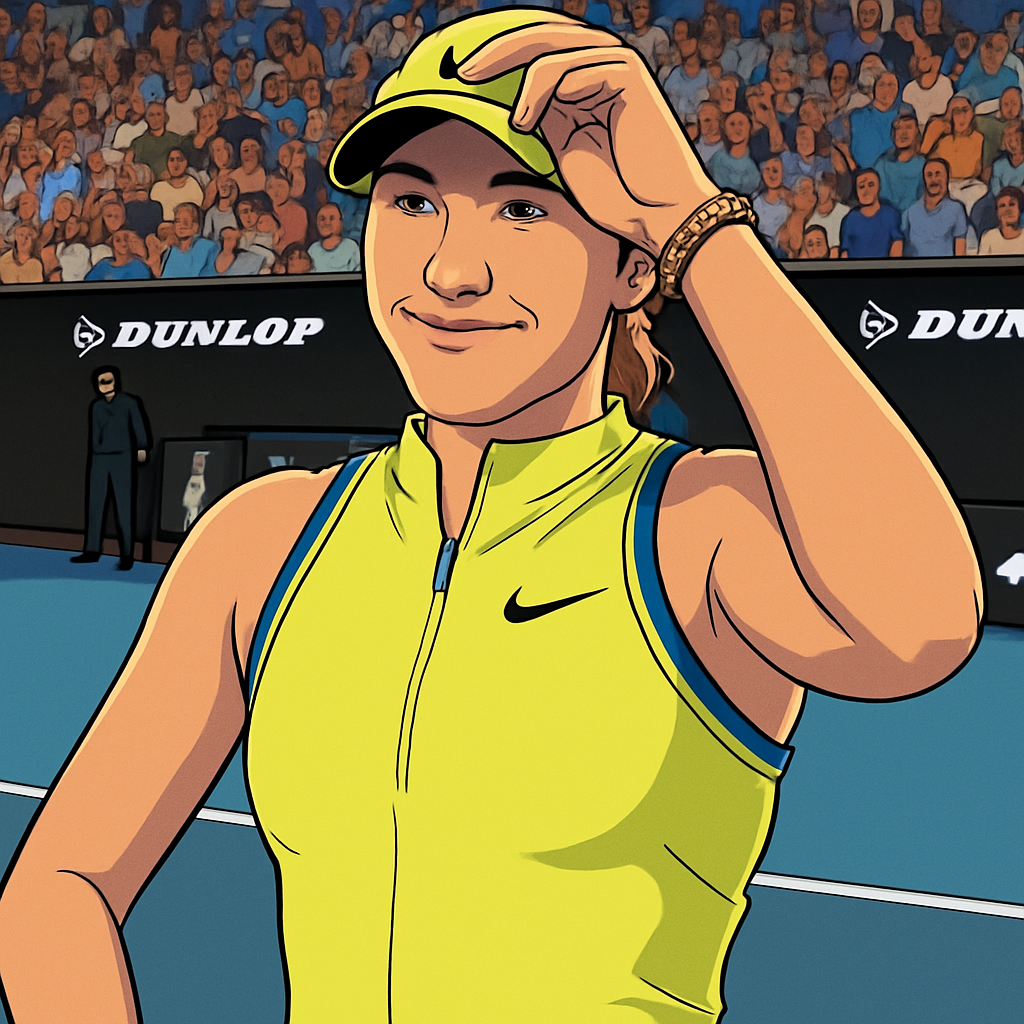
MELBOURNE — In the high-stakes, high-pressure world of professional tennis, where narratives are often dominated by power serves, grueling rivalries, and the weight of expectation, a refreshingly different story has been unfolding at the Australian Open. Its protagonist is 16-year-old Russian phenom Mirra Andreeva, whose prodigious talent on the court is being matched only by her remarkable self-awareness and maturity off it.
Andreeva, who stormed into the fourth round with a stunning victory over sixth seed Ons Jabeur, has captured the hearts of fans and pundits alike. Yet, beyond her lethal two-handed backhand and tactical intelligence, it is a unique post-match ritual that has truly defined her breakout run. Following each win, Andreeva has made a point of thanking an often-overlooked key figure in her success: her future self.
A Ritual of Self-Reliance and Reflection
The trend began after her first-round win. In her press conference, when asked about her pre-match nerves, Andreeva revealed her internal dialogue: "I was a bit nervous before the match... I told myself, 'It's okay, it's just the first round. If you win today, you will thank yourself so much. So just play, and then after the match you will thank yourself.'"
This wasn't a one-off comment. After dismantling Jabeur, she doubled down on the sentiment. "I just reminded myself what I told myself before the first round... I will thank myself, and I did. I thank myself now," she stated with a smile. The practice has become so consistent that an interviewer recently remarked she was becoming "famous" for it.
This habit of "thanking herself" is far from mere teenage quirkiness. It reveals a sophisticated psychological framework. Sports psychologists point to this as a powerful form of intrinsic motivation and self-accountability. By framing her effort as a gift to her future self, Andreeva transforms pressure into a personal contract, focusing on process over outcome.
The Making of a Prodigy
Andreeva's journey to this point has been meticulously plotted. Coached by former French Open finalist Conchita Martínez, her game is a blend of old-school craft and modern aggression. Her strengths are numerous for a player so young:
- Exceptional Court Sense: She possesses an almost preternatural ability to read the game, anticipating opponents' shots and constructing points like a veteran.
- Mental Fortitude: Her composure under pressure, seen in saving match points against Jabeur, belies her age.
- Versatile Arsenal: She can switch from defensive retrieval to aggressive winner-seeming with seamless ease.
Her 2023 season was a preview of this explosion, reaching the fourth round at Wimbledon and the third round at the French Open. However, her current run in Melbourne, defeating a top-10 player and Grand Slam finalist, marks a significant step up in caliber and conviction. Martínez has been instrumental, not just technically but in fostering the calm, thoughtful demeanor Andreeva exhibits.
Navigating the Neutral Athlete Status
Like all Russian and Belarusian players since the onset of the war in Ukraine, Andreeva competes as a "neutral athlete," without her national flag or anthem. This complex backdrop adds another layer to her narrative. She has handled related questions with a poise that mirrors her on-court focus, consistently steering conversation toward tennis and her personal journey, a diplomatic tightrope she walks with surprising grace.
More Than Just a Tennis Story
The viral nature of Andreeva's "thanking myself" comments speaks to a broader cultural moment. In an era where young athletes are often meticulously managed by entourages and brands, her voice is authentically and refreshingly her own. It’s a narrative of self-empowerment that resonates far beyond the baselines. She isn't crediting a lucky charm or an external force; she is recognizing her own agency, effort, and the direct consequences of her choices.
This self-reliance was starkly evident in her analysis of the Jabeur match. "I just try to think about the game I have to play. I had a plan and I tried to just follow this plan. I didn't really think about who is on the other side of the net," she explained. This ability to block out the stature of her opponent and execute her own vision is a hallmark of champions.
The Road Ahead and Lasting Impact
As Andreeva prepares for her next challenge, the tennis world watches with bated breath. Whether she lifts the trophy or not in this tournament, she has already made an indelible mark. She has shown that the next generation of stars can be defined not just by their forehands, but by their perspective.
Her story is a potent reminder that while coaches, families, and teams provide crucial support, the ultimate dialogue—the one that matters in the lonely moments before walking onto Rod Laver Arena—is the one an athlete has with themselves. Mirra Andreeva is not just winning matches; she is mastering that conversation, and in doing so, thanking the person who makes it all possible: the determined, present self who lays the groundwork for future success.
In a sport searching for its next iconic figures, Andreeva offers a compelling blueprint. She combines breathtaking skill with a grounded, introspective personality. As one commentator noted, she plays like a seasoned veteran and explains her process like a seasoned philosopher. The "true colours" Mirra Andreeva has shown in Melbourne are those of a rare and complete competitor—one as comfortable in her own mind as she is commanding on the court.