
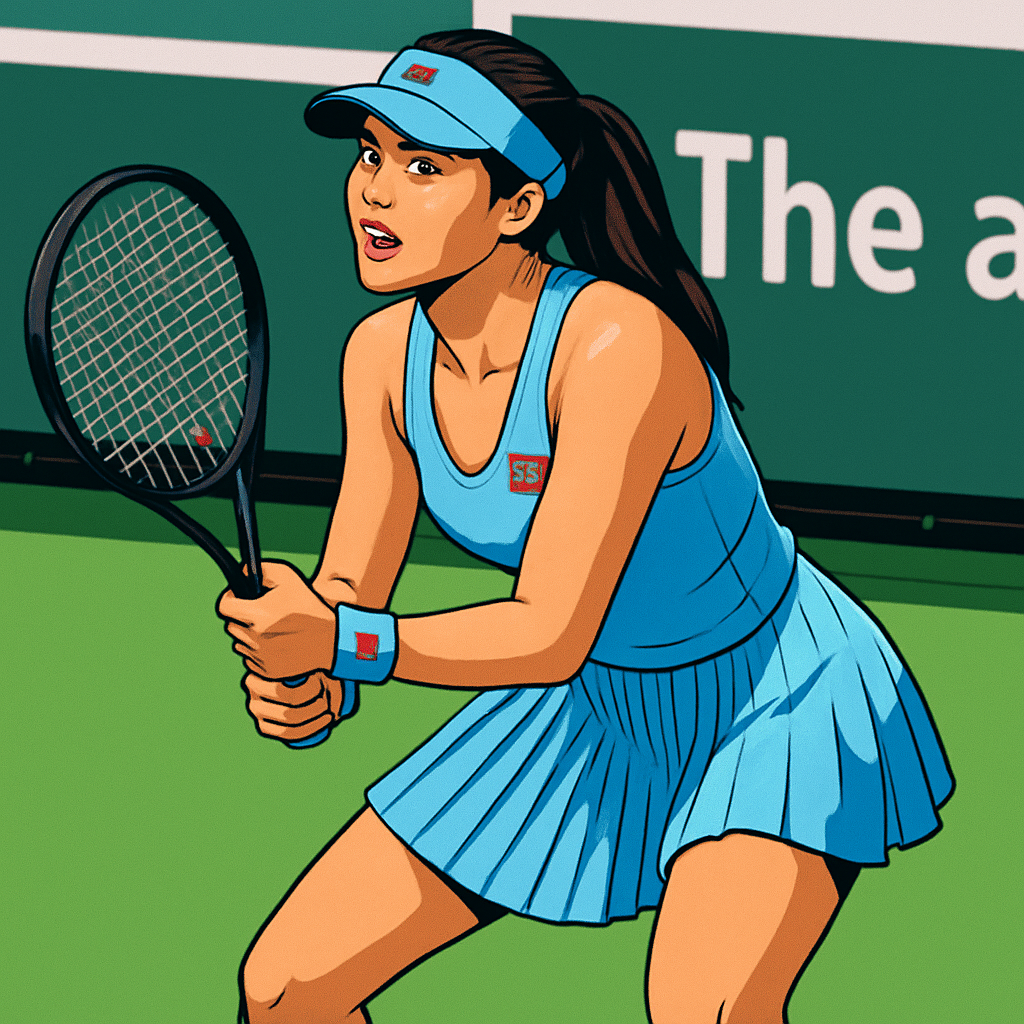
INDIAN WELLS — Emma Raducanu has offered a candid and revealing assessment of her game and her current standing in the sport following a heavy defeat at the BNP Paribas Open, a loss that laid bare the scale of the challenge ahead in her comeback journey.
The 2021 US Open champion was soundly beaten 6-3, 6-0 in the second round by world No. 2 Aryna Sabalenka, a match that lasted just 65 minutes. While the result against a two-time Grand Slam champion was not unexpected, the manner of the defeat—particularly a second-set bagel—prompted Raducanu to break her silence with an unusually frank post-mortem.
A Stark Reality Check on the Tour
Raducanu, now ranked No. 250, did not shy away from the reality of the gulf in class. She admitted that the match served as a clear benchmark, highlighting the difference between her current level and that of the game's elite. "I think it just shows the level where she's at and the level where I'm at right now," Raducanu stated plainly. The 21-year-old acknowledged that Sabalenka's power and consistency from the first ball were overwhelming, leaving little room for her to implement any tactical plan.
The British star pointed to a specific, technical deficiency that was ruthlessly exposed: her second serve. Sabalenka, one of the fiercest ball-strikers on tour, attacked Raducanu's vulnerable second delivery relentlessly. "My second serve, I think she was teeing off on that," Raducanu admitted. "I wasn't hitting it with enough conviction or accuracy. It was just sitting there, and she was having a field day." This technical weakness cascaded into broader issues, eroding her confidence on first serves and her overall game.
The Long Road Back: Patience and Perspective
Perhaps the most telling admission from Raducanu was her perspective on time and expectation. Having missed much of the 2023 season after surgeries on both wrists and an ankle, she is effectively in the early stages of a rebuild. She pushed back against the notion that her fairytale Flushing Meadows triumph should set an immediate benchmark for her current performances.
"I think that for me, I need to realize that that was two and a half years ago," she said of her US Open win. "I need to almost just cut myself some slack and realize that I've come back from surgery, I'm still building. I'm not at the level where I was physically or tennis-wise... I'm just taking time to build back." This public acknowledgment of needing patience marks a significant shift in narrative, both for herself and the public watching her.
Raducanu outlined the key areas she is focused on improving, which read like a comprehensive checklist for a player reconstructing her game:
- Physical Foundation: Building the durability and athleticism to withstand the grind of the tour after a long layoff.
- Serve Mechanics: Specifically, developing a more potent and reliable second serve that doesn't become an instant liability.
- Competitive Sharpness: Regaining the match toughness and point-by-point focus that defines top-level play.
- Technical Refinement: Sharpening all aspects of her game under the pressure of elite competition.
She emphasized that these are not quick fixes, but the essential building blocks for a sustainable return to the top. "It's just going to take me time and patience to keep building until I'm ready to compete with these girls again," she concluded.
External Noise and Internal Focus
The match at Indian Wells was also notable for a controversial moment where Sabalenka requested medical treatment off-court for what appeared to a non-visible issue, a move that sparked debate among pundits. When asked about the disruption, Raducanu displayed a mature detachment, focusing only on what she could control.
"I don't really know. I don't want to comment on that because I don't want to get fined," she said with a smile, before adding, "For me, I was just trying to focus on my end, and whatever was happening with her, I hope she's okay. But for me, it was just about what I could control." This response underscored a player determined to filter out external distractions and concentrate on her own arduous process.
The reaction from the tennis community has been largely supportive of Raducanu's honest appraisal. Many analysts see her clear-eyed assessment not as a sign of defeatism, but as the first, necessary step in a realistic comeback plan. By publicly defining the gap and her roadmap to close it, she is managing expectations and framing her journey on her own terms.
Looking Ahead: Miami and Beyond
Raducanu's immediate focus shifts to the Miami Open, another prestigious WTA 1000 event, where she has been granted a main-draw wildcard. The tournament presents a swift opportunity to apply the lessons from Indian Wells. The draw will be another test, potentially pitting her against another seeded player early on.
Her comments suggest a player who, while bruised by a heavy defeat, is perhaps more mentally clear about her path than at any point since her return. The magical fortnight in New York created a phenomenon, but the last two years have been a harsh education in the relentless demands of professional tennis. Her admission at Indian Wells signifies an acceptance of that reality.
In closing, Raducanu's revelation is less about a single pummeling on court and more about a strategic recalibration off it. By admitting her current limitations and the work required, she is attempting to swap the overwhelming burden of past glory for the manageable grind of daily improvement. The road back to competing with the Sabalenkas of the tour is long, but for the first time in a while, Emma Raducanu seems to have a clear map in hand, even if the destination remains distant.