
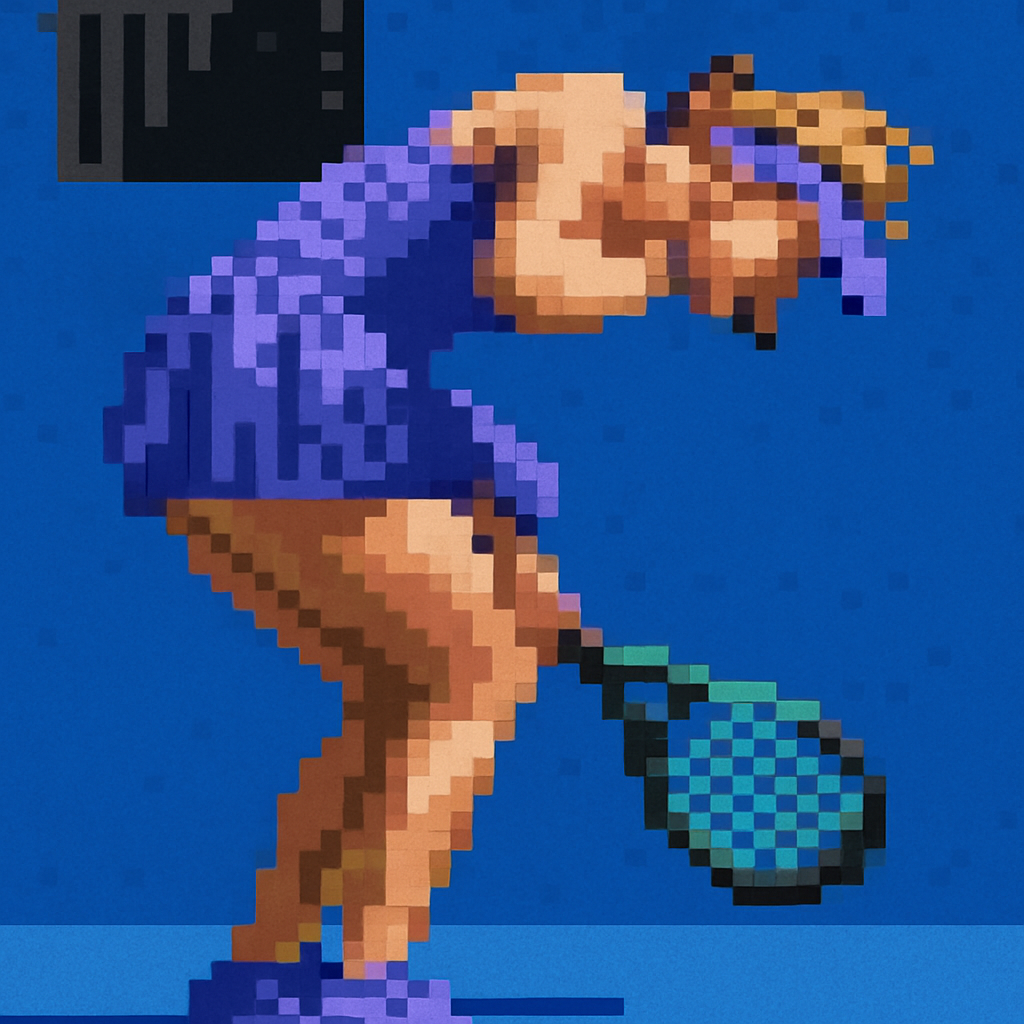
INDIAN WELLS — The intense pressure of professional tennis can sometimes boil over, even for its most promising young stars. At the 2024 BNP Paribas Open, 16-year-old Russian phenom Mirra Andreeva provided a stark reminder of this, unleashing a torrent of frustration on herself and her equipment during a tense third-round match against France's Diane Parry.
The incident, which has sparked widespread discussion about on-court conduct and the immense expectations placed on teenage sensations, saw Andreeva repeatedly slap her own thigh and ultimately hurl her racket to the ground in a moment of pure exasperation. This emotional explosion did not go unpunished, as the chair umpire promptly issued a code violation for racket abuse, a decision that proved costly in the tightly contested match.
A Tight Battle and a Boiling Point
Andreeva, who had stormed into the third round with impressive victories, found herself locked in a grueling battle against the crafty Parry. After splitting the first two sets, the decisive third set was a tense affair, with both players fighting for every point. The flashpoint came with Andreeva serving at 2-3 and 15-30. After losing a demanding rally, the teenager's frustration visibly overflowed.
Turning away from the net, Andreeva began forcefully whacking her left thigh with her racket strings multiple times, a physical manifestation of her anger at the error. The self-reprimand, however, quickly escalated. As she walked back to the baseline, she forcefully slammed her racket onto the hard court, sending it bouncing away. The audible thud and the violent action left no room for ambiguity, and chair umpire Julie Kjendlie immediately announced the code violation.
The penalty came at a critical juncture. Instead of 15-30, Parry was awarded a point, putting her at 15-40 and earning two break points. She converted on her first opportunity, seizing a 4-2 lead in the final set. While Andreeva battled to the end, the momentum had decisively shifted, and Parry closed out the match 7-5, 1-6, 6-3.
Andreeva's Candid Post-Match Reflection
Known for her mature perspective and candidness in press conferences, Andreeva did not shy away from addressing the incident after the match. She expressed regret for her actions, acknowledging the inappropriateness of her behavior while also offering insight into the mental struggle she was experiencing on court. "I regret what I've done, of course. I shouldn't have done that," she stated plainly.
She elaborated on the psychological battle, explaining that her frustration stemmed from an inability to execute her game plan under pressure. "I was just a bit crazy in that moment. I couldn't manage to do what I wanted to do on court. I had a plan, but it was not working at all." This admission highlights the gap between tactical understanding and on-court execution, a common source of frustration for players at every level.
Andreeva also revealed a telling internal dialogue, showcasing the high standards she sets for herself. "I was just talking to myself, saying that I'm so bad, that I cannot put the ball on the court, that I'm doing so many mistakes, that I cannot serve, that I cannot do anything." This harsh self-criticism, while a driver of her rapid improvement, can also become a destructive force during the heat of competition.
The Broader Context: Pressure and Precedent
The incident at Indian Wells is not an isolated moment for Andreeva, nor is it uncommon in the high-stakes world of professional tennis. However, it places a spotlight on the unique pressures faced by a player who has been labeled a "future Grand Slam champion" since her breakout run to the fourth round of Wimbledon at just 16 years old. The expectations are immense, and every match is dissected.
Tennis has a long and complicated history with on-court conduct. While the sport celebrates passionate displays of emotion, it draws a firm line at actions deemed destructive or abusive. The rules are clear:
- Racket Abuse: Intentionally damaging or throwing a racket is a standard code violation, punishable by a warning, point penalty, or even game penalty depending on the severity and context.
- Verbal Abuse: Using profane or offensive language towards an official, opponent, or spectator.
- Audible Obscenity: A swear word heard by officials or the crowd.
- Unsportsmanlike Conduct: A broader category covering any behavior deemed contrary to the integrity of the game.
Andreeva's violation was straightforward, and the umpire's application of the rule was by the book. The consequence—an immediate point penalty—directly impacted the score at a pivotal moment, serving as a harsh but objective lesson in the cost of lost composure.
A Learning Moment on a Grand Stage
For many young players, such public moments of frustration become crucial learning experiences. The tennis world has witnessed legendary players like John McEnroe, Serena Williams, and Andy Murray have famous outbursts early in their careers, from which they learned to channel their emotions. The key for Andreeva will be in how she processes this event. Her post-match honesty suggests a level of self-awareness that bodes well for her development.
Veteran coaches and psychologists often note that managing the emotional rollercoaster of a match is as important a skill as a powerful forehand or a reliable serve. The ability to reset after a bad point, to accept mistakes without spiraling, and to maintain tactical clarity under stress separates the very best from the rest. Andreeva's challenge is to harness her intense competitive fire without letting it consume her.
Reaction from the Tennis Community
Reaction to the incident has been mixed, reflecting the perennial debate in tennis about passion versus discipline. Some fans and pundits expressed sympathy, noting her youth and the immense pressure. Others were unequivocal, stating that such behavior has no place on court and that the penalty was justified and necessary to maintain standards.
Notably, the response has largely focused on Andreeva's potential and the hope that this serves as a growth opportunity. There is a widespread recognition of her extraordinary talent and mental fortitude in big matches, qualities that make this lapse in composure a notable exception rather than a pattern.
Conclusion: A Step on the Path to Maturity
Mirra Andreeva's racket-throwing incident at Indian Wells was a dramatic, punishable, and public loss of cool. Yet, within that moment lies a valuable chapter in the education of a potential future champion. The violation cost her a critical point at a critical time, a concrete consequence for an emotional action. More importantly, her thoughtful and regretful analysis afterward demonstrates a maturity that belies her 16 years.
The journey from prodigy to champion is rarely linear. It is paved with technical refinement, physical development, and, crucially, emotional growth. For Andreeva, the lesson from the desert is clear: her passion and drive are immense assets, but mastering them is the next frontier. As she herself acknowledged, the key is finding a way to compete with her whole heart without letting frustration break her focus or her racket. The tennis world will be watching, expecting this formidable talent to learn and rise from this experience.