
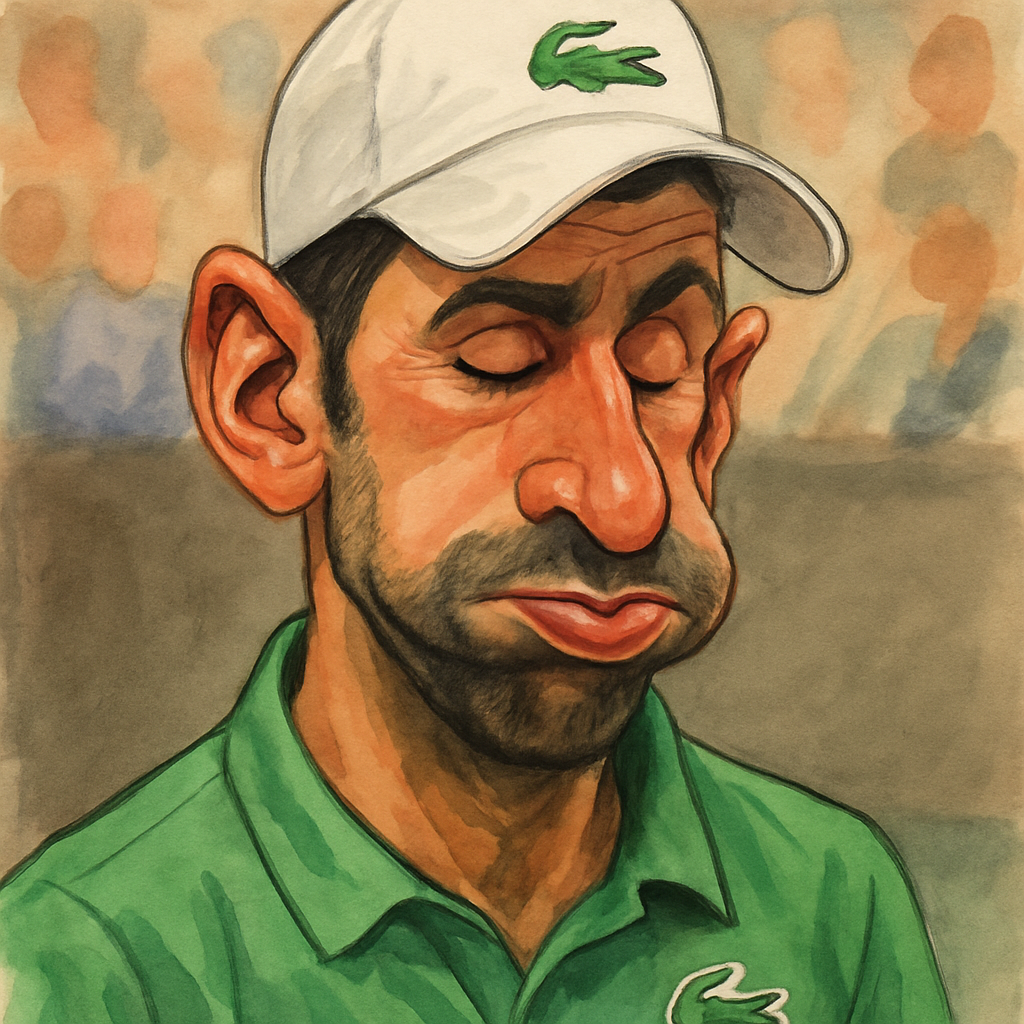
MELBOURNE — Novak Djokovic’s quest for an unprecedented 25th Grand Slam title and an 11th Australian Open crown remains alive, but it advanced in the most improbable and anticlimactic fashion imaginable. On a sweltering Wednesday night at Rod Laver Arena, the world No. 1 scraped into the semi-finals after his Italian opponent, the 25th-seeded Lorenzo Musetti, was forced to retire due to injury while leading two sets to one.
The final scoreline of 6-4, 6-7(4), 2-6, 6-3, 2-0 (ret.) tells only part of the story of a bizarre and dramatic quarter-final. For over three hours, Djokovic looked uncharacteristically vulnerable, struggling with his movement and rhythm, while Musetti played inspired, fearless tennis. The Serbian’s path to a record-extending 48th major semi-final was paved not with his typical dominance, but with grim perseverance and a cruel twist of fate for his younger rival.
A Rocky Start and a Musetti Masterclass
Djokovic began the match with visible physical discomfort, lacking his usual explosive side-to-side movement. He took the first set 6-4, but it was a battle. The turning point came in the second set tie-break. Musetti, deploying a breathtaking array of single-handed backhands, drop shots, and net rushes, seized control. He won the tie-break 7-4 and carried that momentum into a stunning third set, breaking Djokovic twice to take it 6-2.
The Italian was dictating play, his elegant, varied game causing Djokovic constant problems. The defending champion was visibly frustrated, gesturing to his team and struggling to find answers. The prospect of a seismic upset, and Djokovic’s first loss at the Australian Open since 2018, felt palpably real. "Musetti was simply the better player for two sets," one commentator noted.
The Tide Turns and a Heartbreaking Exit
The fourth set saw a shift. Djokovic, renowned for his ability to elevate his game when cornered, began to find his range. He broke Musetti’s serve early and held on to take the set 6-3, forcing a decider. However, the narrative changed irrevocably at the changeover. Musetti, who had received treatment on his lower back and right hip earlier, began to visibly labor. His movement became severely restricted.
After losing the first two games of the fifth set, Musetti walked to the net, his head bowed, and offered his hand in concession. The capacity crowd, which had been treated to a spectacular contest, fell into a stunned silence before offering sympathetic applause. The Italian later explained his difficult decision in a press conference, stating, "I had a problem with my back. Then I had a problem with my hip. I couldn't push anymore on the serve. I couldn't slide. I couldn't run."
Djokovic's Candid Assessment and Relief
For Djokovic, the victory was a mixture of relief and frustration. In his on-court interview, he was gracious but honest about his own performance. "Obviously, I was struggling with my movement a bit, especially in the first two sets," he admitted. "He was the better player for two sets. I was lucky to get through that fourth set."
He was also full of praise for Musetti and empathy for the unfortunate ending. "He played a fantastic match. He's a great talent. It's really unfortunate for him to finish the match this way. I feel for him. I sincerely hope he recovers quickly." The win marked Djokovic’s 33rd consecutive victory at the Australian Open, yet it was arguably one of the most precarious of that historic run.
The Road Ahead: A Monumental Semi-final
The victory sets up a blockbuster semi-final clash that the tennis world has been anticipating for weeks: Novak Djokovic versus Jannik Sinner. The young Italian fourth seed has been the form player of the tournament, blitzing through the draw without dropping a single set. His path to the last four included a commanding 6-4, 7-6(5), 6-3 victory over Andrey Rublev.
The contrast in their journeys is stark. Consider their tournament statistics leading into the semi-final:
- Sinner's Dominance: Has not lost a set; spent nearly 5 hours less on court than Djokovic.
- Djokovic's Struggle: Dropped sets in three of his five matches; visibly battled illness and physical issues.
- Head-to-Head: Djokovic leads 4-2, but Sinner won two of their three meetings in late 2023.
Sinner presents a formidable challenge. His powerful, flat groundstrokes, particularly his bullet-like backhand, can penetrate the court and push Djokovic back. More importantly, he carries the confidence of recent wins over the legend and the energy of a flawless campaign. Djokovic, meanwhile, will have 48 hours to recover and recalibrate. He acknowledged the challenge ahead, saying, "He's playing the best tennis of his life. It's going to be a huge challenge."
A Bittersweet Passage to History
While Djokovic’s semi-final berth keeps his historic ambitions intact, the manner of this victory leaves more questions than answers. His physical condition, which he has described as a combination of a virus and general "rust" after a light preparation, remains a significant concern. The aura of invincibility at Melbourne Park has been pierced, even if the fortress walls ultimately held.
For Lorenzo Musetti, the night was one of heartbreaking "what ifs." He had outplayed the greatest player in the history of the tournament for long stretches, showcasing a performance that promised a career-defining breakthrough. His retirement was a sobering reminder of the physical brutality of best-of-five-set tennis at the highest level.
As the tournament moves into its final stages, the narrative is clear: a seemingly vulnerable Novak Djokovic, a king clinging to his throne, must now face his most dangerous and in-form challenger. Jannik Sinner, fresh, confident, and ruthless, represents the new generation knocking loudly at the door. Friday’s semi-final is no longer just a match; it is a potential passing of the torch, or a defiant reassertion of a dynasty. Djokovic is through, but his path to immortality just got exponentially tougher.