
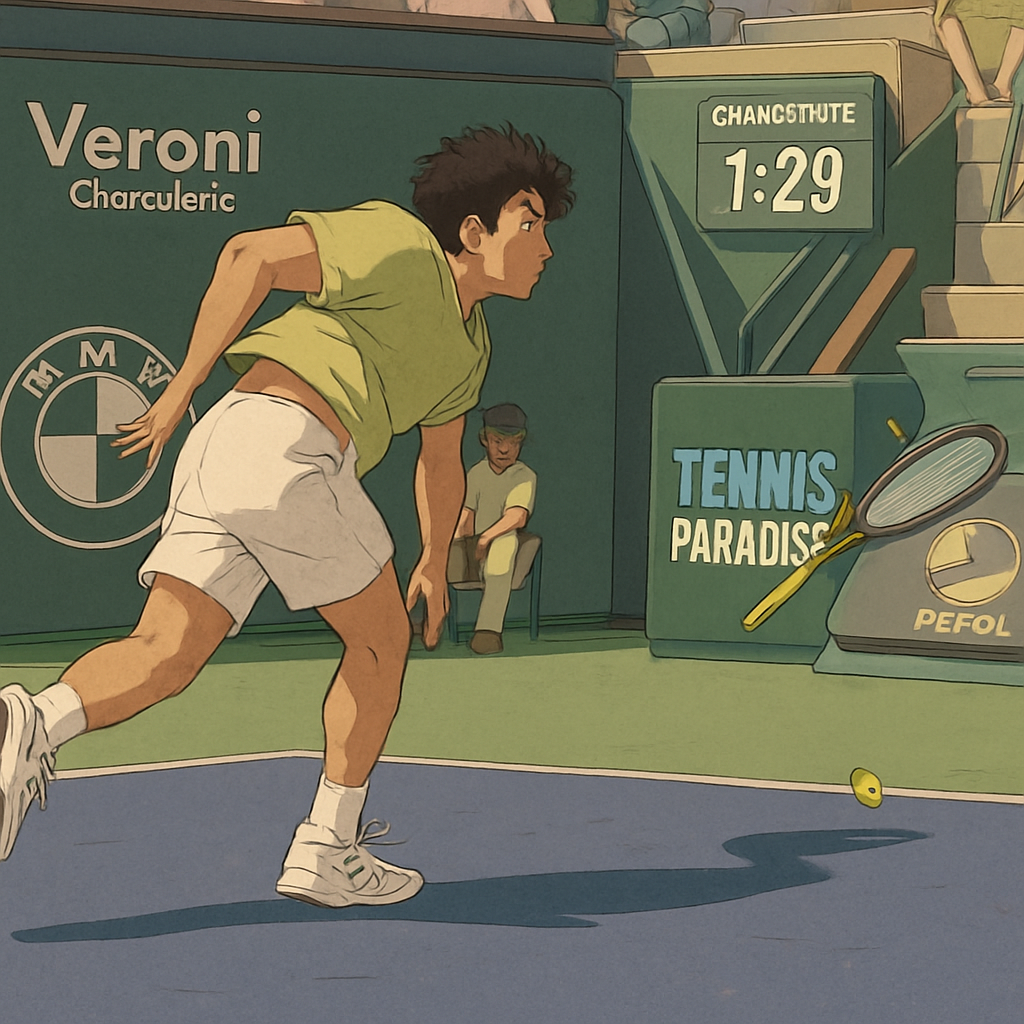
INDIAN WELLS — The fiery passion and raw emotion of professional tennis were on full display at the BNP Paribas Open on Tuesday, as French teenage sensation Arthur Fils unleashed a spectacularly destructive outburst that has become the talk of the tournament. After falling a double-break down in the final set of his second-round match against Roman Safiullin, the 19-year-old obliterated his racket in a fit of frustration, before dramatically discarding the mangled remains into a nearby courtside trash bin.
The incident occurred with Fils trailing 4-1 in the third set against the Russian. Having fought back from a set down to level the match, the young Frenchman’s game unraveled, culminating in a costly error that handed Safiullin the decisive break. In a moment of pure, unadulterated fury, Fils slammed his Yonex racket into the hard court surface not once, but multiple times, reducing the frame to a twisted, stringless wreck.
A Point of No Return and a Symbolic Toss
The destruction of equipment is a common, if costly and penalizable, sight on the tennis tour. What made Fils’ meltdown uniquely theatrical was the second act. After surveying the damage he had inflicted, he didn't simply hand the broken tool to a ball kid or leave it by his chair. Instead, he picked up the carcass of the racket, walked calmly to a large green trash bin positioned just behind the baseline, and unceremoniously dumped it inside. The gesture was a symbolic, almost final, severance from the frustration of the moment. As one social media user quipped, "Arthur Fils didn't just break his racket, he gave it a full funeral."
Unsurprisingly, the act drew an immediate code violation for racket abuse from the chair umpire. Fils, currently ranked a career-high World No. 36, could only offer a wry, resigned smile as he fetched a new racket from his bag. The psychological reset seemed minimal, as Safiullin comfortably held serve in the next game and soon closed out the match 6-4, 4-6, 6-1. Fils’ explosive exit from the tournament was complete.
The Fine Line Between Passion and Penalty
Racket-smashing sits in a grey area of fan perception. To some, it’s an embarrassing display of poor sportsmanship and a lack of emotional control. To others, it’s a visceral, relatable expression of the immense pressure and self-expectation these athletes carry. For a player like Arthur Fils, known for his explosive power and energetic demeanor, such outbursts are becoming a noted part of his burgeoning profile. This incident follows a similar display at the ATP event in Marseille just weeks prior, prompting discussion about his on-court temperament.
The consequences are tangible. Beyond the immediate code violation (which can escalate to point penalties for subsequent offenses), players face direct financial hits:
- Tournament Fines: The ATP fines players for racket abuse. The standard penalty is $2,500 for a first offense during a tournament, but this can increase.
- Equipment Costs: A professional tennis racket, often customized and strung with specific tensions, is not cheap. Destroying one is literally throwing away hundreds of dollars.
- Brand Relations: While equipment sponsors expect wear and tear, public destruction of their product is not an ideal advertisement.
Tennis legend John McEnroe, whose own combustible court behavior is the stuff of legend, has often commented on the modern game’s handling of emotion. In a recent interview, he noted, "The passion is what makes this sport great. The trick is channeling it. Sometimes it boils over. You pay the fine, you learn, you move on." Whether Fils views his bin-toss as a learning moment remains to be seen.
Fan and Pundit Reaction: Viral Moment
The moment was instantly viral, dominating highlight reels and social media feeds. Reactions were mixed but largely entertained by the sheer audacity of the disposal. Many drew comparisons to the infamous 1995 US Open incident where Jeff Tarango’s wife slapped a chair umpire, suggesting Fils’ act was a more victimless, if dramatic, crime. Tennis journalist Ben Rothenberg posted on X, "Arthur Fils committing to the bit. Most players just break it and leave the corpse. He gave his racket a proper burial."
Others, however, expressed concern. Former player and analyst Brad Gilbert emphasized the mental cost, stating, "That kind of release feels good for a second, but it’s an admission of defeat. You’re telling your opponent and yourself that you have no answers left. At 19, he’s got to find a way to problem-solve in the fire." The consensus among pundits is that while the spectacle is memorable, long-term success at the highest level requires mastering those internal fires, not fueling them.
A Glimpse into the Modern Athlete's Mindset
In the post-match press conference, Fils addressed the incident with a blend of contrition and nonchalance characteristic of his generation. "Yeah, I lost my temper. It’s not good, I know. The racket… it was not working anymore, so…" he said with a shrug and a faint smile. "I will pay the fine, for sure. It’s a lot of money, but in that moment, you are not thinking about this. You are just angry with yourself. I need to be better."
This candid response highlights a duality in modern sports: the immense pressure to be a polished professional while acknowledging the very human, unpolished emotions that competition evokes. Fils’ coach, Sergi Bruguera, will likely work on channeling that competitive fury. The energy and passion are assets; the key is directing them inward to fuel a comeback, rather than outwardly in a destructive act that signals surrender.
Conclusion: More Than Just a Broken Racket
Arthur Fils’ racket-smashing, bin-tossing outburst at Indian Wells was more than a mere temper tantrum. It was a symbolic, viral-ready moment that encapsulates the intense pressures of the tour, the fine line athletes walk between passion and penalty, and the ongoing evolution of on-court behavior in the social media age. While the act itself likely cost him a few thousand dollars and added a line to his disciplinary record, it also cemented his reputation as one of the tour’s most electrifying and emotionally transparent characters.
The true test will be how he responds. The greats of the game—from McEnroe to Djokovic—have all had their moments of fiery release, but they learned to harness that fire as a weapon. Whether Arthur Fils uses the experience as a stepping stone to greater mental fortitude or continues to provide viral meltdown moments will be a compelling subplot to his undoubted talent. For now, the image of that racket in the trash bin serves as a powerful reminder: in tennis, sometimes it’s not just points and matches that get discarded, but the very tools of the trade in a blaze of glory and frustration.