
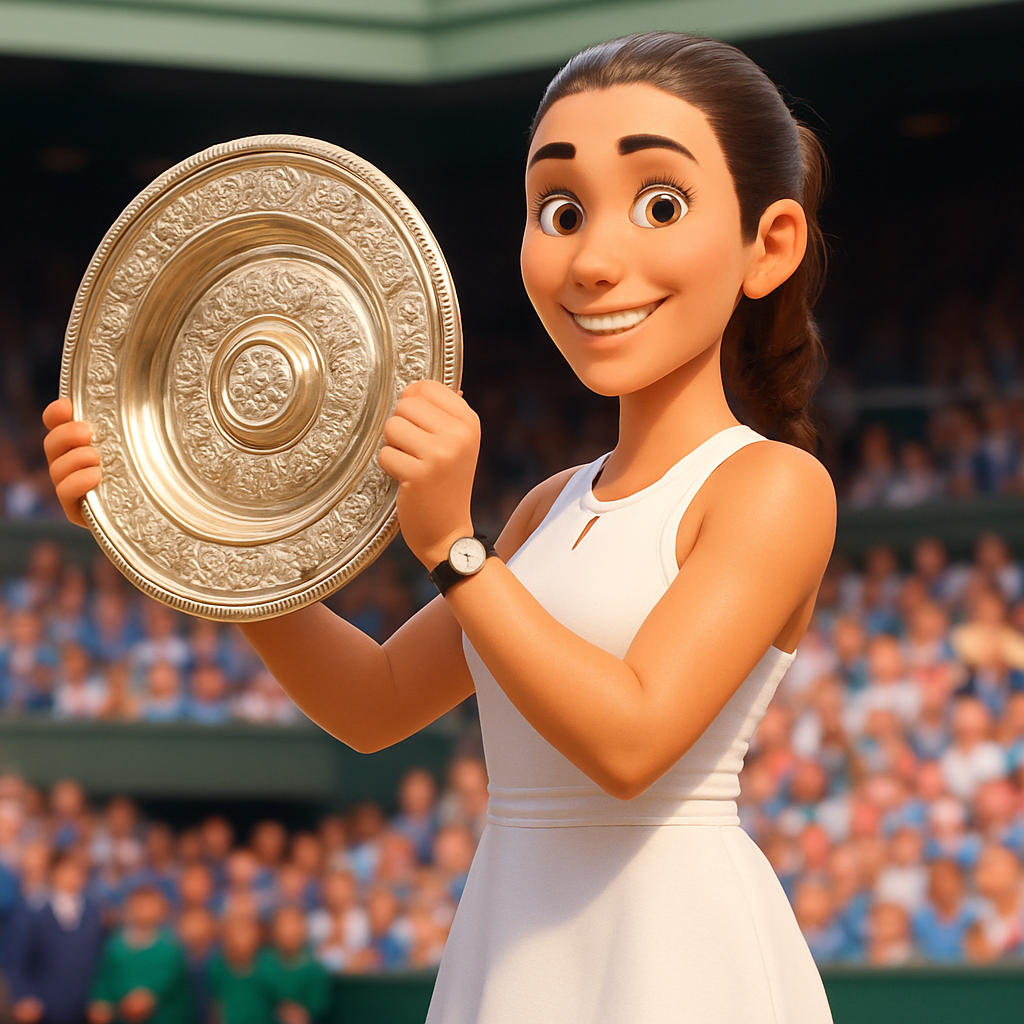
LONDON — In the world of professional sports, few debates are as enduring or as stark as the one surrounding the physical performance gap between elite male and female athletes. For tennis, a sport with equal prize money and parallel tours, this conversation often centers on a hypothetical match-up. Recently, a former Wimbledon champion provided a sobering, first-hand perspective that cuts through the speculation with cold, hard reality.
Martina Navratilova, the nine-time Wimbledon singles champion, has long been vocal on the subject. But her comments are echoed by a chorus of other legendary female players. In various interviews, they have recounted their experiences playing against men—often college players or mid-level club competitors—and the humbling results. The consensus is unanimous and unequivocal: the gulf in power, speed, and athleticism is so vast that even the greatest female champions in history could not compete with a moderately skilled male player.
The Humbling Reality of Mixed Practice Sessions
Many top female pros have incorporated practice sessions with male players into their training regimens. The goal is to face faster serves, heavier groundstrokes, and a more aggressive net game to sharpen their own skills. These sessions, however, often serve as a stark benchmark. Serena Williams, widely considered the greatest female player of all time, addressed this directly in a 2013 interview with Rolling Stone.
She speculated about how she would fare against a top male player, humorously ranking herself around "like 700 in the world" on the ATP Tour. More tellingly, she and her sister Venus famously faced Braasch, a German player ranked 203rd at the time, in 1998. After the sisters boasted they could beat any man outside the top 200, Braasch, then 31 and reportedly not training at his peak, played them back-to-back. He defeated Serena 6-1 and Venus 6-2.
The story is not an anomaly. In 2012, former French Open champion Francesca Schiavone trained with a young Italian male player ranked outside the ATP's top 800. She was stunned by the difference. "I was playing with a guy who was 800 in the world, and I couldn't beat him," she told The New York Times. "I couldn't even score a point. It was a completely different sport."
Breaking Down the Physical Disparity
The reasons for this chasm are rooted in fundamental biological differences. While skill, strategy, and mental fortitude are comparable at the elite level, the raw physical outputs are not. This isn't a commentary on effort or talent, but on the physiological realities of average male versus female athletic potential. The differences manifest in several key areas that directly dictate the pace and power of the modern game:
- Serve Speed: A top male serve routinely exceeds 135 mph, with records pushing 160 mph. The fastest women's serves top out around 130 mph, with the average first serve in competition being significantly slower.
- Muscle Mass: Men naturally possess a higher percentage of lean muscle mass and greater fast-twitch muscle fiber capacity, translating to more explosive movement and shot generation.
- Court Coverage: Superior speed and stride length allow male players to defend a wider court, retrieving balls that would be winners against female opponents.
As seven-time Grand Slam champion Justine Henin explained, the difference isn't just in power, but in time. "The ball comes faster, you have less time to prepare your shot, and the spin is different, heavier. It changes everything in your timing and positioning," she said. This compression of reaction time is what often makes the match-up feel like "a different sport," as Schiavone described.
A Champion's Candid Admission
Perhaps the most cited commentary on this issue comes from John McEnroe, who in 2017 stated on NPR that while Serena Williams was the "greatest female player ever," she would be ranked "like 700 in the world" on the men's circuit. This sparked controversy, but Williams herself had already offered a similar assessment. The most poignant admissions, however, come from those who have directly tested the theory.
In a 2023 podcast, 1977 Wimbledon champion Virginia Wade discussed the topic with characteristic bluntness. "I've played against many men in practice, good club players, very good amateurs. I could give them a game, certainly, but beating them consistently? No," she said. "The strength they generate, even without perfect technique, is just on another level. A male amateur with a big serve and a willingness to come to net could be a nightmare."
Wade emphasized that this reality should not diminish the achievements of female athletes. Instead, it reframes them. Women's tennis, she argues, is a distinct athletic discipline that emphasizes different combinations of skill, stamina, and tactical nuance. Comparing the two directly, she suggests, is a futile exercise. "We are playing our own magnificent game at the absolute limits of female physical potential. That is the competition. That is the glory."
Separating Celebration from Comparison
The testimonies from champions like Wade, Schiavone, and the Williams sisters serve a crucial purpose: they ground a often hyperbolic debate in lived experience. This acknowledgment is not an admission of inferiority, but a statement of fact that helps define the separate but equal nature of the two professional tours. The WTA and ATP are parallel sporting endeavors, each representing the pinnacle of achievement within their respective athlete populations.
The insistence from legends that they could not beat a male amateur underscores a critical point for fans and commentators. As former world No. 1 Andy Murray has noted, the focus should be on appreciating the unique qualities of the women's game—its often longer rallies, strategic point construction, and diverse shot-making—rather than constantly measuring it against the men's power-based standard.
In an era where equality is rightly sought in pay, exposure, and respect, understanding this physical dichotomy is key. True equality in tennis means valuing the WTA tour for its own supreme excellence, not as a diluted version of the ATP. The candid confessions from Wimbledon champions are not a sign of weakness, but a powerful reminder that greatness exists on a spectrum. The most decorated female champion in history competing against a male amateur is not a fair fight, and recognizing that doesn't tarnish her legacy—it clarifies the monumental scale of her achievements within her own domain.
As Virginia Wade succinctly put it, "We have nothing to prove by beating a man. We have everything to prove by beating each other, and that's the battle we've dedicated our lives to. That's where the history is made." The history she refers to is no less grand, and the champions it crowns are no less legendary, for existing in a separate sphere of athletic endeavor.