
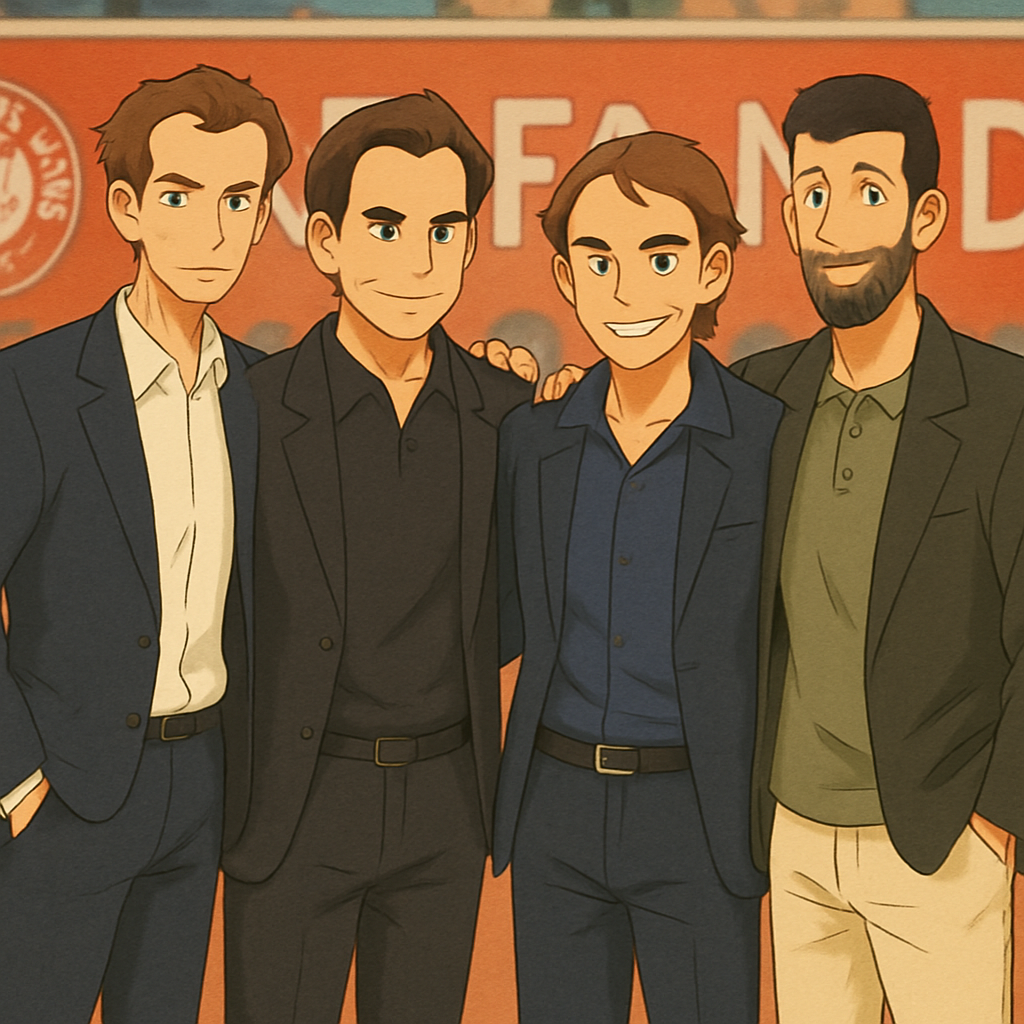
LONDON — For over a decade, the narrative of men’s tennis was dominated by a quartet, not a trio. Andy Murray, the dour Scot with a ferocious competitive heart, stood alongside Roger Federer, Rafael Nadal, and Novak Djokovic in what became known as the ‘Big Four’. Yet, in a recent and remarkably candid reflection, Murray peeled back the curtain on the psychological and physical toll of that era, admitting that facing the other three legends often made him feel, in his own words, "insignificant."
The confession came not in bitterness, but with the clarity of hindsight. Murray, a three-time Grand Slam champion, two-time Olympic gold medalist, and former world No. 1, spent years dissecting their games, pushing his body to its absolute limit, and wrestling with the monumental challenge of surpassing them. His journey was one of incredible triumph set against a backdrop of near-constant frustration, a testament to the unprecedented standard set by his rivals.
The Everest of Excellence: A Trio Unlike Any Other
To understand Murray’s feeling of insignificance, one must first grasp the sheer statistical and stylistic dominance of Federer, Nadal, and Djokovic. They didn’t just win tournaments; they redefined the sport’s possibilities. Federer brought a balletic, effortless grace that masked a ruthless efficiency. Nadal introduced a new dimension of physicality and spin, a hurricane of topspin from the left side. Djokovic perfected the art of elastic defense and unbreakable mental fortitude. Murray observed, "When they were at their best, I sometimes felt like I was playing a different sport. The margin for error against them was zero."
Their collective resume is staggering. They have, as of 2024, won 66 of the last 80 Grand Slam tournaments, a period spanning nearly 20 years. Each has completed the career Grand Slam. Each has held the world No. 1 ranking for over 200 weeks. Competing in this era meant that a player’s career, no matter how brilliant, was inevitably measured against this golden benchmark. For Murray, his greatest successes were often framed as breakthroughs against an impenetrable oligarchy.
The Psychological Battle: More Than Just Tennis
The feeling of insignificance stemmed not from a lack of self-belief, but from the relentless pressure and perfection required. Murray detailed the exhaustive preparation: "You’d spend two weeks getting ready for Rafa on clay, working specifically on handling his spin, and then you’d lose in four sets. Next month, you’d face Roger on grass and it was a completely different puzzle. Just as you thought you had a solution, Novak would emerge, absorbing everything and turning defense into offense in a blink."
This cyclical challenge created a unique mental burden. The Big Three possessed an aura of inevitability, particularly in the latter stages of majors. Murray reached 11 Grand Slam finals, winning three. The eight losses all came to Federer or Djokovic. The cumulative weight of those defeats, each requiring a Herculean effort just to reach the final stage, chipped away at even the strongest mentality. He wasn't just losing matches; he was running into historical forces.
Specific Challenges Posed by Each Legend
Breaking down the matchups highlights why Murray felt so overwhelmed:
- Federer: "His serve was a weapon, but it was the variety and the disguise. You never knew if he was going to chip and charge, hit a winner from nowhere, or just move you around until you made a mistake. He made the difficult look trivial."
- Nadal: "It was a physical and mental war of attrition. You had to win every point three times over. The topspin to your backhand was a constant, grinding pressure. He never gave you a free moment, never a cheap point."
- Djokovic: "Novak took the sport to a place of pure physical elasticity and mental resilience. His ability to return serve, to slide on any surface, and to raise his level at the most critical moments felt almost superhuman."
The Lonely Pursuit of Breaking Through
Murray’s breakthrough moments—his 2012 Olympic gold over Federer at Wimbledon, his 2013 Wimbledon title ending Britain's 77-year wait, his 2016 Wimbledon title and year-end No. 1 finish—are all the more heroic when viewed through this lens. They were victories snatched from the jaws of a history that seemed predetermined. The 2012 Olympic final, in particular, was a cathartic release. "To beat Roger on Centre Court, after losing to him in the Wimbledon final a month earlier, was the moment I truly believed I could live with them," he recalled.
Yet, even at his peak, the shadow was long. His ascent to world No. 1 in 2016 required a staggering, body-breaking run of form to overtake an injured Djokovic, a feat he achieved but could not sustain due to the physical cost. His hip injury, which ultimately required major surgery, was in many ways a direct consequence of the brutal, physical style he had to adopt to compete with Nadal and Djokovic over thousands of hours on court.
A Legacy Forged in the Crucible
Today, with his career winding down, Murray’s perspective is one of hard-earned respect mixed with sober realism. The feeling of insignificance has transformed into a profound understanding of his own place in history. "I pushed my body and mind as far as I possibly could. I won what I won. But to have done it in any other era, I would have won more. That’s just a fact," he stated plainly.
His candid admission does not diminish his achievements; it elevates them. It underscores that his titles were not just victories in a tournament, but conquests against a tide of sporting destiny. He made the Big Four a reality, forcing his name into a conversation that many thought would only ever include three. While Federer, Nadal, and Djokovic made him feel insignificant through their otherworldly prowess, Andy Murray’s relentless pursuit in the face of that feeling is what makes his career significant, inspirational, and ultimately, legendary in its own right.
In the end, Murray’s story is the ultimate competitor’s paradox: to spend a career feeling small in the shadow of giants, only to be remembered as a giant himself for having the courage to stand there and fight, time and time again.