
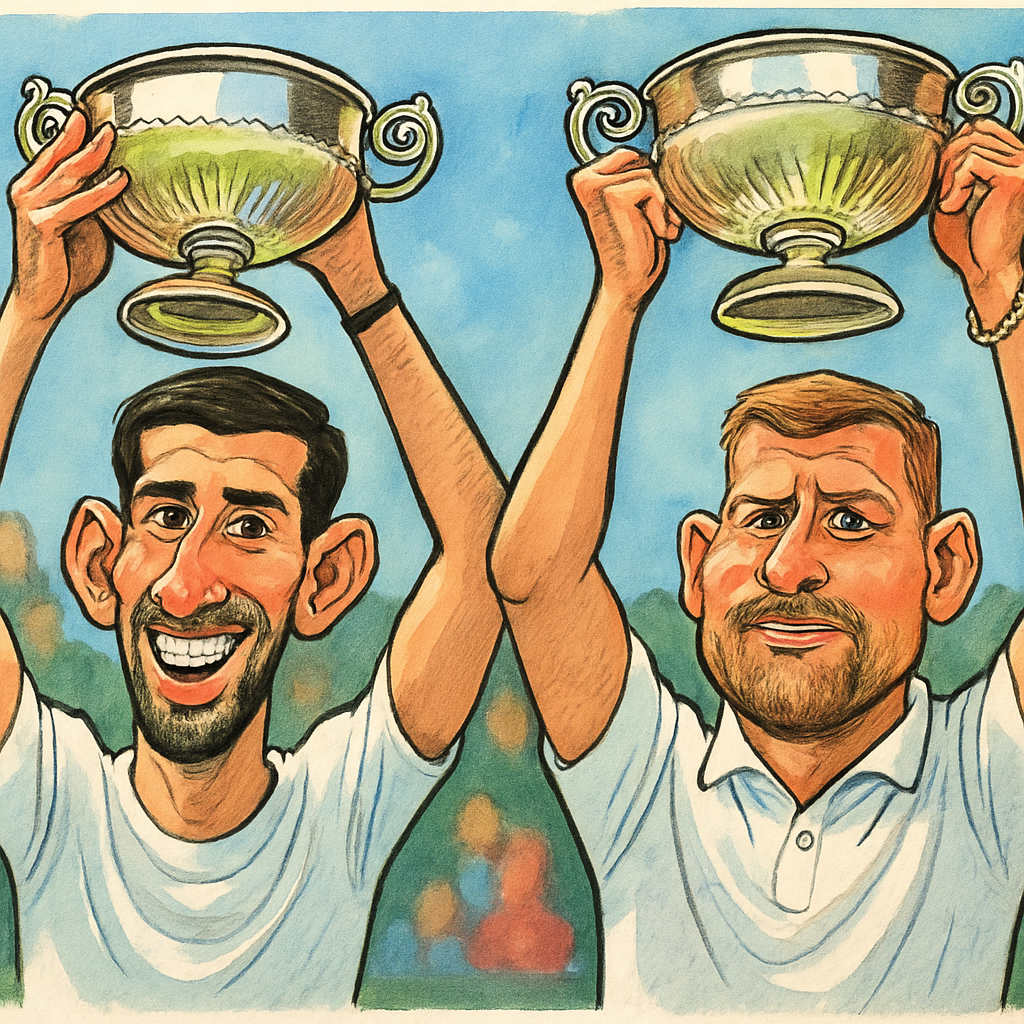
LONDON — For 89 long years, the Wimbledon men’s doubles trophy had eluded an all-British pairing, a drought stretching back to the era of Fred Perry and Pat Hughes in 1934. That staggering statistic was finally, gloriously, put to rest on a sun-drenched Centre Court in July 2023, not by household singles stars, but by two unassuming, hard-grafting doubles specialists: Julian Cash and Lloyd Glasspool. Their victory was a masterclass in partnership and perseverance, but the story of their celebration—a journey from the hallowed lawns of SW19 to the neon lights of a Croydon nightclub and finally to the gilded halls of Buckingham Palace—is a uniquely British tale of sporting triumph.
The Moment of History on Centre Court
The final itself was a tense, gripping affair against the formidable 15th seeds, Marcelo Arévalo of El Salvador and Jean-Julien Rojer of the Netherlands. Cash and Glasspool, playing with a synergy forged through years on the Challenger circuit, claimed the first set in a tie-break, lost the second, but rallied to dominate the third. The winning moment, a perfectly placed volley, sparked scenes of unbridled joy. "It's pretty surreal, to be honest," Glasspool confessed immediately after the match, his voice thick with emotion. "We've dreamed of this since we were kids. To do it here, at Wimbledon, as the first British pair in 89 years... there are no words."
For Cash, the win was the culmination of a career dedicated to the nuances of the doubles craft. "You grow up watching Wimbledon on TV, you play the junior events here, and you always wonder what it would be like to win the real thing," he said. "The weight of that history, the 89 years, it was in the back of our minds, but we used it as fuel rather than pressure." Their victory was a testament to a modern doubles approach built on big serves, aggressive net play, and an almost telepathic understanding of each other’s movement.
A Celebration for the Ages: From Trophy to Infernos
After the formalities—the trophy presentation, the press conferences, the initial champagne spray in the locker room—the duo faced a quintessential question: how does a modern British tennis champion celebrate? For Cash and Glasspool, the answer was refreshingly down-to-earth and spectacularly unexpected. Eschewing a private members' club in Mayfair, they embarked on a journey to Croydon, south London, to the legendary and famously raucous nightclub, Infernos. Clutching the Wimbledon trophy, they walked into the club, a scene immortalized in blurry, joyous social media videos.
"We just wanted to be with our friends, our team, people who had been on the journey with us," Glasspool later explained. "Infernos is an institution. It was loud, it was hot, it was absolutely chaotic—and it was perfect. The trophy got passed around, people were taking selfies with it on the dance floor. It was the most normal, insane celebration you could imagine."
The night became instant folklore. The contrast between the pristine, tradition-steeped Wimbledon and the vibrant, unpretentious chaos of Infernos captured the public’s imagination. It was a celebration that felt genuinely of the people, a reminder that beneath the elite athleticism, these were two young men savoring a lifelong dream with their nearest and dearest. Key moments from the night included:
- The iconic image of the Wimbledon trophy gleaming under Infernos' disco lights.
- The duo dancing to classic club anthems with their support team.
- Fans in the club, unaware of the historic guests, doing double-takes at the sight of the championship cup.
An Audience with Royalty
If Infernos represented one end of the British cultural spectrum, the next chapter of their victory tour represented the other. As is tradition for British Wimbledon champions, Cash and Glasspool were invited to a Royal Garden Party at Buckingham Palace. Trading their tennis kits and clubwear for morning suits, they presented their trophy to The Princess of Wales, Catherine, who is the Patron of the All England Lawn Tennis and Croquet Club. "It was a complete 180 from the night before, but equally incredible," Cash noted with a grin.
The meeting was a poignant full-circle moment. They discussed the final, the pressure of the occasion, and the significance of their win for British tennis. "She was incredibly knowledgeable about the match and genuinely interested in our journey," Glasspool said. "To stand there in the Palace gardens, talking about our win at Infernos... it was surreal."
The Legacy of the Win
Beyond the personal glory and the unforgettable celebrations, Cash and Glasspool’s victory has had a tangible impact on British tennis. It has:
- Inspired a new generation of doubles specialists, proving a Grand Slam is attainable.
- Highlighted the importance of dedicated doubles pathways and funding.
- Created a iconic, relatable story that bridges the gap between the sport's elite image and its public appeal.
Their partnership, built on mutual respect and a shared work ethic, demonstrates that success in modern tennis isn't confined to the singles court. "Doubles is a brilliant, tactical, and exciting sport," Cash asserts. "We hope our win shows kids that there's more than one way to reach the top of the game."
Conclusion: A Modern British Fairytale
The journey of Julian Cash and Lloyd Glasspool—from breaking an 89-year curse on Centre Court, to celebrating with the famous trophy in a packed nightclub, to presenting it to royalty—encapsulates a modern, multifaceted Britain. It is a story where historic achievement meets unscripted joy, and where tradition and populism can happily coexist. They did not just win a tennis tournament; they created a lasting narrative. As Glasspool perfectly summarized, "It was the best week of our lives. We made history, we partied where we wanted, and we met the Princess. You really couldn't write it." In doing so, they didn't just lift a trophy; they lifted the profile of their sport and provided a blueprint for celebration that will be remembered for the next 89 years.