
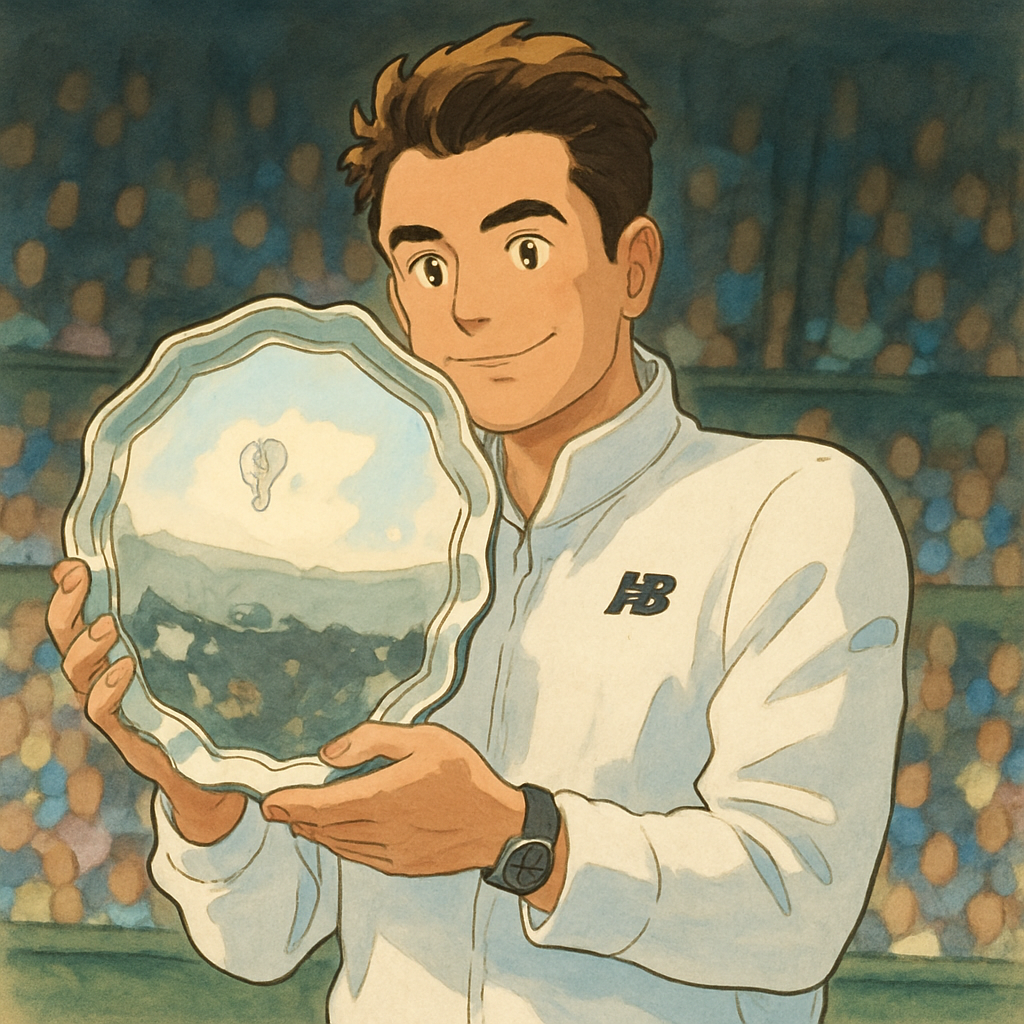
LONDON — The tennis world said farewell to one of its most distinctive and powerful forces on Wednesday as Milos Raonic, the Canadian star whose thunderous serve propelled him to a Wimbledon final and the world No. 3 ranking, announced his retirement from professional tennis at the age of 33.
In a heartfelt social media post, Raonic reflected on a career that saw him break barriers for Canadian tennis and captivate audiences with a game built around one of the most feared weapons in the sport's history. "I've had the chance to live out my dreams, and for that I consider myself the luckiest person," he wrote, sharing a video montage of his greatest on-court moments.
The Serve That Changed the Game
Milos Raonic’s career will forever be synonymous with the serve. Standing 6-foot-5 with a fluid, explosive motion, he didn't just hit aces; he delivered pronouncements. His serve was a spectacle of physics and intimidation, routinely clocking over 140 mph and leaving opponents often reduced to spectators. He finishes his career with over 8,200 aces, a staggering rate of 20.5 per match.
The numbers behind his service dominance are staggering:
- He holds the record for the most aces in a best-of-three-sets match (47).
- He is one of only three men to serve over 10,000 aces in his career.
- He led the ATP in aces per match for four consecutive seasons (2012-2015).
- He famously hit a 150 mph serve, one of the fastest ever recorded.
This weapon was the foundation of his success on grass and hard courts, turning matches into high-pressure serving clinics. As tennis analyst and former player Brad Gilbert once noted, "Playing Raonic was like facing a sudden-death tiebreaker from the first point. You knew you might only get one or two looks at his serve per set, and you had to capitalize."
A Trailblazer for Canadian Tennis
When Raonic burst onto the scene by reaching the fourth round of the 2011 Australian Open as a qualifier, he signaled the arrival of a new power from a nation not historically known for producing tennis champions. He was the vanguard, proving that a Canadian could not only compete with but dominate the world's best. His success paved the way for the "Canadian tennis boom," inspiring and creating a pathway for the generation that followed.
His list of pioneering achievements is long and transformative for Canadian sports:
- First Canadian man in the Open Era to reach a Grand Slam singles final (Wimbledon 2016).
- First Canadian man to reach the world's top 10 (2013) and later the top 3 (2016).
- First Canadian man to win an ATP Masters 1000 title (2013 Montreal).
- Key figure in leading Canada to its first-ever Davis Cup final in 2019.
His 2016 run to the Wimbledon final remains the pinnacle of his career. Seeded sixth, he defeated Roger Federer in a thrilling five-set semifinal, saving three match points, to become the first Canadian man to reach a major final. Though he fell to Andy Murray in the championship match, the moment was historic. "That fortnight was magic," Raonic later recalled. "It was the culmination of everything I had worked for."
A Constant Battle With Injuries
For all his power and success, Raonic's career was perpetually shadowed by physical setbacks. His aggressive, high-impact style took a severe toll on his body. A litany of injuries—to his back, foot, wrist, calf, and most persistently, his right shoulder—led to prolonged absences from the tour. After his last match in Atlanta in 2021, he underwent surgery for an Achilles tendon injury and would never return to regular competition, playing only a handful of matches in the subsequent three years.
The frustration of being unable to compete at his peak was a recurring theme. In his retirement announcement, he acknowledged this struggle, writing, "It is with a heavy heart that I step away from the sport that has given me so much. The challenges with injuries have been a constant battle, and while my passion for the game remains, my body can no longer cooperate at the level required to compete."
The What-Ifs of a Career
Raonic's retirement inevitably invites reflection on what might have been. With eight ATP titles, including that prestigious Montreal crown, and over $20 million in prize money, his career was undeniably successful. Yet, many believe that without the relentless injury cycle, he could have achieved even more. He possessed a game that troubled the very best, boasting wins over Novak Djokovic, Roger Federer, Rafael Nadal, and Andy Murray. His presence in the latter stages of majors was a constant threat, but his body rarely allowed for sustained, uninterrupted campaigns.
Legacy and Lasting Impact
Beyond the records and the rankings, Milos Raonic's legacy is multifaceted. He redefined the modern serve-and-volley game, blending raw power with underrated touch and net skills. He was a consummate professional, known for his meticulous preparation and analytical approach to improvement. Most importantly, he was a pioneer. The sight of a young Denis Shapovalov or Felix Auger-Aliassime watching Raonic on TV is now part of Canadian sporting lore.
Tributes poured in from across the tennis world. The ATP Tour hailed him as "a trailblazer and an inspiration." Fellow Canadian Bianca Andreescu, the 2019 US Open champion, called him "the one who started it all for us... thank you for paving the way." Andy Murray, his 2016 Wimbledon final opponent, simply stated, "What a career. Congrats, Milos."
As the tennis world moves on, the echo of a Raonic ace—the distinctive *thwack* followed by the futile stretch of an opponent—will remain a vivid memory. He exits the stage as the luckiest person, having lived his dream, and in doing so, he gifted fans a dream of what Canadian tennis could become. His final words in his announcement resonate with the grace of a champion who gave his all: "I look forward to what comes next, and I will always be watching and cheering from the sidelines."