
BASEL — The Swiss Indoors tournament in Basel was rocked by a sudden and perplexing retirement on Tuesday, as Canadian star Felix Auger-Aliassime withdrew from his first-round match against Spain's Jaume Munar after losing the opening set 7-5. The abrupt decision left commentators, fans, and his opponent visibly baffled, casting a shadow over the sixth seed's preparations for the season-ending ATP Finals.
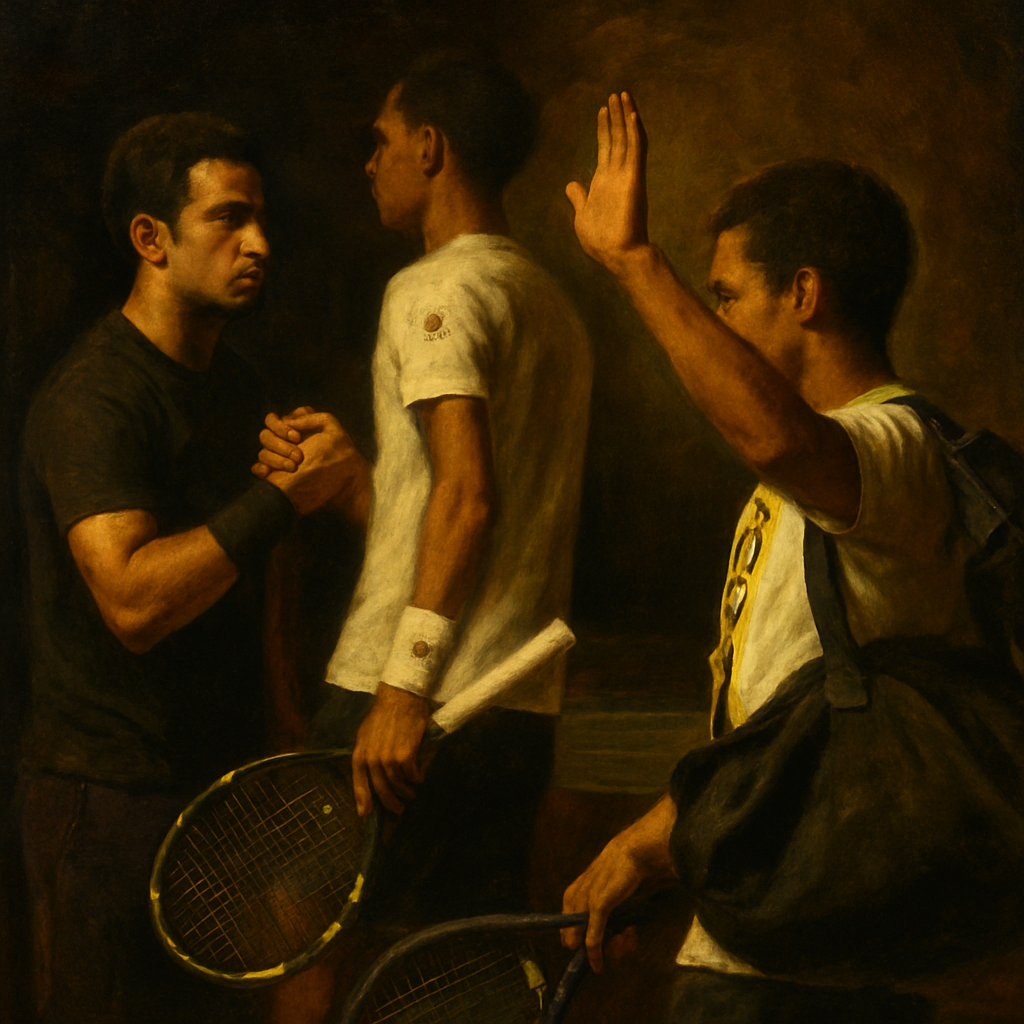
Auger-Aliassime, a finalist at this event in 2022, had been struggling for consistency throughout a challenging 2024 season. While there were no obvious signs of physical distress during the 58-minute first set, his movement and intensity appeared slightly off. After being broken at 5-5 and subsequently losing the set, the 24-year-old approached the net, shook Munar's hand, and informed the chair umpire he could not continue, a move that sent a ripple of confusion through the St. Jakobshalle.
A Puzzling Exit for Commentators and Fans
The television commentators covering the match were caught completely off guard. One noted, "He wasn't moving with his usual fluidity, but there was no medical timeout, no call for the trainer. To see him simply walk to the net and retire is utterly baffling." Another added, "This is a real head-scratcher. You have to wonder what is going on behind the scenes."
Jaume Munar, who was awarded the victory, also appeared surprised. In his post-match on-court interview, he expressed a mixture of satisfaction and concern. "It is never the way you want to win a match," Munar stated. "Felix is a great player and a great guy. I hope he is okay and that it is nothing serious."
The lack of a clear, visible injury only fueled speculation. Social media was immediately flooded with questions and theories, with fans and pundits alike trying to decipher the reason for the sudden withdrawal. The primary points of confusion were:
- No apparent physical incident during the set.
- No request for a medical evaluation on court.
- The timing, immediately after losing a tight set.
A Season of Struggle and Setbacks
To understand the context of this retirement, one must look at Auger-Aliassime's turbulent 2024 campaign. After a breakout 2022 and a solid 2023 that saw him qualify for the ATP Finals, this year has been a significant step back. He has struggled with form and a series of niggling injuries that have prevented him from building any sustained momentum. His record for the year now stands at a modest 22-18, a far cry from the dominance he displayed just two seasons ago.
Key factors in his difficult season include:
- Inconsistent Serve: His once-devastating serve has been prone to bouts of double faults.
- Forehand Errors: His aggressive forehand, a major weapon, has often been a source of unforced errors.
- Physical Issues: He has managed knee and back concerns at various points throughout the year.
This context makes the Basel retirement all the more concerning. Was it a precautionary move to avoid aggravating a known issue with the Paris Masters and a potential ATP Finals spot still on the line? Or was it a more worrying sign of a new, undisclosed problem?
The Official Statement and Speculation
Following the match, the tournament released a brief statement from Auger-Aliassime, which did little to clarify the situation. The Canadian cited "physical discomfort" as the reason for his retirement. This vague explanation has done little to quell the speculation. Tennis journalists have pointed out that players often use such terminology when managing a chronic issue, preferring not to disclose specific details to opponents and the public.
One seasoned tennis analyst noted on a broadcast panel, "When a player retires without a clear moment of injury, it's often related to a pre-existing condition they were trying to manage. Given Felix's history this year, it could be his knee or back flaring up. The concern is that if he's retiring as a precaution, his confidence in his body isn't where it needs to be for the final push of the season."
Implications for the Race to Turin
The retirement carries significant consequences for Auger-Aliassime's hopes of returning to the ATP Finals in Turin. He entered the week on the bubble, needing strong results in Basel and the upcoming Paris Masters to secure one of the final qualifying spots. The early exit in Basel, offering zero ranking points, is a major blow. It puts immense pressure on him to perform in Paris, one of the most demanding Masters 1000 events of the year.
His main rivals for the Turin spot, including players like Casper Ruud and Taylor Fritz, are still active in their respective tournaments this week, gaining valuable points. Auger-Aliassime is now in a position where he may need to reach the latter stages, if not the final, in Paris to keep his qualification dreams alive—a tall order for any player, let alone one dealing with physical uncertainties.
A Pattern of Concerning Retirements
This is not the first time Auger-Aliassime has retired mid-match, though the circumstances have varied. Earlier in his career, retirements were more commonly linked to clear physical ailments like dizziness or cramps. The ambiguity of this particular incident is what sets it apart and raises the alarm. The tennis community is left wondering if this is a strategic withdrawal to preserve his body for a more critical event or a sign of a deeper, unspoken issue, whether physical or mental.
The mental toll of a difficult season cannot be underestimated. The pressure to defend ranking points and live up to high expectations can be immense. While there is no evidence to suggest this was a factor in Basel, the cumulative effect of setbacks can sometimes manifest in ways that affect a player's decision-making and on-court resilience.
What Comes Next for FAA?
All eyes will now be on Auger-Aliassime's status for the Rolex Paris Masters, which begins next week. Will he be fit to compete? Will he provide a more detailed explanation for his sudden exit in Basel? His team has yet to release any further information, leaving a cloud of uncertainty hanging over his immediate future.
For a player of his immense talent, this moment represents a critical juncture. The hope among his fans and within the sport is that this retirement was a prudent, if confusing, measure to ensure his long-term health. The fear, however, is that it signals a more significant problem that could derail the end of his season and his aspirations to re-establish himself among the game's elite. For now, the tennis world is left waiting and hoping for answers from the baffled Canadian.