
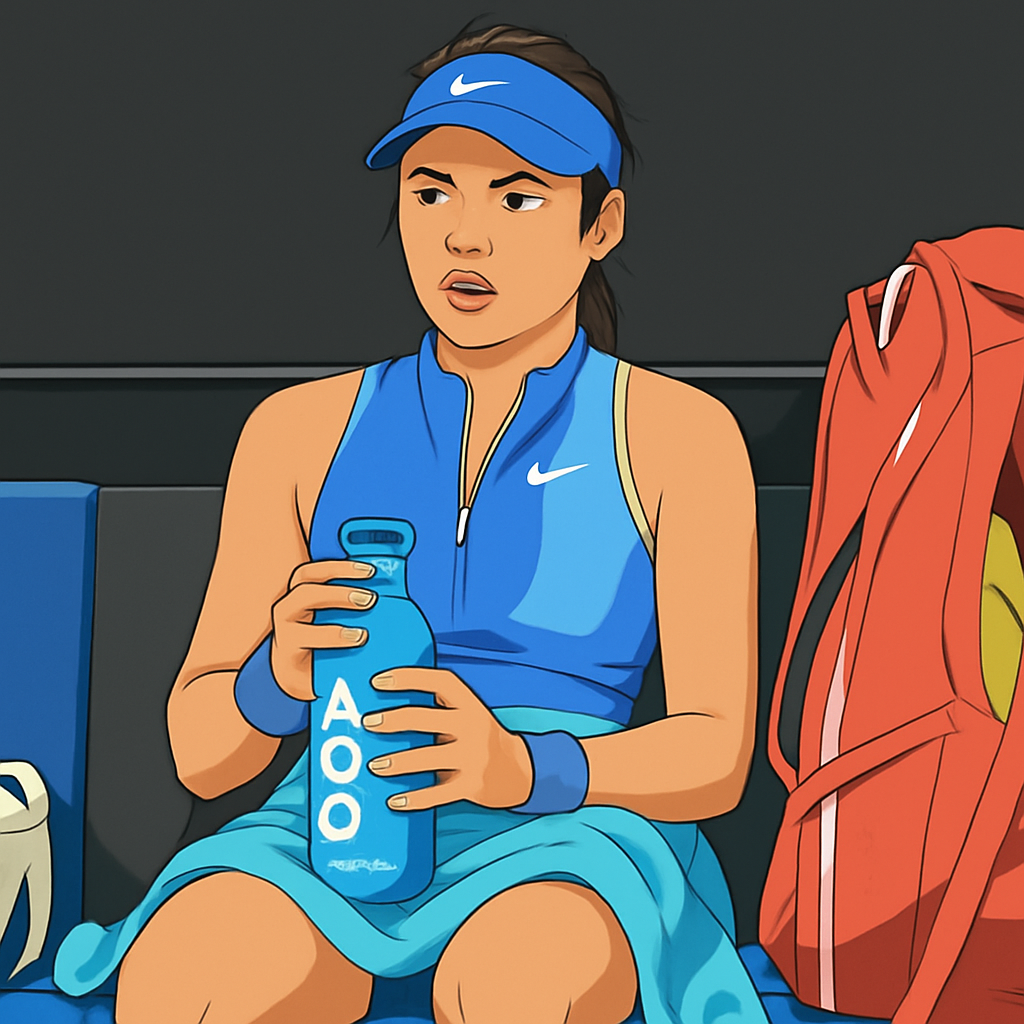
MELBOURNE — Emma Raducanu's highly anticipated Australian Open campaign came to a painful and premature end in the second round, succumbing to China's Wang Yafan in a grueling three-set battle that lasted over three hours. The 6-4, 4-6, 6-4 defeat has reignited scrutiny over the 21-year-old's coaching situation, with former British No. 1 Annabel Croft accusing Raducanu's part-time mentor, Nick Cavaday, of creating "confusion" at a critical moment.
Raducanu, playing in her first Grand Slam since undergoing surgeries on both wrists and one ankle, showed flashes of her 2021 US Open-winning brilliance. However, her physical resilience was pushed to its limit against the determined Wang. The match's pivotal juncture arrived in the deciding set when, leading 4-2 and seemingly in control, Raducanu called for a medical timeout for blisters on her right hand.
The Pivotal Medical Timeout and Coaching Confusion
It was during this treatment that television cameras captured a seemingly tense exchange between Raducanu and Cavaday, who was sitting in the player's box. Croft, commentating for the BBC, analyzed the incident in real-time, suggesting the coach's intervention may have disrupted Raducanu's flow. "There is a little bit of confusion there from the coach," Croft observed. "He came down and was gesticulating... I'm not sure if that helped or hindered."
The sequence of events was critical. Raducanu received treatment, then consulted with Cavaday, who appeared to be giving tactical instructions. Upon returning to the court, her momentum had evaporated. Wang won the next four games in a row to seal the victory. Croft elaborated post-match, stating, "It looked like he was telling her to be more aggressive, but it just seemed to add a layer of complication when perhaps she just needed simple, calming reassurance."
Raducanu's Post-Match Reflections and Physical Toll
In her press conference, Raducanu was sanguine about the loss, focusing on the positives of competing pain-free after her long hiatus. She did not directly criticize Cavaday but acknowledged the difficulty of regaining focus after the medical intervention. "It's always difficult after a medical timeout to regain focus and momentum," she admitted.
The physical toll of the match was evident. Beyond the blisters, Raducanu revealed she had been managing illness in the days leading up to the tournament. Her primary takeaway, however, was resilience. "I fought really hard. I put everything out on the court. I have no regrets. I left it all here."
A Fragmented Coaching History
The incident with Cavaday brings Raducanu's much-discussed history with coaches back into the spotlight. Since her historic US Open win, she has worked with a succession of high-profile figures, including Andrew Richardson (during the US Open win), Nigel Sears, Torben Beltz, and Dmitry Tursunov. This revolving door has often been cited by pundits as a potential barrier to sustained development.
Cavaday, a childhood coach who re-entered Raducanu's team in late 2023, represents a return to a familiar face. However, their current arrangement is described as informal and part-time, raising questions about the long-term structure of her support system. Key criticisms from analysts of her coaching carousel include:
- A lack of technical and tactical consistency in her game.
- Disruption to the vital player-coach trust and understanding.
- Difficulty building a long-term strategic plan for improvement.
Tennis legend Martina Navratilova previously commented on the issue, suggesting, "Stability is everything at this level. You need someone who knows your game inside out."
The Road to Recovery and Rebuilding
Despite the defeat, the overarching narrative from Melbourne for Raducanu is one of cautious optimism. Her first-round victory over Shelby Rogers was her first at a Grand Slam since 2022, and she competed with a freedom absent during her injury-plagued 2023 season. The core question now is how she builds from this foundation.
Tennis analysts agree that her immediate priorities must be:
- Physical Consolidation: Continuing to build match fitness and durability for best-of-three-set battles.
- Coaching Clarity: Formalizing a full-time coaching partnership to provide stability.
- Match Rhythm: Playing a consistent schedule of tournaments to regain sharpness.
Former British Davis Cup captain John Lloyd noted, "The talent is undeniable. What she needs now is not more talent, but more time—time on court, time with a consistent team."
Conclusion: A Setback on the Comeback Trail
Emma Raducanu's Australian Open exit was a harsh reminder of the fine margins at the elite level and the complexity of managing a high-stakes comeback. While the loss to Wang Yafan is a setback, her ability to compete physically is a significant victory in itself. The incident involving Nick Cavaday, however, underscores a lingering vulnerability.
As Croft's analysis highlighted, in moments of extreme pressure and physical duress, clear and calming communication is paramount. Whether the "confusion" was a minor misstep or a symptom of a broader need for a more defined coaching structure will be for Raducanu and her team to assess. Her journey back to the top was never expected to be linear, and this chapter in Melbourne provides both encouraging signs of her fighting spirit and clear lessons on the support system required to harness it fully. The tennis world now watches to see how she responds in the tournaments ahead.