
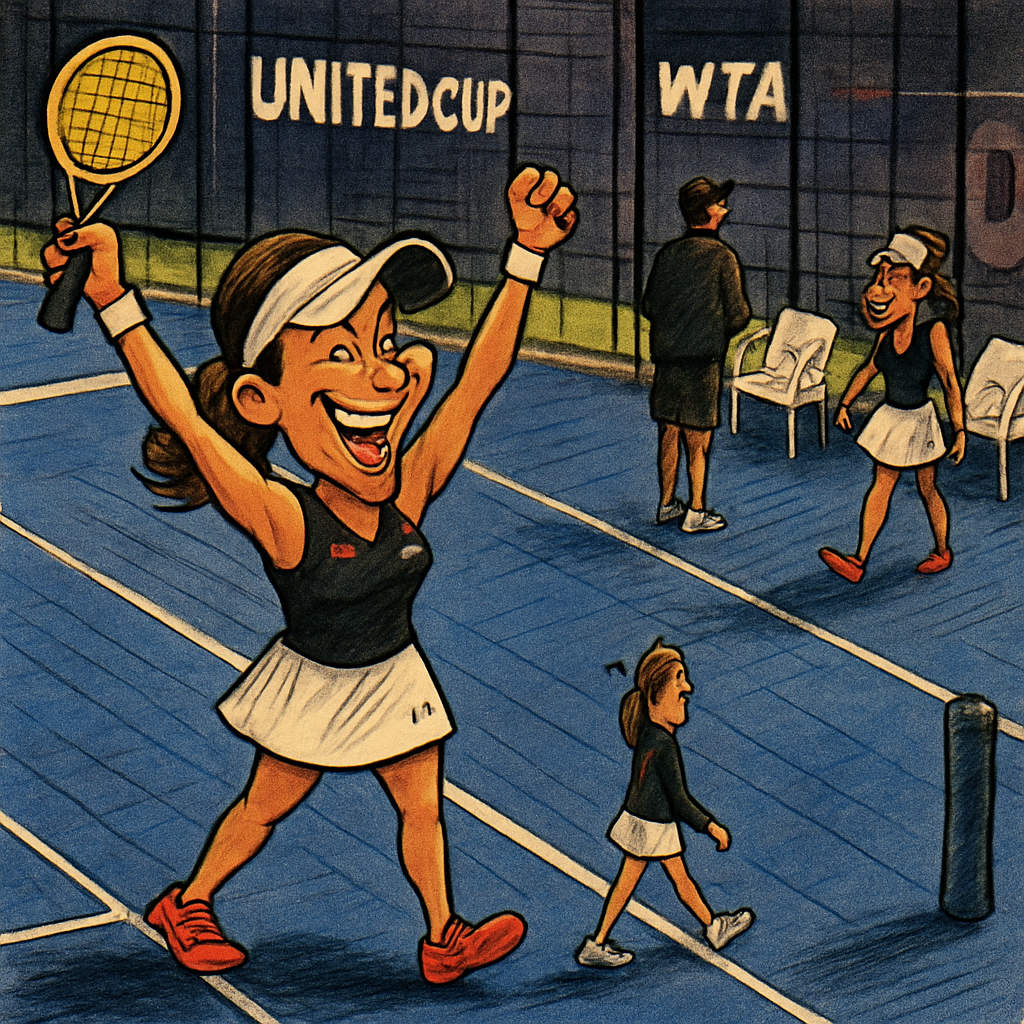
SYDNEY — The United Cup, designed as a vibrant, team-oriented launchpad for the tennis season, found itself embroiled in an unexpected logistical controversy on Tuesday. British star Emma Raducanu was forced to complete her pre-match warm-up in near-darkness on an unlit outdoor practice court, a situation that left her team frustrated and sparked questions about the tournament's organization for high-profile athletes.
The incident occurred ahead of Raducanu’s crucial singles match against Australia’s Ajla Tomljanović. With Great Britain’s mixed team quarter-final tie against the hosts finely poised, the 2021 US Open champion’s preparation was far from ideal. Instead of a controlled, focused warm-up session, Raducanu and her hitting partner navigated a public practice court at Sydney’s Ken Rosewall Arena as daylight faded, with no functional floodlights to illuminate the playing surface.
A Flick of a Switch and a Communication Breakdown
The root of the problem, according to the British team, was a simple but critical miscommunication. Team captain Anne Keothavong explained that their allocated one-hour practice slot on Court 11 was from 5:30 pm to 6:30 pm local time. However, as the summer evening drew in, the court’s lights failed to activate. Keothavong’s attempts to resolve the issue reportedly hit a bureaucratic wall.
"We were told we weren't allowed to turn the lights on," Keothavong stated bluntly in her post-tie press conference. "We were told that the person who had the switch wasn't present. So, yeah, she had to hit in the dark for the last 20 minutes." This left Raducanu finishing her vital hitting session in increasingly poor visibility, a significant disruption for any athlete before a high-stakes match.
The tournament organizers, Tennis Australia, presented a different sequence of events. A spokesperson stated that the British team’s practice was scheduled to conclude at 6:15 pm, not 6:30 pm, and that the lights on the outdoor court are programmed on an automatic timer linked to sunset. They claimed a tournament official was dispatched to assist but arrived to find the court empty, implying the team had left.
Raducanu's Resilient Response on Court
Despite the chaotic and unorthodox warm-up, Emma Raducanu displayed remarkable composure once she stepped onto the main arena court under the bright lights. Facing a partisan home crowd firmly behind Tomljanović, the Briton produced a performance of grit and quality, battling to a 6-1, 6-7(5), 6-1 victory in just over two hours.
The win was particularly satisfying given it was Raducanu’s first competitive match against Tomljanović since their emotionally charged 2022 US Open clash, which the Australian won before Raducanu retired with injury. After the match, when asked about the dark warm-up, Raducanu downplayed the incident with characteristic dry humour, but her comments hinted at the underlying inconvenience.
"I think we were scheduled until 6:30 p.m. and the lights weren't on until 6:10 p.m., so it was getting dark," she recounted. "We couldn't see the ball after a certain point. We just made do with it. It was a little bit difficult but I think it actually might have helped me because I had no high expectations going out there. I was just seeing the ball and hitting it."
This ability to adapt and reframe a negative situation into a potential positive is a testament to Raducanu’s evolving mental approach. However, her captain was less philosophical about the practical implications. Keothavong emphasized that the primary concern was player safety and proper preparation, elements that were compromised in the fading light.
Broader Questions for Tournament Logistics
The incident raises pointed questions about the operational protocols at a combined ATP-WTA event featuring many of the world’s top players. While the United Cup is praised for its innovative team format and festive atmosphere, ensuring consistent, professional standards for all athletes is paramount. The confusion highlights a potential gap in communication and contingency planning.
Key issues brought to light by the situation include:
- Scheduling Accuracy: The discrepancy between the British team’s understanding of their slot (6:30 pm) and the tournament’s claim (6:15 pm).
- Access Control: Why was no tournament official present or immediately available with access to manual overrides for essential facilities like lighting?
- Contingency Plans: What is the backup procedure when a scheduled practice session is disrupted by a basic infrastructure issue?
For a player like Raducanu, who has managed a carefully planned return from multiple surgeries and is meticulously rebuilding her game and confidence, such disruptions are more than a minor nuisance. Pre-match routines are sacrosanct for elite athletes, providing a sense of control and readiness before the unpredictable nature of competition.
A Victory Overshadowed by Avoidable Friction
Ultimately, Raducanu’s victory ensured Great Britain progressed to the United Cup semi-finals, marking a successful and confidence-boosting team campaign for her. The win over Tomljanović was a clear highlight, demonstrating her fighting spirit and improving physical resilience. Yet, the story of her dark warm-up threatened to become an unnecessary subplot.
The episode serves as a reminder that at the highest level of professional sport, the margin for error is infinitesimal. Preparation is everything. While players must adapt to changing conditions—weather, crowd noise, opponent tactics—they should reasonably expect fundamental facilities like a lit practice court to be a given, not a negotiation.
In her post-match comments, Raducanu chose to focus on the triumph, not the tribulation. "I'm just really happy to have got through that and battled against a really tough opponent who obviously had the crowd behind her," she said. Her performance indeed spoke loudest, proving her quality under the stadium lights, even if her preparation was left in the dark.
As the United Cup continues to establish itself on the tennis calendar, the hope will be that its undoubted strengths—the team dynamic, the enthusiastic crowds—are matched by seamless organization behind the scenes. For all athletes, but especially for those returning from long absences or managing their workloads with precision, consistency off the court is the foundation for excellence on it.