
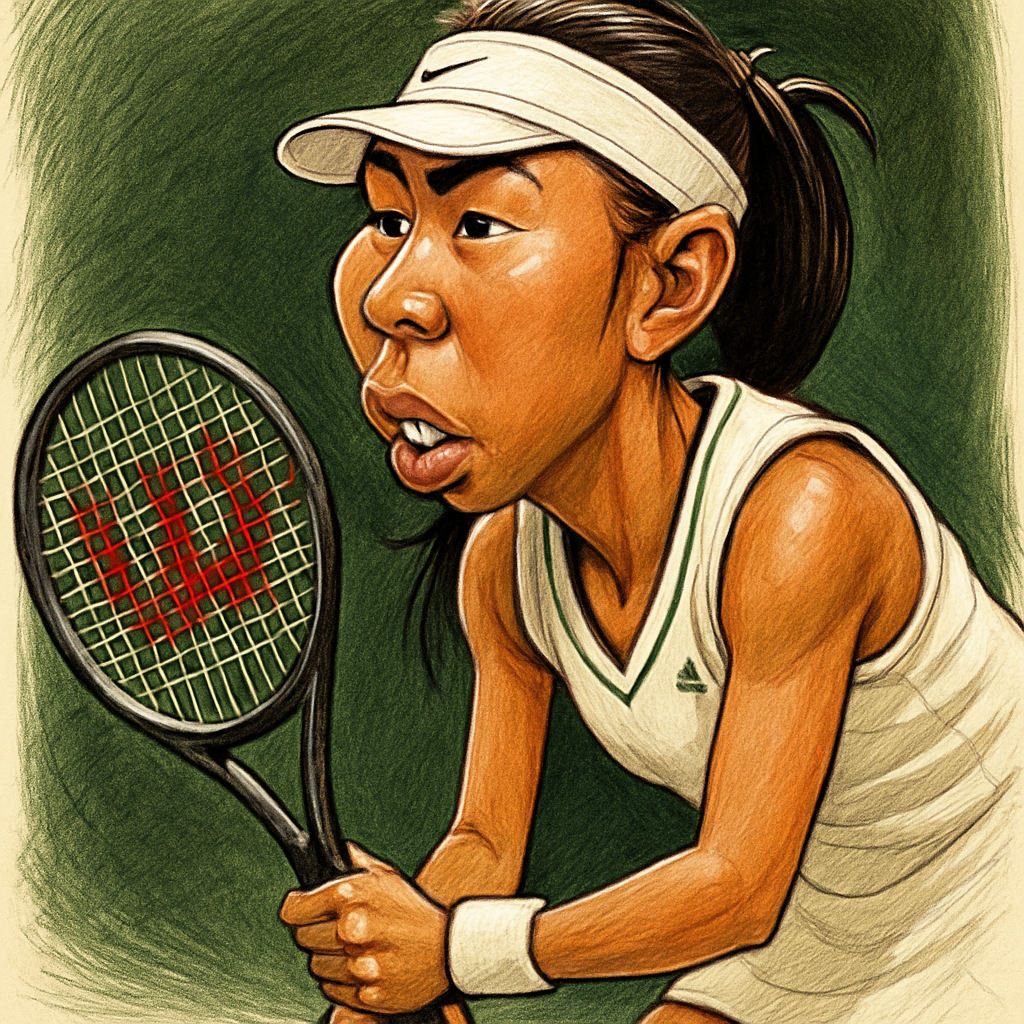
LONDON — For most aspiring athletes, the hallowed grass courts of Wimbledon represent the pinnacle of sporting pressure. But for British teenage tennis sensation Mimi Xu, the true crucible of nerves wasn't facing a former US Open champion on Centre Court, but rather the mundane, bureaucratic ordeal of a standard driving test.
The 16-year-old, who made headlines with her spirited performance against Emma Raducanu at the 2024 Championships, has revealed that the anxiety of parallel parking and navigating roundabouts under the watchful eye of an examiner far surpassed the butterflies of her Grand Slam debut. In an exclusive interview following her Wimbledon campaign, Xu detailed the surprising hierarchy of stress in her young life.
The Ultimate Test: M25 vs. Centre Court
"People assume that walking out in front of thousands of people at Wimbledon would be the most nerve-wracking thing imaginable," Xu explained. "But honestly, my driving test a few months before was on another level entirely. On the court, you're in control. You've trained for this moment your entire life. In the car, you're at the mercy of other drivers, the weather, and a single examiner who holds your freedom in their hands."
Xu, who splits her time between training and studying for her GCSEs, passed her test on the first attempt at the Tolworth test centre in South West London. She described the lead-up to the test as a unique form of torture. "With tennis, the pressure builds, but it's a familiar pressure. The driving test pressure is just constant, cold dread."
She contrasted the two experiences, highlighting the stark differences in their nature. A tennis match, even at Wimbledon, operates within a framework she understands intimately. The variables are largely internal: her fitness, her focus, her shot selection. The driving test, however, introduced a host of unpredictable external factors that she felt powerless to control.
A Tale of Two Pressures
When asked to break down the specific elements that made the driving test more stressful, Xu didn't hesitate, listing them with the precision of a seasoned competitor analyzing a rival's game. The key distinctions, she noted, were the lack of a "warm-up" period, the finality of a single minor error, and the intense, silent scrutiny of the examiner.
"In tennis, you have a knock-up, you settle into the match. If you lose the first point, it's fine, you have the whole match to recover," she said. "In the driving test, you pull out of the test centre and you're immediately being judged. One serious fault in the first thirty seconds, and it's essentially over. There's no coming back."
The nature of the mistakes was another critical factor. On the tennis court, an unforced error costs a point. During the driving test, a similar lapse in concentration could, in the worst-case scenario, have catastrophic real-world consequences. This underlying gravity, the understanding that she was operating a potentially dangerous machine, added a weight that was absent from her sporting pursuits.
The Unforgiving Checklist of Fear
Xu recounted the mental checklist that ran through her head during the test, a far cry from the fluid, instinctual mindset of a tennis match. Her concerns were not about topspin or footwork, but about a series of technicalities that could lead to instant failure.
She identified several specific manoeuvres that induced more anxiety than facing a Raducanu backhand down the line:
• The Parallel Park: "The sheer precision of it. A few inches too far and you hit the kerb. It feels so claustrophobic."
• The Independent Driving Section: "Following the sat-nav instructions while simultaneously monitoring your speed and other road users is a multitasking nightmare."
• The Show Me, Tell Me Questions: "Having to recall the exact location of the brake fluid reservoir while trying to calm your nerves is a special kind of test."
"You're just hyper-aware of every single thing," Xu elaborated. "The examiner is sitting there, silent, just scribbling on their clipboard. Every time they move their pen, your heart stops. You're just waiting for them to tell you to pull over because you've failed."
Raducanu Reaction: A Shared Experience
Her Wimbledon opponent, Emma Raducanu, who famously navigated her own intense rise to fame, was reportedly amused and understanding when Xu shared her driving test ordeal. The shared experience of passing a driving test seems to be a rare common ground for athletes from all disciplines, a universal rite of passage that transcends the world of elite sport.
"Emma just laughed and said she completely got it," Xu revealed. "She said that nothing in her tennis career, including winning the US Open, had prepared her for the unique, quiet terror of a driving examiner's clipboard." This camaraderie highlights a fascinating aspect of athlete psychology: the pressures they face are often highly specific to their field, but the vulnerability of learning to drive is a great equalizer.
Sports psychologists suggest that Xu's experience is not uncommon. Dr. Amanda Owens, a specialist who works with young athletes, explained: "In sport, pressure is a known quantity. Athletes develop sophisticated coping mechanisms for performance anxiety. The driving test is different. It's a binary pass/fail on a skill set that is still novel, combined with a complete lack of autonomy. That loss of control is a primary driver of acute stress."
Freedom on Four Wheels
Despite the trauma of the test itself, Xu has no regrets. Passing her test has granted her a newfound independence that complements her demanding schedule. "It's completely changed my life," she beamed. "Being able to drive myself to training, or to see my friends, without having to rely on my parents or a lift is incredible. It's a different kind of freedom."
She now navigates the busy roads between her home and the National Tennis Centre with a confidence that belies her initial terror. The skills that make her a formidable tennis player—anticipation, spatial awareness, and calm decision-making under pressure—have, it turns out, made her a competent driver as well.
In the end, Mimi Xu's story is a relatable reminder that pressure is profoundly personal. What appears as the ultimate test to an outsider may be an athlete's comfort zone, while a commonplace challenge can become an Everest of anxiety. For this rising star, the journey to a full driving licence was a tougher mental battle than her first steps onto the sport's most famous stage.
As she looks ahead to a promising professional career, equipped with both a potent forehand and a clean driving licence, Xu offered a final piece of advice to other young athletes: "Don't underestimate the driving test. Honestly, it's a whole different sport."