
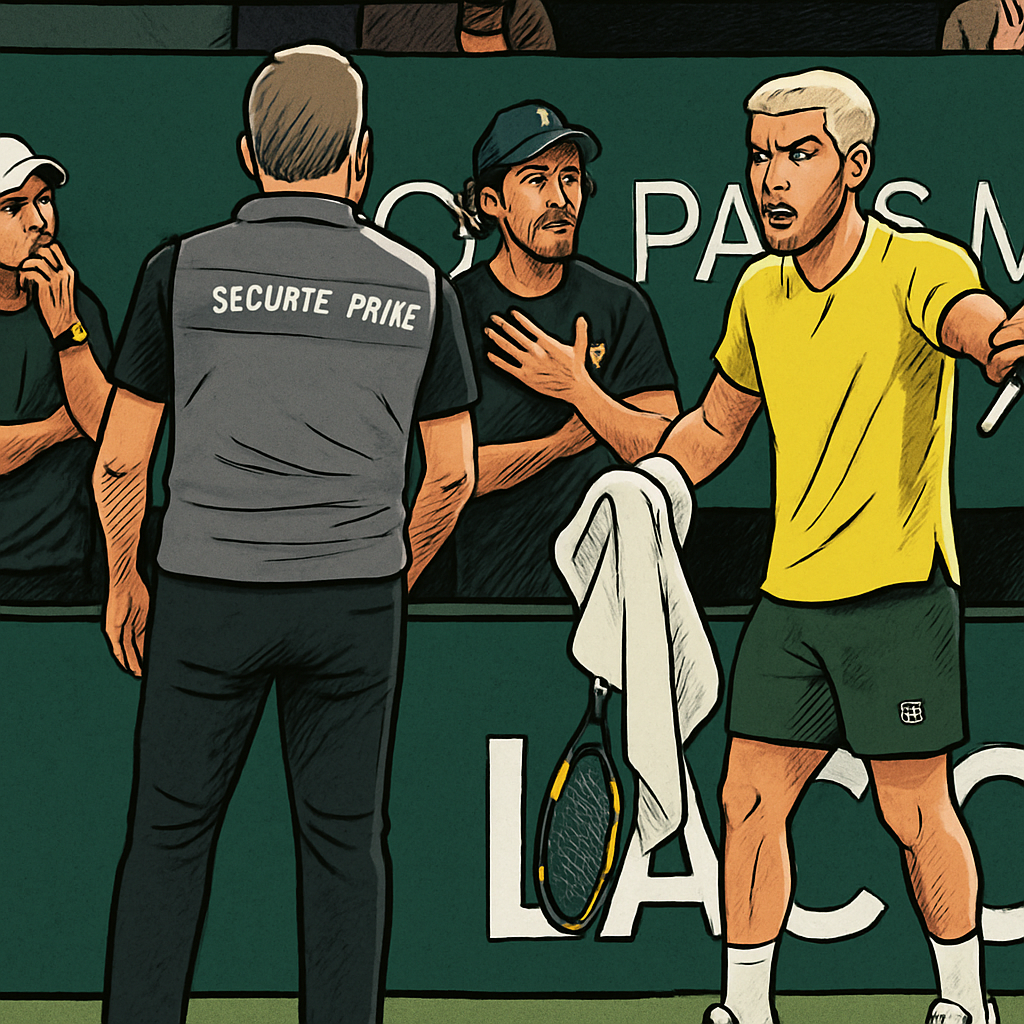
PARIS — The tennis world witnessed a rare and concerning sight on Wednesday at the Rolex Paris Masters as Carlos Alcaraz, the world number two and one of the sport's brightest young stars, suffered a surprise second-round defeat to Britain's Cameron Norrie. More alarming than the 6-4, 7-6(3) loss itself, however, was the visible frustration and on-court argument the Spaniard engaged in with his coach, former world number one Juan Carlos Ferrero, signaling a period of significant struggle for the two-time Grand Slam champion.
The match against Norrie was a stark contrast to the explosive, joyful tennis that has become Alcaraz's trademark. From the outset, he appeared out of sorts, struggling with his timing and uncharacteristically littering his game with unforced errors. This frustration boiled over during a changeover in the first set, where television cameras captured a tense exchange with Ferrero. Alcaraz was seen shaking his head and speaking animatedly, while his coach offered firm, pointed advice, a public display of discord that is highly unusual for the typically harmonious pair.
A Public Display of Frustration
The on-court coaching moment became the focal point of the match. Alcaraz, clearly agitated by the direction the contest was taking, seemed to reject his coach's input. In his post-match press conference, Alcaraz did not shy away from addressing the incident, offering a worrying verdict on his current mental and physical state. "It's really tough to play at this level, to stay focused, to stay at your best," he admitted.
He elaborated on the root of the argument, revealing it stemmed from a deep-seated issue with his recent performances. "We were talking about the way I should play. I didn't think I was playing badly. I was missing easy shots, sure, but I thought the level was there. J.C. [Ferrero] was trying to tell me what to do, but I was so frustrated in that moment that I couldn't listen." This admission highlights a significant communication breakdown at a critical moment, a crack in the foundation of one of tennis's most successful player-coach relationships.
The Physical and Mental Toll
Beyond the spat with his coach, Alcaraz issued a series of concerning comments that point to a player grappling with the intense demands of the tour. He cited a combination of physical issues and mental fatigue, a dangerous cocktail for any athlete. "I have to improve a lot of things physically, for example. I think I lost a lot of physical condition since the American swing," he stated, referencing his triumphant run at Wimbledon in July and his hardcourt campaign in the US.
This physical dip, he suggested, is directly impacting his confidence and, consequently, his results. The list of recent setbacks is growing, making his comments more than just a one-off reaction to a single loss. Since his stunning Wimbledon victory, his results have been inconsistent by his own sky-high standards.
- A quarterfinal loss to Jannik Sinner in Beijing.
- A surprise early exit in Shanghai to Grigor Dimitrov.
- Now, a second-round defeat in Paris to Cameron Norrie.
"When you are not feeling 100% physically," Alcaraz explained, "it affects your mind as well. You don't hit the ball as cleanly, you don't move as well, and the doubts start to creep in. Right now, I need to find myself again."
Norrie Capitalizes on the Chaos
While Alcaraz's internal struggles took center stage, credit must be given to Cameron Norrie, who executed a perfect game plan. The British number one remained solid and consistent from the baseline, absorbing Alcaraz's power and expertly exploiting his opponent's erratic play. Norrie's resilience was particularly evident in the second-set tiebreak, where he raced to a 6-1 lead before closing out the match, handing Alcaraz his first loss to a player outside the Top 10 since the French Open.
In his on-court interview, Norrie acknowledged the strange dynamic of the match. "It's always tough playing Carlos, he's an amazing player and he brings so much energy. But today I could see he was frustrated. I just tried to focus on my side of the court, stay tough in the rallies, and make it as physical as possible. I'm happy with how I managed the situation."
The Road to the ATP Finals
This loss casts a shadow over Alcaraz's immediate future, particularly with the ATP Finals in Turin just around the corner. The year-end championship gathers the world's top eight players, and a struggling, doubting Alcaraz is a far cry from the formidable force many predicted would challenge Novak Djokovic for the title. His comments suggest a player in need of a reset, not a grueling test against the best of the best.
When asked about his goals for the remainder of the season, his response was uncharacteristically muted and focused on fundamentals rather than trophies. "The most important thing right now is to recover my level. To go to Turin and show my best tennis, I need to train, I need to recover my confidence. It's not about winning or losing right now, it's about feeling good on the court again."
A Critical Juncture
The partnership with Juan Carlos Ferrero has been the bedrock of Alcaraz's meteoric rise. Ferrero has been credited with honing the young Spaniard's raw talent, instilling discipline, and managing his career with expert precision. This public disagreement, therefore, is more than a simple heated moment; it is a symptom of the immense pressure and high expectations now placed on Alcaraz's shoulders. The physical regression he described is a common challenge for young players navigating a full season on tour, but the mental toll, evidenced by the on-court argument and his candid admissions, is what will concern his team the most.
Tennis legends and pundits were quick to weigh in. John McEnroe, commentating for Tennis Channel, noted, "You never want to see that between a player and a coach, especially a team that's been so tight. Carlos is so young, and he's already achieved so much. This is a new kind of pressure for him – the pressure to back it up, to be the guy every single week. It looks like it's weighing on him."
For Alcaraz, the path forward is clear, albeit difficult. He must use the short time before Turin to address his physical conditioning, mend the momentary rift with his coach, and, most importantly, rediscover the joy and fearlessness that defined his game. The tennis world waits to see if this worrying verdict is merely a temporary blip or the sign of a more profound challenge for the young phenom. As he himself put it so succinctly, "I have to find myself again."