
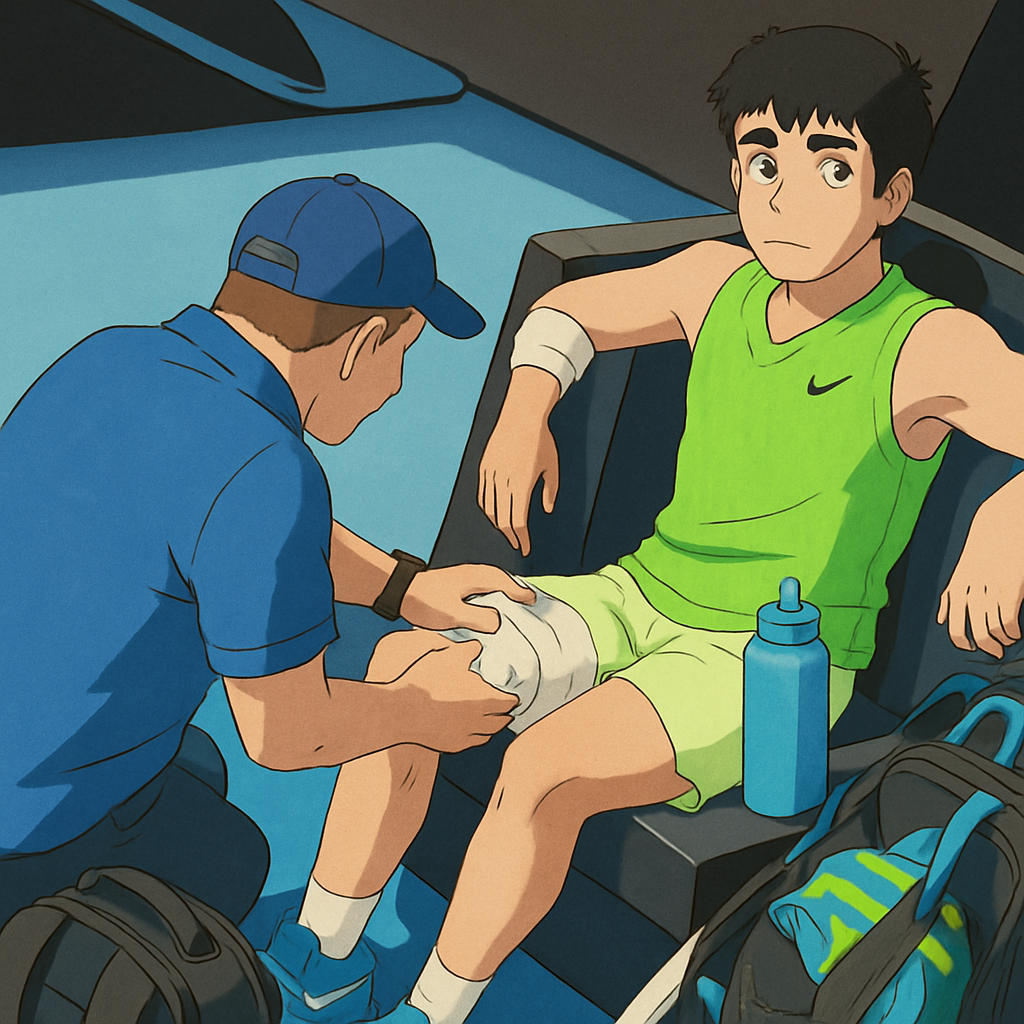
MELBOURNE — The tennis world held its collective breath on Friday night as Carlos Alcaraz, just one match away from his first Australian Open final, suddenly clutched at his right leg in visible distress during his semifinal clash with Alexander Zverev.
The incident occurred at a critical juncture. After splitting the first two sets, Alcaraz had just broken Zverev’s serve to go up 2-1 in the third. As he prepared to serve, the 20-year-old Spaniard winced, took a few ginger steps, and immediately signaled to the chair umpire. He then left the court for a medical timeout, sending a wave of anxiety through Rod Laver Arena and casting a shadow over his impending final against Daniil Medvedev.
The On-Court Scare and Immediate Aftermath
For nearly ten minutes, the stadium waited in tense silence. Alcaraz returned with his upper right thigh heavily strapped. While he moved with noticeable caution initially, he remarkably managed to maintain his level, closing out the third set 6-1. He sealed the match 6-3, 6-7(1), 6-1, 6-2, but the dominant victory was overshadowed by concern for his physical state.
In his post-match press conference, Alcaraz moved quickly to allay fears. He explained the issue was related to muscle tension, not a tear, and credited his physiotherapist for the swift intervention. "I took the medical timeout because I felt the muscle a little bit," Alcaraz stated. "It was really tense. It was worrying me a little bit because I had never felt that before."
He emphasized that the treatment was preventative. "We did a few tests with the physio on the court and off the court as well," he detailed. "It was not an injury. It was just a moment of tension, and we treated it to release the muscle. After that, I felt much better."
A Crucial Recovery Period Before the Final
With less than 48 hours to recover before facing Daniil Medvedev in Sunday’s final, Alcaraz outlined his plan for the all-important rest day. His priority is clear: managing the affected area to ensure he is as close to 100% as possible for the championship match.
"Tomorrow is going to be a day for recovery," Alcaraz confirmed. "I will do some work in the gym, some swimming, and a lot of treatment with my physio. I need to be really focused on recovering everything, especially on that part of the body."
The Spaniard’s camp is reportedly optimistic. Sources indicate the issue is being treated as muscular fatigue and overload—common at this stage of a grueling two-week Grand Slam—rather than a structural injury. His ability to play freely after the timeout is seen as the most positive sign.
Key Recovery Steps for Alcaraz on Saturday:
- Intensive Physiotherapy: Continuous work to release tension and promote blood flow in the quadriceps.
- Light Active Recovery: Activities like swimming and gentle cycling to maintain mobility without impact.
- Nutrition and Hydration: Maximizing nutrient intake to aid muscle repair and replenish energy stores.
- Mental Reset: Balancing necessary preparation with complete physical and mental rest.
- Final On-Court Session: A very light hit to gauge feeling and maintain rhythm, likely late Saturday.
The Stakes: A Chance at a Third Major and History
The timing of this scare could not be more consequential. Alcaraz stands on the brink of his third Grand Slam title and a unique piece of history. A victory on Sunday would make him the youngest man in the Open Era to win a major on all three surfaces—grass (Wimbledon 2023), clay (Roland Garros 2022), and hard court.
His opponent, Daniil Medvedev, presents a monumental challenge. The Russian has already endured over 20 hours on court this tournament, surviving two brutal five-setters, and is renowned for his physical resilience and tactical intelligence. Medvedev, seeking his second major title, will undoubtedly test Alcaraz’s movement to its limit.
Alcaraz acknowledged the battle ahead. "It’s going to be really tough. Daniil is a wall," he said. "He returns almost every ball. He’s an amazing athlete. I need to be ready for a long, long match, and to be in my best physical shape."
Expert Analysis and the Road to the Final
Tennis analysts and former players have largely echoed Alcaraz’s own assessment. The consensus is that while the scare was real, his post-timeout performance suggests it was managed effectively in the moment. The true test will be how the muscle responds after the adrenaline of the semifinal wears off.
It’s worth noting Alcaraz’s path to the final has been relatively efficient. He has dropped only three sets and, prior to the semifinal, had spent nearly three hours less on court than Medvedev. This lighter load could prove a significant advantage in his recovery race.
As the tennis world watches and waits, Alcaraz projected a calm and confident demeanor. "Right now, I feel perfect," he insisted late Friday night. "It’s not going to be a problem for the final. I’m sure of that."
The final word, as always, will be written on the court. All preparations now lead to Sunday night at Rod Laver Arena, where Carlos Alcaraz will aim to push past a major physical scare and capture the one major trophy that has eluded him, completing a historic surface sweep and solidifying his place at the pinnacle of the sport.