
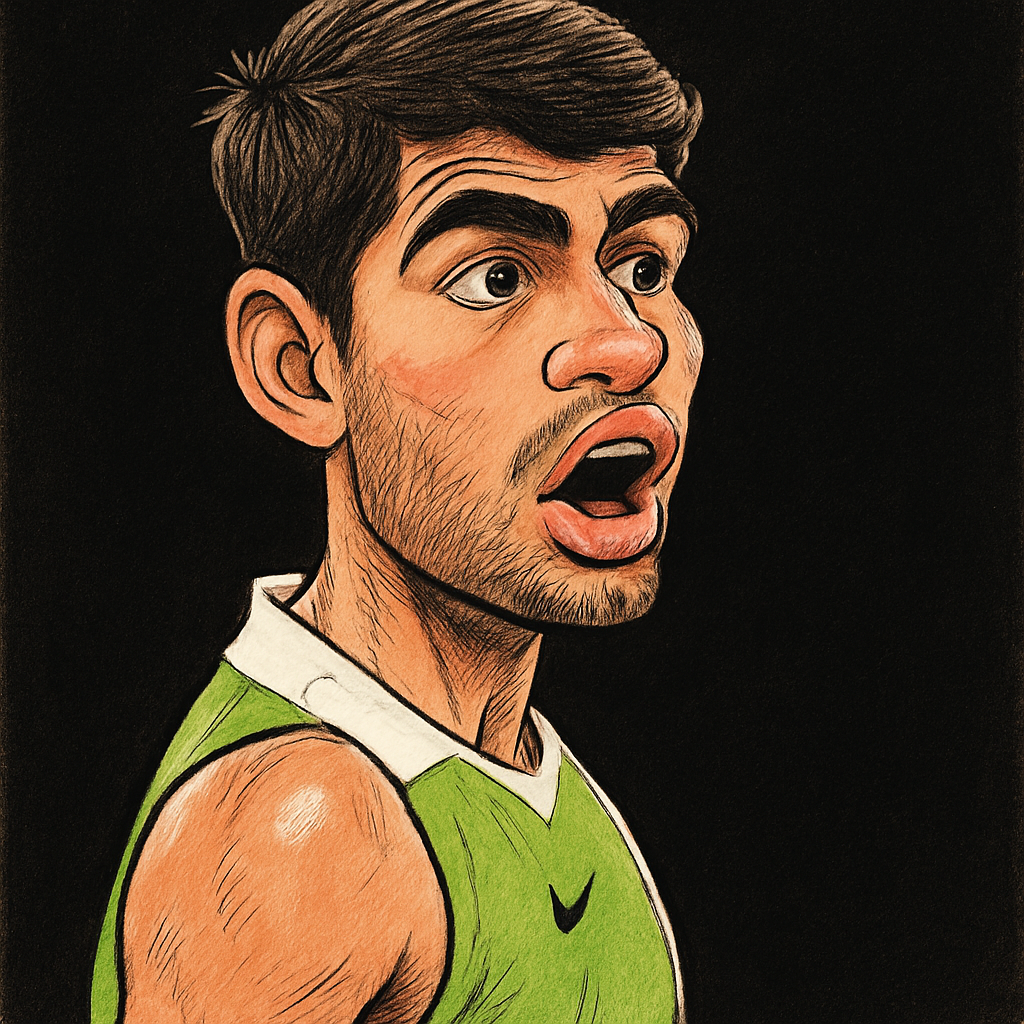
MELBOURNE — The electric atmosphere of a night session on Rod Laver Arena turned tense and confrontational on Wednesday as world No. 2 Carlos Alcaraz engaged in a heated dispute with chair umpire Mohamed Lahyani, an incident that drew loud boos from the Australian Open crowd and left his opponent, Alex de Minaur, visibly frustrated during a critical juncture of their quarterfinal clash.
A Pivotal Point Sparks Controversy
The flashpoint occurred with Alcaraz serving at 5-6, 30-30 in a tightly contested first set. The Spaniard hit a second serve that was called out by the line judge. De Minaur, Australia’s last hope in the singles draw, prepared to receive but then stopped his motion, believing the serve was a fault. However, Lahyani immediately overruled the call, declaring the ball in. Under tennis rules, because de Minaur had not made a play on the ball, the point was awarded to Alcaraz, bringing up set point.
A bewildered de Minaur rushed to the chair, pleading his case. He argued that he had been affected by the out call and was therefore entitled to a let and a first serve. Lahyani, citing the rulebook, stood firm. It was at this moment that Alcaraz, from across the net, began to vocally confront the umpire. "You cannot give that point. You cannot give that point!" Alcaraz insisted repeatedly, gesturing emphatically.
Crowd Reaction and De Minaur's Disbelief
The Rod Laver Arena crowd, fiercely partisan for their home favorite, erupted in loud boos and whistles, directing their displeasure at both the decision and Alcaraz’s intervention. The scene created an uncomfortable delay. De Minaur, looking exasperated, was heard saying to Lahyani, "He’s telling you how to do your job now. That’s what’s happening." The Australian’s point highlighted the unusual nature of a player arguing *against* a point being awarded in his own favor.
Despite the protestations, Lahyani’s ruling stood. Alcaraz, now with set point, promptly double-faulted, bringing the game back to deuce. The dramatic twist seemed to swing momentum, and de Minaur eventually broke serve to claim the first set 7-5, sending the Melbourne Park crowd into a frenzy. The key factors in the controversy were:
- The initial out call from the line judge.
- Lahyani's immediate overrule, deeming the ball good.
- De Minaur's halted return, constituting a cessation of play.
- The application of the rule granting the point to Alcaraz.
Post-Match Explanations and Rule Clarification
In his post-match press conference, a victorious Alcaraz explained his reasoning for confronting the umpire. "I thought that Alex stopped because of the out call. I heard the call. For me, it was kind of a let. I went to Mohamed to tell him that the point shouldn’t be mine. It should be a let, a first serve again... I would feel really bad if I had won that point because of that."
De Minaur, while gracious in defeat, expressed his continued confusion over the incident. "The rule is the rule. The umpire made a decision. That's all there is to it... It's a tough one. It's one of those things that happens in tennis. You've got to move on." Tennis officials later clarified that Lahyani’s application of the rules was technically correct, as the overrule came instantly and de Minaur, by his own admission, stopped playing.
The Crucial Distinction: Hindrance vs. Official's Error
The core of the dispute lies in a nuanced area of tennis rules. A player is entitled to a let if hindered by an official's incorrect call *during* play. However, if an official immediately corrects an error (an overrule) before a player makes a stroke, and the player stops, the point is awarded to the other player. Lahyani judged it as the latter. Alcaraz and de Minaur both perceived it as the former—a hindrance caused by the line judge's initial, incorrect "out" shout.
Sportsmanship in the Spotlight
While the rule was enforced, the incident sparked a wider debate about sportsmanship and the spirit of the game. Alcaraz’s decision to argue against receiving the point was widely praised on social media and by pundits as an act of exceptional integrity, even if it was technically a misreading of the situation. "It was unbelievable sportsmanship from Carlos," said former player Jim Courier on broadcast.
Conversely, some analysts questioned whether Alcaraz’s intervention, however well-intentioned, put undue pressure on the umpire and disrupted de Minaur’s attempt to plead his own case. The booing from the crowd indicated they believed the Australian had been hard done by, a sentiment fueled by the high stakes of a home Grand Slam quarterfinal.
Alcaraz Regroups and Advances
Ultimately, the controversy did not derail Alcaraz’s title ambitions. After dropping the tumultuous first set, the two-time Grand Slam champion recalibrated, elevating his aggressive, net-rushing game to dominate the next three sets 6-1, 6-2, 6-3. His victory booked a semifinal spot against Alexander Zverev, shifting the focus back to his scintillating form.
Yet, the confrontation with Lahyani will be a memorable subplot of the 2024 Australian Open. It highlighted the intense pressure of Grand Slam tennis, the complex and sometimes counterintuitive nature of its rules, and the fine line between competitive fire and fair play. In the end, the episode showcased Carlos Alcaraz not just as a phenomenal talent, but as a young champion willing to prioritize principle over point, even as a hostile crowd booed his conscience.