
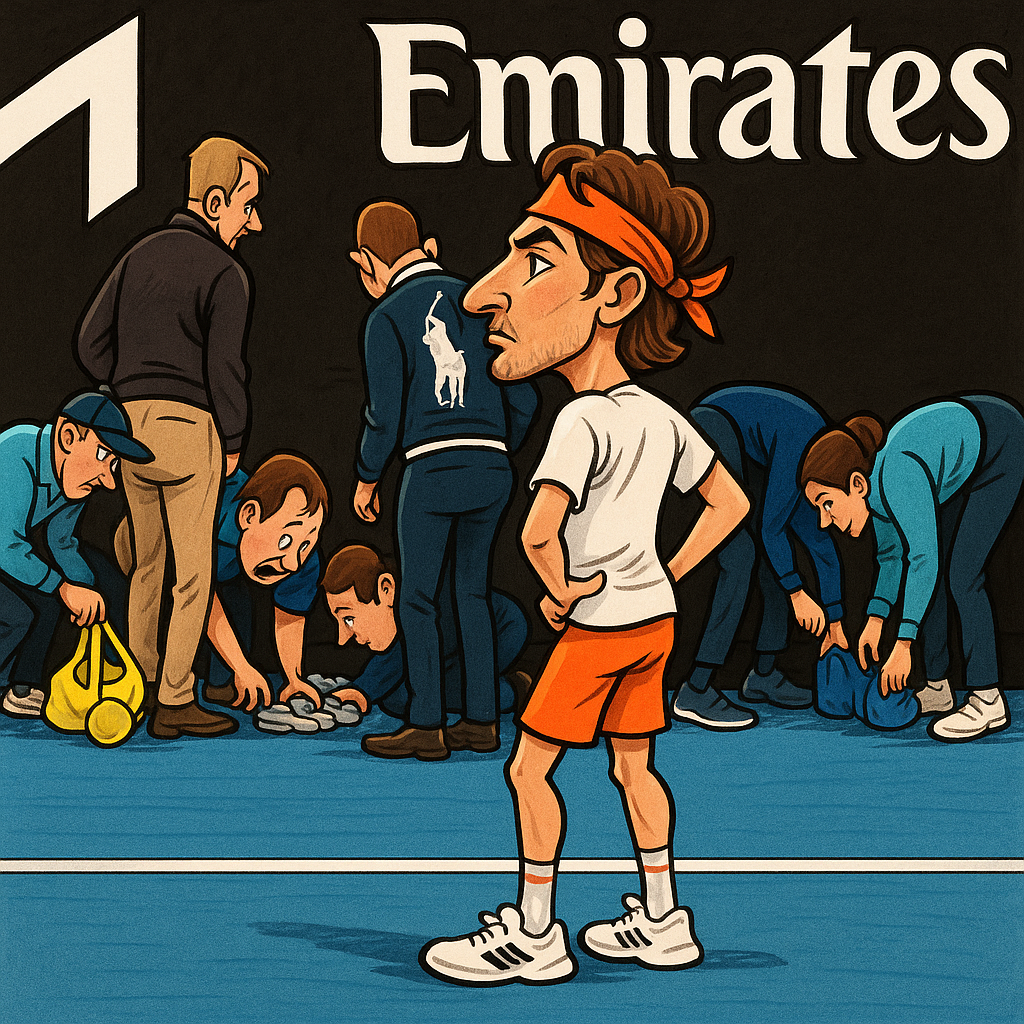
MELBOURNE — The 2024 Australian Open was plunged into an unusual and concerning double delay on Tuesday evening as a second-round match on Rod Laver Arena was suspended for the second time in just half an hour after a ball kid became unwell on court. The incident, which occurred during the clash between seventh seed Stefanos Tsitsipas and local hopeful Jordan Thompson, cast a shadow over the night session and highlighted the immense, often overlooked, pressure placed on the tournament's youngest volunteers.
A Disturbing Interruption in High-Stakes Play
The match, a tense affair with Thompson pushing the 2023 finalist, was first paused at 8:42 PM local time when a female ball kid stationed at the net appeared dizzy and needed to be escorted from the court by medical personnel. Play resumed after a brief stoppage. However, scarcely 30 minutes later, with Tsitsipas leading 4-3 in the third set after dropping the first two, the situation escalated. Another ball kid, positioned at the back of the court, visibly faltered and collapsed to the ground, prompting an immediate and more urgent response.
Chair umpire Aurélie Tourte swiftly called, "Stop, stop, stop please," as players and officials rushed to the child's aid. A tournament doctor and physiotherapist were on scene within moments, attending to the youngster as a hushed concern fell over the stadium. The child was eventually able to walk off the court with support, receiving a warm round of applause from the sympathetic crowd.
Extreme Conditions and a Grueling Schedule
While Tennis Australia did not release specific details on the cause of the illnesses, citing privacy, the conditions that evening were a primary suspect. The match began in sweltering heat that had plagued the day session, with on-court temperatures reportedly exceeding 35 degrees Celsius (95°F) earlier in the day. Although the sun had set, the residual heat and high humidity created a physically draining environment.
Ball kids at Grand Slams are renowned for their athleticism and discipline, but they are also subjected to the same brutal conditions as the players. Their duties are far from passive; they are in constant motion, sprinting, crouching, and focusing intensely for stretches that can last over an hour per rotation. The physical demands are significant, especially for younger teenagers. Key stressors include:
- Prolonged Static Postures: Holding a rigid, attentive stance for long periods can impede circulation.
- Dehydration: The focus on hydrating players is paramount, but volunteers must also vigilantly manage their own fluid intake.
- Heat Accumulation: The all-black uniform, while iconic, absorbs heat, and the hard court surface radiates it upward.
- Adrenaline and Nerves: The pressure of performing flawlessly on a global stage in front of thousands can be immense.
Player Reaction and Tournament Protocol
Both Stefanos Tsitsipas and Jordan Thompson handled the distressing situation with notable compassion. Tsitsipas was seen fetching an ice pack and water for the affected ball kid, while Thompson also offered assistance. Following the second suspension, the players left the court for an extended break of approximately 25 minutes to allow for a full assessment and for replacement ball kids to be organized and briefed.
Upon resumption, Tsitsipas acknowledged the crowd, stating, "I want to thank everyone for their patience. It was a very difficult situation for everyone, especially for the ball kid. Our thoughts are with them and I hope they are feeling better." Thompson echoed the sentiment, praising the medical team's rapid response. A Tennis Australia spokesperson later confirmed that both children had been treated and were "recovering well."
A Recurring Challenge at Melbourne Park
This was not an isolated incident in the tournament's history. The Australian Open's summer scheduling has frequently brought extreme heat into play. In a memorable and similar incident in 2014, Canadian player Frank Dancevic collapsed on court during a match, later criticizing the "inhumane" conditions. While the tournament has since implemented a more comprehensive Extreme Heat Policy (EHP) for players, the well-being of ball persons, line judges, and other on-court officials remains a persistent point of discussion.
The EHP allows for the closure of roofs on the main show courts and scheduling adjustments, but it primarily focuses on competitor welfare. The ball kid program, however, is a point of pride for Tennis Australia, with thousands of applicants vying for a few hundred spots. The organization provides extensive training, uniforms, meals, and supervision, but Tuesday's events prompted questions about whether protocols for volunteer welfare in extreme conditions need to be as formalized as those for the athletes.
Broader Implications and Duty of Care
The dual suspensions sparked immediate debate among pundits and fans about the duty of care extended to all participants in a sporting spectacle. While players have teams, ice vests, and regulated break times, the army of volunteers that makes the event possible operates under different guidelines. The incident served as a stark reminder that the glamour of a night session on Rod Laver Arena rests on the shoulders of many, including children performing a demanding physical role.
Tennis journalist Ben Rothenberg noted on social media, "The ball kids are athletes too, in their own way, and tonight showed the very real physical toll this job can take. Their well-being has to be part of the heat policy conversation, not an afterthought." The conversation inevitably turned to potential solutions, such as more frequent rotations, mandatory cooling breaks for on-court officials, and even reconsideration of uniform material during heatwaves.
Match Resolution and Lasting Focus
When play finally continued after nearly an hour of total delays, Stefanos Tsitsipas refocused to complete a 4-6, 7-6(6), 6-2, 7-6(4) victory over the resilient Jordan Thompson. The Greek star advanced, but the post-match narrative was shared between his escape act and the well-being of the volunteers.
In the end, the story of the evening was not about a ranking point or a stunning winner, but about human resilience and vulnerability under the bright lights. The Australian Open, a festival of tennis, was momentarily humbled by the physical limits of its youngest participants. It prompted a necessary reflection on the balance between sporting tradition, spectacle, and the fundamental responsibility to protect every individual on court, regardless of their role in the drama. As the tournament progresses, the hope is that the two recovering ball kids are the last to succumb to the fierce Melbourne summer, and that their experience leads to even stronger safeguards for the essential volunteers who help the Grand Slam spin.