
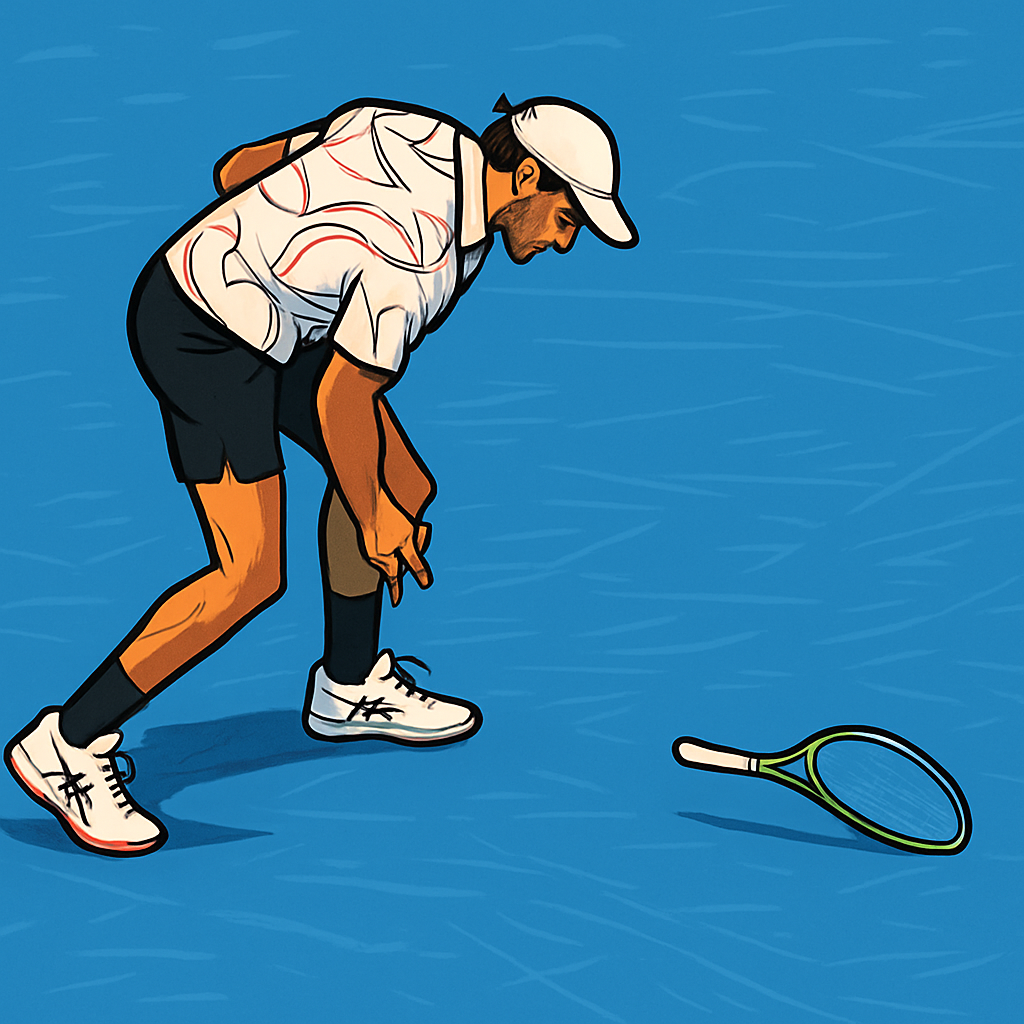
MELBOURNE — The Australian Open is renowned for its scorching heat and high-stakes drama, but a second-round match on Court 3 turned ugly in a different way, as rising Italian star Luciano Darderi’s frustration boiled over, leading to a racquet-throwing incident that struck his own coach in the player’s box.
The 21-year-old, who was facing a daunting challenge against world No. 4 and eventual champion Jannik Sinner, appeared to lose his composure during a critical phase in the third set. After dropping his serve, Darderi hurled his racquet in anger towards his team. The equipment flew into the seating area, striking his coach, Franco Davín, on the arm.
A Moment of Fury and Immediate Regret
The incident occurred with Sinner leading 4-2 in the third set, having already secured the first two sets 6-2, 6-3. Visibly frustrated by his inability to crack Sinner’s impenetrable baseline game, Darderi’s emotions got the better of him. Broadcast footage clearly shows the racquet leaving his hand and sailing directly into the box where Davín, the experienced Argentine coach who once guided Gastón Gaudio and Juan Martín del Potro to Grand Slam titles, was sitting.
The reaction from both parties was immediate. Darderi’s face transformed from rage to horror as he realized what he had done. He rushed to the net, not to confront Sinner, but to call up to his team and check on Davín. “I’m sorry! Are you okay?” he was heard shouting, his hands on his head in clear distress.
Davín, for his part, handled the situation with remarkable calm. He stood up, showed his arm to his player to indicate he was fine, and gestured for Darderi to refocus on the match. The chair umpire, Miriam Bley, issued a code violation for unsportsmanlike conduct, but no further penalty was given.
The Aftermath and Public Apology
Play resumed, but the match was effectively over, with Sinner closing it out 6-2, 6-3, 6-2. In his post-match press conference, a contrite Darderi addressed the incident head-on. “I want to apologize to my coach, to my team, to the crowd, to everyone,” he stated. “It was a very ugly gesture. I’m not like that. I was very nervous, and the frustration came out in the worst way.”
He elaborated on his state of mind, revealing the immense pressure he felt stepping onto the court against one of the tour’s most dominant forces. “Playing against Sinner, who is playing unbelievable tennis, I wanted to do something more, and when I couldn’t, I lost control. It’s a lesson for me, a big one.”
Franco Davín, showing the patience of a seasoned mentor, was quick to forgive. In comments to Argentine media, he downplayed the physical impact and focused on his player’s character. “It was nothing, just a shock. More than anything, I felt bad for him because he is a good kid who made a mistake in a moment of extreme tension.”
A Broader Conversation on Pressure and Conduct
The incident sparked immediate debate among fans and pundits about player conduct and the immense psychological pressure at the elite level. While racquet abuse is a common sight on tour, a player accidentally striking their own team member is a rare and serious occurrence. It highlighted several key issues in modern tennis:
- The Intensity of Grand Slam Pressure: For a young player like Darderi, facing a top seed on a big stage can be overwhelming.
- The Fine Line of Emotional Expression: While passion is celebrated, controlling its physical manifestation is a professional requirement.
- Player-Coach Dynamics: The incident tested, but ultimately underscored, the strong bond and trust within a coaching team.
Tennis legend Jim Courier, commentating for Australian television, noted the unique nature of the event. “You see racquets thrown, you see them broken, but you almost never see a coach take a battering like that. It’s a stark reminder that these athletes are under a microscope, and their emotions are raw and real.”
The Rules and Potential Consequences
Under the Grand Slam rulebook, the chair umpire has discretion in penalizing unsportsmanlike conduct. The violation typically follows a progression: First offense: Warning (code violation). Second offense: Point penalty. Third offense: Game penalty. In this case, because the racquet made contact with a person (albeit unintentionally and within his own team area), some argued a harsher initial penalty could have been considered. However, the umpire likely factored in Darderi’s immediate remorse and the lack of malicious intent.
Looking Forward: A Learning Experience
For Luciano Darderi, the match against Sinner was always going to be a steep learning curve about the level required to compete for majors. The racquet incident became an unintended, but perhaps more profound, lesson in professionalism and emotional management. “This will stay with me,” Darderi conceded. “I will work with my team, not just on my forehand, but on handling these moments better. I am embarrassed, but I will learn from it.”
Jannik Sinner, who displayed his typical focused and unflappable demeanor throughout the match, offered a gracious perspective when asked about his opponent’s outburst. “It’s a tough moment for him. We have all been there, feeling the frustration. I just tried to stay concentrated on my side of the court. He is a young player with great potential, and I am sure he will grow from this.”
While the Australian Open 2024 will be remembered for Jannik Sinner’s maiden Grand Slam triumph, the early-round flashpoint on Court 3 served as a raw, human footnote. It was a reminder that beneath the polished spectacle of professional tennis, the sport is played by young athletes grappling with immense pressure, where moments of frustration can sometimes, quite literally, hit home.