
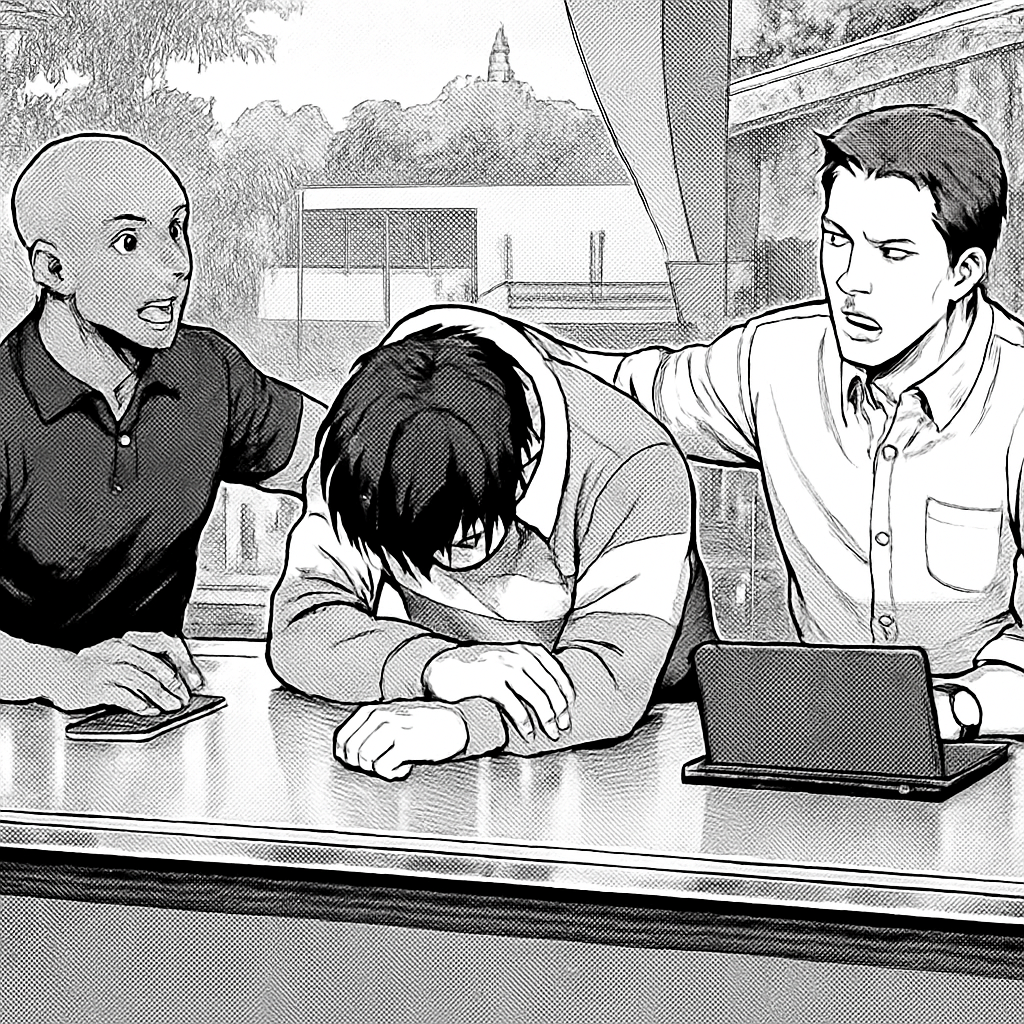
MELBOURNE — The brutal reality of the Australian Open’s extreme heat policy was laid bare in a shocking and distressing scene on Tuesday, as Italian qualifier Luciano Darderi collapsed on court, writhing in agony and struggling to breathe during his first-round match.
The 21-year-old, ranked 142nd in the world, was competing against French veteran Adrian Mannarino on Court 3 when the punishing Melbourne conditions took a devastating toll. With temperatures soaring above 32 degrees Celsius (90°F) and the on-court temperature significantly higher, Darderi’s body ultimately gave out, forcing a medical emergency that halted play and sent a wave of concern through the tournament.
A Distressing Collapse Live on Television
The incident occurred early in the fourth set, with Darderi trailing two sets to one. After playing a point, the Italian suddenly staggered to the back of the court, clutching his chest and abdomen before collapsing to the ground. Broadcast cameras captured the full, unsettling sequence as Darderi rolled onto his back, his face contorted in pain, gasping for air and visibly distressed. "He can't breathe, he can't breathe," a commentator could be heard saying urgently.
Medical staff rushed to his aid, providing oxygen and attempting to cool him down with ice packs and wet towels. For several tense minutes, Darderi remained on the court surface, receiving treatment while a concerned Mannarino and the chair umpire looked on. The scene was a stark reminder of the physical dangers posed by playing elite sport in extreme heat, a recurring and controversial issue at the season's first Grand Slam.
The Extreme Conditions and Tournament Policy
The Australian Open operates a five-stage Extreme Heat Policy (EHP), which tournament referee Wayne McKew has the sole discretion to invoke. The policy considers a combination of air temperature, humidity, wind speed, and the Wet Bulb Globe Temperature (WBGT), a more accurate measure of heat stress. On Tuesday, the conditions were severe enough to prompt the suspension of play on outside courts later in the afternoon, but not before Darderi’s match had begun.
Critics argue the policy can be reactive rather than proactive, leaving players vulnerable in the window before official suspensions are called. The physical demands are immense; players are not only exerting themselves but are also subjected to radiant heat from the court surface, which can be 20 degrees hotter than the air temperature. Key factors in heat illness include:
- Dehydration: Profuse sweating leads to critical loss of fluids and electrolytes.
- Core Temperature: The body’s ability to cool itself through sweating becomes overwhelmed.
- Cardiovascular Strain: The heart works harder to pump blood to the skin for cooling and to muscles for performance.
Darderi’s symptoms—acute cramping, difficulty breathing, and collapse—are classic signs of severe heat exhaustion, bordering on heat stroke, a potentially life-threatening condition.
Player Reactions and the Ongoing Heat Debate
The incident immediately reignited the perennial debate about player safety in Melbourne. Former world No. 1 Andy Roddick commented on social media, "The heat rule at the Aussie Open has always been a joke … This is awful to see." Many players and pundits have long called for a more uniform, objective rule, such as automatically closing the roof when a specific WBGT threshold is reached, rather than leaving it to subjective judgment.
Adrian Mannarino, who was awarded the match by retirement at 6-4, 3-6, 6-3, 0-1, was visibly shaken. In his post-match press conference, the Frenchman expressed his concern and highlighted the unpredictable nature of such collapses. "You never know when it's going to happen," Mannarino said. "It's just terrible. I feel sorry for him. I hope he's going to be fine. It's never easy to win a match like this."
A History of Heat-Related Incidents
The Australian Open has a notorious history with heat. In 2014, Canadian player Frank Dancevic hallucinated and fainted during a match. In 2018, Slovenia’s Dalila Jakupovic fell to her knees in a coughing fit, unable to breathe due to the poor air quality from bushfire smoke combined with heat. Each incident prompts scrutiny of the tournament's protocols. While the roof on Rod Laver Arena and Margaret Court Arena provides relief for headline matches, hundreds of players compete on uncovered outside courts, where the risk is highest.
Aftermath and Recovery for Darderi
After nearly ten minutes of on-court treatment, Luciano Darderi was eventually helped to his feet and, with support, walked off the court to a warm applause from the concerned crowd. He was taken to the tournament's medical center for further evaluation and treatment. Thankfully, later updates indicated the young Italian was recovering well. A tournament spokesperson stated, "Luciano Darderi received medical attention on site and is now in recovery. He is being monitored by our medical team."
For Darderi, the episode was a brutal end to what had been a triumphant run through qualifying to reach his first Australian Open main draw. The physical and emotional setback is significant, but the priority remains his health. The tennis community rallied around him on social media, sending messages of support and relief that the situation was not more serious.
Conclusion: A Wake-Up Call for the Sport
The distressing collapse of Luciano Darderi serves as a powerful and urgent wake-up call. While the Australian Open has improved its heat policies over the years, the sight of a young athlete in such acute distress begs the question: are the current measures sufficient? The incident underscores the fine line athletes walk in extreme conditions and the immense, sometimes dangerous, physical price of competition. As climate change makes heatwaves more frequent and intense, the sport’s governing bodies face increasing pressure to prioritize athlete welfare over strict scheduling, ensuring that the pursuit of victory never comes at the cost of a player's well-being. The hope is that from this alarming event, a constructive review will emerge, leading to clearer, safer protocols that protect every competitor who steps onto the court.