
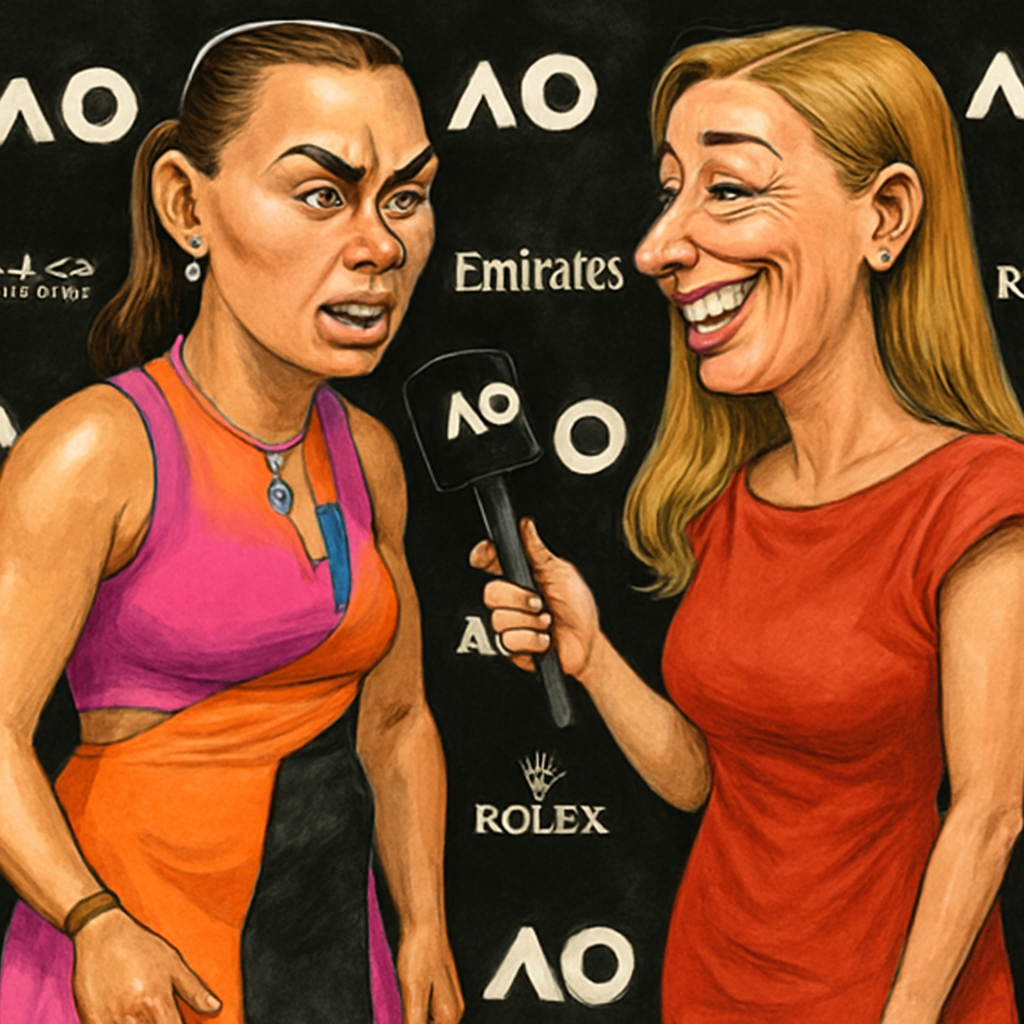
MELBOURNE — Aryna Sabalenka’s dominant march to a second consecutive Australian Open title was punctuated by a powerful off-court volley, forcing broadcaster TNT Sports into a public apology. The incident, stemming from a perceived slight during her semi-final victory, marked the second time in a week the world No. 2 has publicly challenged media narratives, showcasing a newfound willingness to defend her character and legacy.
The controversy erupted during TNT Sports’ coverage of Sabalenka’s commanding 7-6(2), 6-4 win over American Coco Gauff. In a segment analyzing the match, analyst and former player Andy Roddick made comments that Sabalenka and her team interpreted as questioning the authenticity of her on-court persona. The specific remarks suggested a disparity between the "scary" competitor seen by opponents and the friendly individual known off the court.
The On-Air Comments and Immediate Backlash
While Roddick’s analysis was likely intended as strategic insight, the framing struck a nerve. Sabalenka, who has worked extensively with a sports psychologist to manage the immense pressure of high-stakes matches, perceived the commentary as dismissive of her mental resilience and emotional authenticity. The Belarusian star, who has been remarkably open about her journey to control her emotions on court, took to social media to express her disappointment.
In a pointed post on her Instagram story, Sabalenka wrote: "It’s so funny to hear all these comments from the ‘expert’ commentators on my ‘persona’ and how I ‘bring the evil’ on court. Maybe you should all just focus on analyzing the game rather than my personality. There is a reason why I have been at the top of the game for so long… and it’s definitely not because of an ‘act’."
The post quickly went viral, drawing support from fans and fellow players who criticized the reduction of a top athlete’s complex psychology to a simplistic "Jekyll and Hyde" narrative. The backlash was swift and significant, leading TNT Sports to issue a formal apology during its broadcast the following day.
TNT Sports' On-Air Apology
A presenter on the network’s "Live at the AO" show addressed the issue directly, stating: "We’d like to address some comments made in our coverage yesterday. On behalf of the team, we apologize to Aryna Sabalenka if any commentary was perceived as negative or disrespectful. Our intention is always to provide insightful analysis of the tennis, and we have the utmost respect for Aryna, her competitive spirit, and her incredible achievements in the sport."
This public retraction was a notable moment, underscoring the growing influence athletes wield over media narratives in the social media age. It also highlighted Sabalenka’s evolving confidence in using her platform to confront what she views as unfair characterization, a stance she had firmly established just days earlier.
A Pattern of Pushing Back
The TNT incident was not an isolated one during Sabalenka’s Australian Open campaign. Earlier in the tournament, she delivered a sharp rebuke to a journalist during a press conference who asked if she felt her two previous Grand Slam titles were "tainted" because they were won during the era of Russian and Belarusian players competing under neutral flags due to the ongoing war in Ukraine.
Sabalenka’s response was immediate and unequivocal. Leaning into the microphone, she replied: "I have a question for you. What does it mean, ‘tainted’? I won my titles with my hard work, my sweat, my blood on the practice court. So you think my titles are ‘tainted’? I don’t. Next question." The forceful reply was met with applause from others in the press room and was widely praised for its clarity and conviction.
These consecutive episodes reveal a significant shift in Sabalenka’s public demeanor. Long known for her explosive power on the court, she is now demonstrating a different kind of strength—a composed, articulate, and assertive defense of her professional integrity. This assertiveness appears rooted in several key factors:
- Grand Slam Validation: Winning two Australian Open titles has solidified her status, giving her the confidence to speak from a position of established success.
- Mental Fortitude: Her public work on mental conditioning has equipped her with tools to handle external noise and articulate her perspective under pressure.
- A Changing Media Landscape: Athletes now have direct channels to their audience, allowing them to bypass traditional media filters and challenge narratives in real-time.
The Broader Context of Media Scrutiny
Sabalenka’s experiences tap into a wider conversation in tennis about the nature of commentary and press conference questioning. The intense focus on a player’s "persona" or off-court life, particularly for female athletes, is often criticized as a distraction from their sporting prowess. Analysts and journalists walk a fine line between providing engaging, human-interest context and venturing into reductive or speculative territory.
The swift apology from TNT Sports suggests a recognition of crossing that line. It also sets a precedent for how broadcasters might approach analysis of players who are increasingly willing and able to publicly hold them accountable. The incident underscores that modern athletes are not passive subjects of commentary but active participants in shaping their own stories.
Conclusion: A Champion in Control
Aryna Sabalenka’s 2024 Australian Open victory will be remembered not only for her devastating power and tactical maturity on the blue hard courts but also for her commanding performance in the arena of public perception. By forcing a major sports network to apologize and shutting down a line of questioning she deemed disrespectful, Sabalenka displayed a masterful control of her narrative.
Her actions signal a new chapter for one of tennis’s most formidable competitors—one where her mental strength is matched by her vocal advocacy for respect. In an era where athletes are more than just competitors, Sabalenka has proven she is a formidable force both in rally construction and in constructing her own legacy, refusing to let others define her champion’s journey. As she moves forward, the message to media and commentators is clear: the analysis should be on the tennis, because the person holding the racket is no longer willing to be a silent target.