
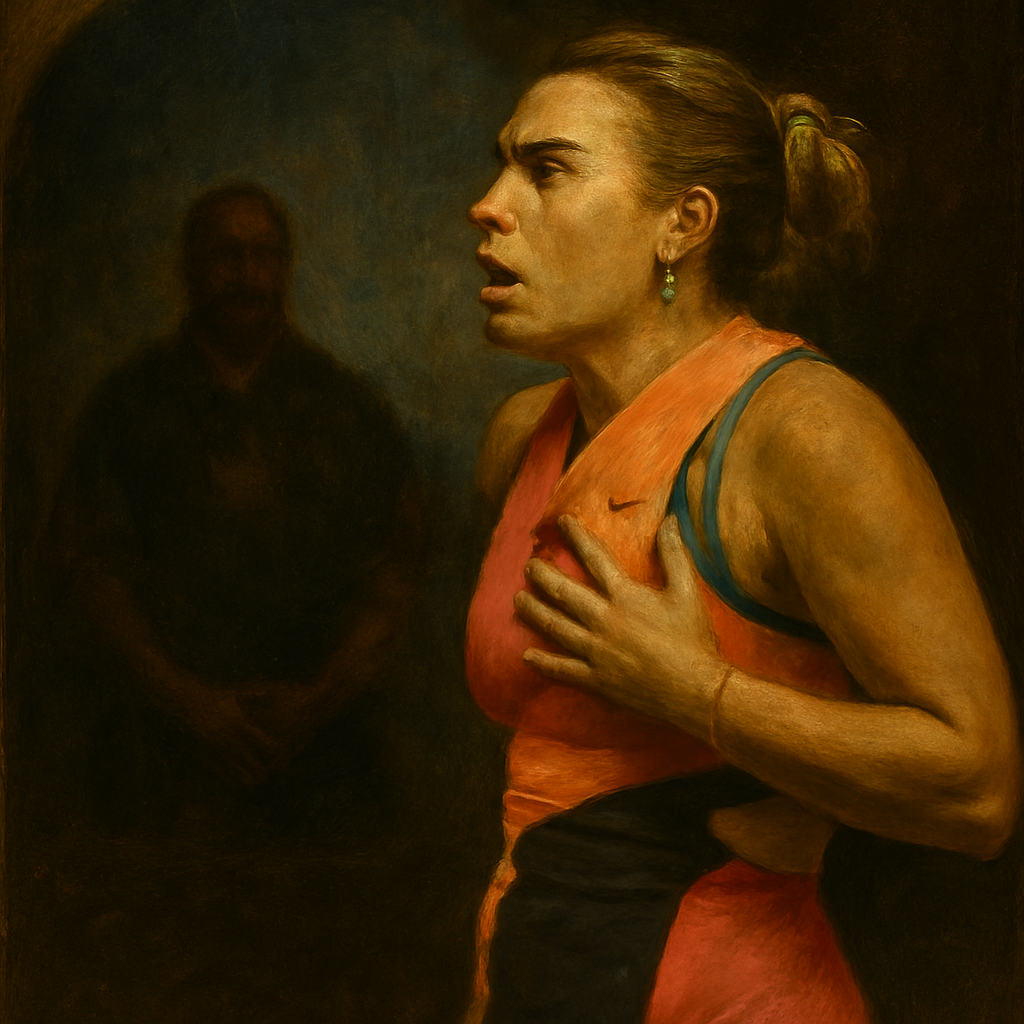
MELBOURNE — The 2024 Australian Open was a tournament of triumph for Aryna Sabalenka, who successfully defended her women's singles title without dropping a single set. Yet, amidst the dominant run, a fiery moment of controversy erupted in her third-round match against Lesia Tsurenko, where the usually composed world No. 2 unleashed a furious tirade at chair umpire Eva Asderaki-Moore over a hindrance call that left fans and commentators buzzing.
The incident occurred early in the second set, with Sabalenka leading 4-1. After a grueling rally, Sabalenka unleashed a powerful forehand that forced Tsurenko into a defensive, lunging slice. As the ball floated back, Sabalenka let out a loud, guttural grunt as she moved forward to strike a put-away volley into the open court. Immediately, chair umpire Asderaki-Moore, one of the most respected officials in the game, awarded the point to Tsurenko, ruling a hindrance against Sabalenka.
The Immediate Reaction: Fury on Rod Laver Arena
Sabalenka’s reaction was instantaneous and volcanic. She marched to the chair, her disbelief quickly morphing into anger. “What is wrong with you?” she demanded, pointing at Asderaki-Moore. “What is that? What is *wrong* with you?” The Belarusian star argued vehemently that her grunt was a continuous part of her shot-making and did not come after she had struck the ball, which is the key distinction in the hindrance rule. She felt the grunt was a natural, involuntary exhalation of effort, not a deliberate attempt to distract her opponent.
Asderaki-Moore remained calm but firm, explaining her judgment. The crucial interpretation hinged on the timing: the umpire deemed Sabalenka’s shout occurred as Tsurenko was still in the process of recovering and potentially tracking the ball, thus constituting a hindrance. Sabalenka was having none of it. "It's after I hit the ball! It's after I hit the ball! I didn't scream before she hit the ball!" she protested repeatedly, her voice echoing around the stadium.
Understanding the Hindrance Rule in Tennis
The rule at the heart of the controversy is one of the more subjective in tennis. The International Tennis Federation (ITF) rules state that a player must not communicate verbally or make any audible noise when the ball is in play toward the opponent’s court if it hinders the opponent. The key factors umpires consider include:
- Timing: Did the noise occur as the opponent was preparing to or in the act of playing the ball?
- Nature: Was it a natural, effort-related grunt or a deliberate shout?
- Impact: Did it actually hinder the opponent's ability to play the shot?
Sabalenka’s frustration was compounded by the high stakes and her own high standards. "You're going to call this at 4-1? On a point like that? It's such an important point," she argued, highlighting the perceived severity of the call at a pivotal moment, even with a lead.
A History of Grunts and Controversy
Sabalenka is far from the first player to be penalized for audible hindrance, and the issue has a long, contentious history in women's tennis. The debate over grunting peaked over a decade ago, with legends like Monica Seles and Maria Sharapova known for their powerful, signature sounds. Critics have often argued that excessive grunting can be gamesmanship, while players and sports scientists assert it is a natural byproduct of exerting maximum force and stabilizing the core. This incident served as a stark reminder that the rule, while rarely invoked at the highest level, remains a discretionary tool for chair umpires.
The Aftermath and Regaining Composure
After several more heated exchanges, where Sabalenka sarcastically asked if she should just “play without screaming,” she eventually returned to the baseline, shaking her head. The call stood, and the game score moved to deuce. Crucially, Sabalenka managed to channel her fury. She won the next two points to hold serve for 5-1, letting out an even more emphatic roar after sealing the game—a clear message of defiance. She went on to close out the match 6-0, 6-0 in the next game, but the confrontation was the talk of the tournament.
In her post-match press conference, Sabalenka had cooled down but stood by her position. "I wasn't arguing about the rule. If I did something wrong, it's fine. But I felt like I didn't. I just let her know that I wasn't agreeing with that call... I just hope that next time she's going to think a little bit longer before she's going to call something like that, especially on the important point." This nuanced response showed a player defending her actions in the moment while acknowledging the official's authority.
Expert Analysis and Broader Implications
Tennis analysts were split. Some supported Asderaki-Moore’s decisive application of the rules, praising her for having the courage to make a tough call against a top seed. Others felt the hindrance was marginal and that the point penalty was too severe for the nature of the offense, suggesting a let or a warning might have been more appropriate. The incident sparked widespread debate about the consistency of hindrance calls and whether the rule needs clearer, more objective parameters for players and officials alike.
For Sabalenka, the moment became a testament to her evolved mental fortitude. Earlier in her career, such a controversy might have derailed her focus entirely. At this Australian Open, however, she used it as fuel, immediately winning the next crucial points and steamrolling through the rest of the tournament. The fiery exchange highlighted her passion, but her subsequent composure underscored the champion's mentality she has cultivated.
In the end, the hindrance call became a dramatic footnote in Sabalenka’s victorious campaign. It provided a raw glimpse of the competitive fire that burns beneath her powerful game, a momentary crack in the facade of her dominant run. While the question of “what is wrong with you?” was directed at the umpire, the episode ultimately reinforced what is *right* with Sabalenka: an unwavering self-belief and a resilient champion's spirit that can overcome even the most frustrating of interruptions on the path to glory.