
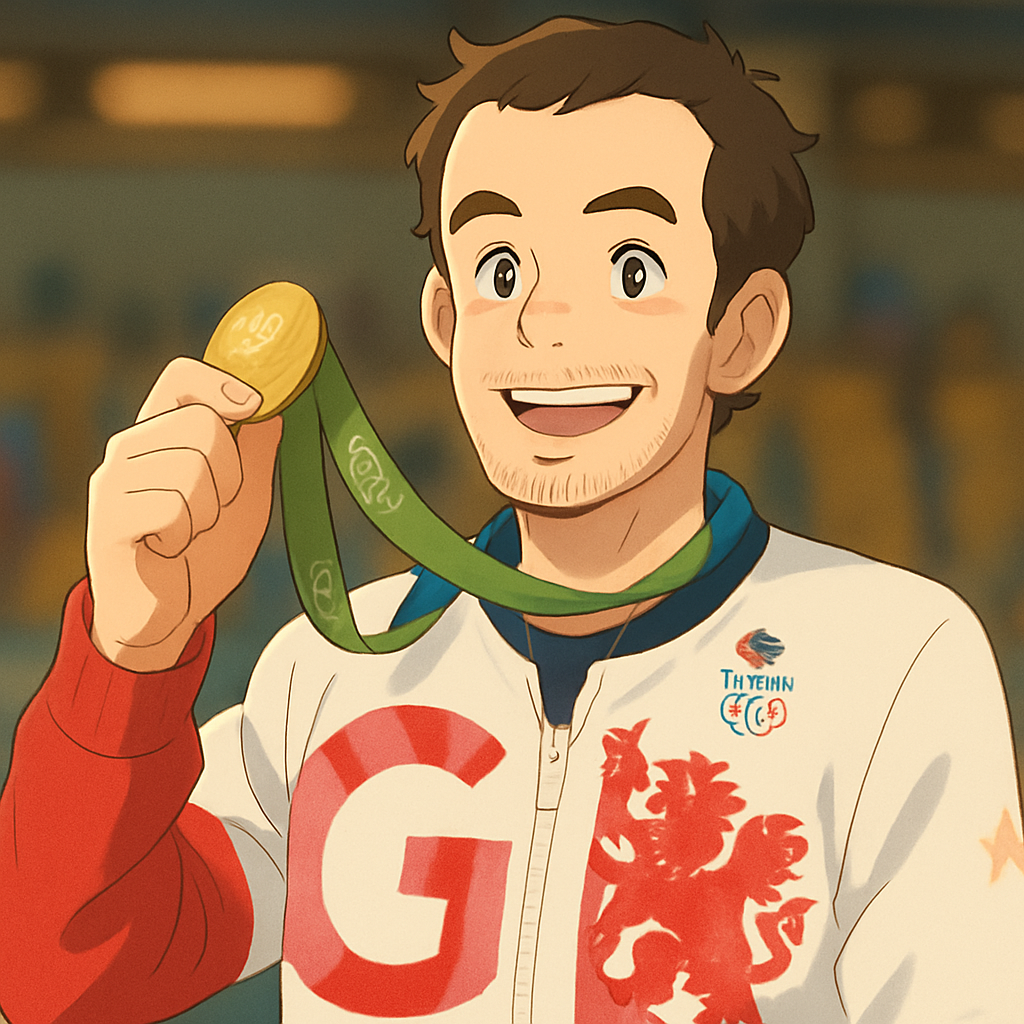
LONDON — In the world of elite sport, where every gram of advantage is measured and every accolade is a testament to a lifetime of sacrifice, Andy Murray’s attitude towards his own monumental achievements is refreshingly, and famously, grounded. The three-time Grand Slam champion and two-time Olympic gold medalist recently offered a candid glimpse into his home life, revealing not only where he keeps his trophies but also his surprisingly casual relationship with his Olympic medals.
In an interview with The Times, Murray disclosed that his most prized tennis mementos are not displayed in a grand, climate-controlled trophy room, but are instead scattered around his home in Surrey. His Wimbledon trophies, the holy grail of British tennis, have a place of honor on his mantelpiece. However, his two Olympic gold medals, won in consecutive Games in London 2012 and Rio 2016—a unique and historic feat in men’s tennis—are treated with far less ceremony.
A Plaything for the Kids
Murray’s revelation about the medals was both humorous and heartwarming. He explained that his four young children—Sophia, Edie, Teddy, and Lola—often treat the iconic gold discs as toys. "The gold medals, the kids wear them more than I do," Murray said with a laugh. "They’re in the house somewhere. I think they’re in a bag or a drawer somewhere, the medals." This nonchalant storage stands in stark contrast to the blood, sweat, and tears shed to earn them, a dichotomy that perfectly encapsulates Murray’s pragmatic personality.
For Murray, the intrinsic value of the Olympics was never about the physical medal. His 2012 victory at Wimbledon, on Centre Court, was a seminal moment for British sport, exorcising the ghosts of Fred Perry and ending a 76-year wait for a home men’s champion. The 2016 triumph in Rio, achieved while battling through injury and fatigue, solidified his reputation as one of the sport’s greatest competitors. The memories, the performances, and the pride for his country are what he carries with him, not the object itself.
The Mantelpiece and the Memories
While the Olympic medals may be lost in a drawer, other trophies have designated spots. As mentioned, his Wimbledon trophies are on the mantelpiece. His US Open trophy from 2012, however, met an unfortunate fate. "I left the US Open trophy on the subway in New York after I won it," he admitted. It was thankfully recovered, but the story highlights a recurring theme: for Murray, the journey and the achievement far outweigh the material symbol.
This perspective has been shaped by a career defined by relentless work ethic and brutal honesty, often directed at himself. Now in the twilight of his playing days and battling a series of injuries, Murray’s reflections carry a poignant weight. He is actively sifting through a career’s worth of memorabilia, deciding what to keep for himself and what might be donated to museums or used for charitable purposes. This process is less about vanity and more about legacy and utility.
What’s in the Trophy Cabinet?
A peek into the Murray household would reveal a mix of the prestigious and the personal. Alongside the Grand Slam silverware, you might find:
• His 2013 Wimbledon trophy (his first, as the 2012 champion's trophy is a permanent cup).
• His 2016 Wimbledon trophy.
• His 2012 US Open trophy (the one from the subway).
• His Davis Cup trophy from 2015.
Notably absent from any formal display are the Olympic medals. They exist in the realm of family life, occasionally draped around a child’s neck during play. This normalizes the extraordinary for his family, a conscious or subconscious effort to ensure his children see beyond the glitz of his profession to the man beneath. "I’m not that bothered about that stuff," Murray reiterated about the trophies and medals, emphasizing his focus is elsewhere.
The True Legacy of London and Rio
Murray’s Olympic achievements are unparalleled in tennis history. He is the only player, male or female, to win two singles gold medals. The first, at the London 2012 Games, was a masterclass of pressure performance, defeating Roger Federer on the same grass where he had lost the Wimbledon final just weeks prior. The victory sparked a national celebration and announced Murray as a champion of the highest order.
Four years later, defending his title in Rio, he displayed incredible resilience. The physical toll was immense, but he battled through to defeat Juan Martín del Potro in a grueling four-set final. "The effort it took to win that second one, with everything my body was going through, makes it incredibly special," Murray has reflected in the past. The medals are tokens of these epic struggles, but the stories are what he truly owns.
As he contemplates retirement, Murray’s relationship with his accolades is evolving. The process of sorting through them is, in a way, a review of his own life’s work. He has spoken about the potential for his trophies to do good, perhaps being auctioned for his charitable foundation or loaned to tennis museums to inspire the next generation. The goal is for them to have a purpose beyond collecting dust.
A Champion’s Perspective
In an era where athletes often cultivate personal brands with meticulous care, Murray’s indifference to his own hardware is a striking anomaly. It underscores a competitor who fought for the victory itself—for the challenge overcome, for the history made, for the flag raised. The physical spoils were almost a secondary consideration. This mindset perhaps explains his enduring popularity; fans see in him a purity of competitive spirit, unadulterated by pretense or materialism.
His children wearing his Olympic gold medals is the perfect metaphor for Murray’s legacy. He has taken the ultimate symbols of individual sporting excellence and integrated them into the simple, messy, joyful reality of family. They are not relics on a pedestal, but part of the fabric of everyday life. The medals are played with, valued for their shine and weight in a child’s hand, not for their historic significance. In doing so, Murray has given them a meaning far richer than any display case could provide.
As Andy Murray continues to wind down his legendary career, his trophies and medals will eventually find their final resting places—some in museums, some in his home, and some, it seems, forever in a drawer or a child’s toy bag. But their location is irrelevant. The legacy of Andy Murray is not stored in silver or gold; it is etched in the record books, in the memories of epic matches, and in the undeniable fact that he gave absolutely everything, for every point, every time. The medals were just proof. The real prize was the fight.